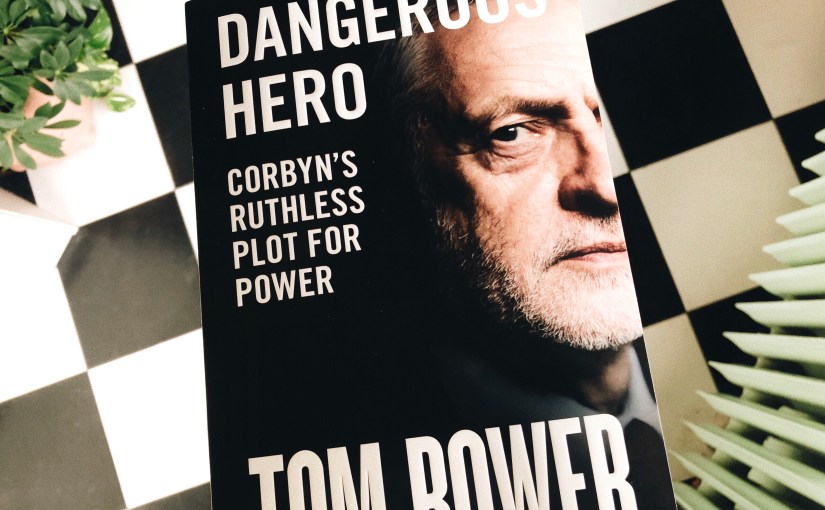
Dangerous Hero – Corbyn’s ruthless plot for power – Tom Bower

29-3-19

Dear Partners in thought,

In a nice fit with some Interludes on the Brexit saga and as I was intrigued about him and his strange journey, I wanted to know more about Jeremy Corbyn, the unlikely leader of the Labour Party at an incredibly challenging time for Britain. I felt that I was not the only one in the dark as to whom this unlikely leader was and where he came from. While we hear a lot about JC, we actually know very little beyond his historical radical past and the usual accusations, such as those linked to anti-Semitism, that have stuck to him for months (and we discover, years) now. So with all of this in mind, I would like to tell you about “Dangerous Hero – Corbyn’s ruthless plot for power”, a brand new book by journalist Tom Bower, once at the BBC, who has been covering news and writing books on world events and their makers since the late 1960s. TB’s book goes into Corbyn’s roots and his political journey, explaining how he was able to seize the Labour leadership, only eighteen years after Blair’s New Labour emerged and five after Gordon Brown’s sunset, taking it way leftwards in a stark contrast with his own electorate but on the strength of new party members, many of whom quite radical, whom he brought with him to change the course of British politics. The story of JC from the early 1970s to now is also a story of the Labour Party and a reminder, for those who forgot it, of the Marxist and Trotskyist radicalism of a huge segment of that party at the local authority level and the many radicalised union-led strikes and electricity shortages that were the daily experience of the British people during that socially challenging pre-Thatcher period. 

To be fair, TB’s book could have been commissioned by the Tory Central Office so much it is a hatchet job on JC (however deserved it may be) so this should be borne in mind. Interestingly Tom Bower is a contemporary of JC and was even a radical student at the London School of Economics, then known as “Tom the Red” before shedding a lot of the colour as he “grew up”. With this in mind, it is quite key to remember that the JC attributes stated in this Book Note are really from TB’s book, which does come across as a never ending list of shortcomings with very few redeeming features. If all these attributes were indeed true and there is nothing to suggest otherwise, it is hard to believe that JC would be qualified to hold any type of high political office in the UK. While such a peculiar background would make his rise to the Labour leadership all the more surprising, it may also be linked to his core skill of artful insider’s political party maneuvering, which to some may indeed be JC’s only skillset since he entered politics as a radical youth.  

JC was born in Wiltshire in May 1949 and joined Labour as a teenager, becoming a Trade Union representative when moving to London. In 1974 ha was elected to Haringey Council and became Secretary of the Hornsey Constituency Labour Party before being elected MP for Islington North in 1983. Being a left wing radical, he often opposed the Labour leadership throughout his career, focusing his action on anti-fascim, anti-apartheid, nuclear disarmament and a united Ireland, many positions being effectively against US and Western interests both before and after the Cold War. During the Blair and Brown years, JC often opposed “New Labour” and chaired such groups as the Stop the War Coalition. He became Labour Leader in 2015, taking the party leftwards, supporting the re-nationalisation of public utilities and the railways, a less interventionist military policy and an increase of funding for welfare and public services. Although a Eurosceptic he supported mildly remaining in the EU during the June 2016 referendum, much alike Theresa May when the Home Secretary of David Cameron’s government. He was able to secure his leadership by increasing the number of new left wing members in the Labour Party, knowing that they and not Labour voters would now decide on the party leadership. In doing so he created a gap between a radicalised Labour leadership and a much more moderate base. The most damaging criticism against JC over the last three years has been attacks on his perceived antisemitism, going back to his early years of public life and strong opposition to Israel, which he was not able to quell through clear and definite personal refutations now that he is the Labour leader.              

TB interviewed a lot of the then young radical left leaders of the early seventies for his book (those, we learn, who did not commit suicide as many did), most who did not achieve political stardom as they were outside the British establishment circles. Many remembered JC though all were in agreement to state how unimpressive he was intellectually, making his rise to power at Labour all the more surprising, if not for his doggedness and “entryst” qualities (entrysm being the favourite infiltration game of left radicals wanting to take over local Labour Party committees the Marxist and “Trot” ways). We discover an uneducated JC, something that nobody knows, later going to great length to be against school elitism, even preferring for his children not to go to good schools so as not to give them an unfair advantage even if they would receive a worst education by not doing so. We see a JC who boasted about books he never read (we discover that he does not read books) or cannot manage his family finances to the point his debts will lead him to his second divorce (he remarried in 2013), providing a poor prospect for leading the country. Not understanding Marxism or Trotskyism as political “philosophies” he would nonetheless stick to all their tenets to “make the rich pay” and promote true socialism in the UK, first at the local authority of Haringey which he would eventually lead after much internecine warfare, characteristic of the Labour dynamics in the 1970s.     
Quite aside from the political arena, TB takes us to a trip into JC’s private life which is not that private as politics is everything for him. We read about JC’s travels with his first wife which were not focused on having a good time in nice accommodations but on tent/camping and eating can food to her dismay even though she was also from the hard left. They even traveled to Central Europe and visited Vienna though he made the point not to enter the palace of Schoenbrunn as it was too much a sign of imperial power. Similarly they visited Czechoslovakia and Prague with JC praising the local regime for its achievements on the road to socialism, felling no sympathy for the “delusional” Prague coup, otherwise known as “Prague Spring” of 1968.   

TB takes us through the life of JC as a Labour activist in Haringey, followed by his election in 1974 as a Council member and head of the public works committee while also being Secretary of the Hornsey Constituency Labour Party and head of the local National Employers Public Employees’ union or NUPE, a multiplicity of roles that would create conflicts of interests during strike times that were many in the mid-to late 70s. Interestingly Jane Chapman, his first wife, also chaired a Haringey Council Committee, most council members finding her more capable than JC. Their relationship will go gradually South, JC not caring much for their couple and its well being (as we had noted in terms of their holiday plans), being totally devoted to his cause of a hard left, Trotskyste activism. 

We run into JC’s “fellow Labour travellers” among the hard left some of whom would become leading figures, like Ken Livingstone (future Mayor of London before Boris Johnson), John McDonnell (a very serious politician though of a very abrasive nature who would become Shadow Chancellor under JC after 2015), George Galloway (who would run onto many “affairs” over the years and became close to dubious foreign leaders) but also Tony Benn, a radical Labour grandee, close to JC party-wise, who shared many traditional features with the Tories given his background and the Marxist Ralph Miliband, father of Ed and David, a future left wing Labour leader (opposing David Cameron as PM) and a future New Labour foreign secretary (under Gordon Brown). Those individuals were very active in the Labour Party throughout the 1970s, creating much positioning headache for the Labour moderates and various party leaders and PMs from Harold Wilson, to Dennis Healey to Michael Foot even if the latter was not deemed a moderate. This was the time of very controversial party members with some MPs involved in lobby groups like the World Peace Organisation or the Movement for Colonial Freedom actually financed by the Soviet Union, a fact that was not always obvious at the time (JC was a member of the MCF). To those men (there were very few women though Dianne Abbott, still an active Labour MP,  was one of them), all radical activists, JC was not a leader in the making but just a team member, lacking the requisite intellect and Marxist grounding to be considered leadership material unlike a Tony Benn.  

While the Tories had won a general election in 1979 leading to the Thatcher and a pro-business, free markets era, harsh economic times were leading them to an eventual loss in the next general election, just garnering 20% in the polls. Then, as often in history, a foreign crisis erupted in April 1982 when Argentina invaded the Falkland Islands off their shores as a way to unite its people and deflect domestic problems. The UK reacted swiftly, with backing from the U.S. and sent a naval force which eventually re-took the islands and led to the collapse of the Galtieri junta. The Falklands war united Britain with Labour led by Michael Foot supporting the Thatcher government and only a few Labour MPs and elected officials including JC to oppose military intervention. JC came across as an enemy of the UK and the U.S. and a supporter of Stalin, Mao, Castro and Galtieri, the latter even if a hard right military dictator whose views were polar opposite of JC. As the mood turned pro-Tory following the quick war (in spite of the loss of HMS Sheffield which some war opponents declared was let happen so Britain could go full force against the Argentines) the country was getting ready for the June 1983 general elections. Residents and businesses were leaving Haringey, the highest spending British local authority with the highest rates aimed at funding administrative staff increases (including two “anti-nuclear officers” charged with promoting world peace). On election day, Labour’s campaign manifesto, driven by a draconian programme of wealth confiscation, was dubbed “the longest suicide note in history”. Labour that should have won handsomely pre-Falklands, did not withstand its Marxist drive and secured its worst result since 1918 with 27.6% vs. 42.4% for the once doomed Thatcherian Tories. Britain’s working class, many of whom own their cars and homes, largely voted for Margaret Thatcher. 

In spite of this debacle, JC got his first parliamentary election victory and joined the reduced Labour group in Westminster. He showed no interest in the dynamics of Parliament including those of its own group, not playing as a team member and contributing little to the group and Whips’ wishes. JC displayed very personal positions on Israel (opposing it firmly while always supporting any aspect of the Palestinian cause) or Nicaragua (supporting Daniel Ortega and opposing the Contras and the U.S.) or even the IRA which was making headlines in all of the 1980s with terrorist attacks on the mainland (with JC defending the rights of jailed terrorists) or supporting the new Marxist government of Grenada that orchestrated a coup in the island. As JC started his new parliamentary career, actually allowing him at long last to have a better lifestyle, substantial disruption was erupting with the national miners’ strike and their flying pickets from Yorkshire and Scotland. The strikes which made headlines the world over were strongly supported by JC and the hard left MPs and led by Arthur Scargill, who would become the frontal opponent to Margaret Thatcher (it was later shown that the strikes were also funded by both the Soviets and Gaddafi’s Libya). When Tony Blair came to power with a strong victory for New Labour in 1997, he had to deal with two oppositions comprising the Tories who had lost power after nearly two decades and his own left wing with the likes of JC and John McDonnell (he seriously considered whether deselection was not possible but having such a strong majority decided to live with this impediment). On an amusing note following his divorce in 1999 from his second wife, Claudia, JC had a string of relationships with many women (so that the tabloids nicknamed him “Hot Trot” not getting what the attraction for this unkempt and ill-mannered man could be) until he met Laura Alvarez from Mexico, a small party activist but a great JC follower unlike his two previous wives, whom he married in 2013. 

As an MP JC will only and proudly represent the hard left on domestic and foreign policy matters. He will be pushing policies that are hard core socialist if not communist including the nationalisation of banks and public transport. Internationally he will have softer stances towards the Soviet bloc during the Cold War (so much so that he met several times with Czech diplomats who were intelligence officers in London – though never betrayed). He will consistently be on the opposite side of the U.S., UK and the West in general  on nearly all foreign policy matters ranging from his pro-Ira stance during the troubles (his friend, John McDonnell would publicly apologise for his support years later on the BBC), Cuba and Castro, the hard-line Islamic if not Islamist organisations, going as far as almost admiring the “skills” of the plane hijacking terrorists on 9-11, Iran, the Afghan and Iraq wars (of note, he would be “right” about the WMDs, not that his general intent was not misplaced initially), Gaddafi and Lybia, and of course Israel generally (resurrecting the now topical question regarding the link between anti-Zionism and anti-semitism that have plagued his leadership). As stated JC was very-Eurosceptic, not hiding his historical disdain for the EU as a capitalist pot against the masses. On the central subject of terrorism across Europe and the response to it, JC will always find it hard to support the killings of terror’s perpetrators like in the wake of the Paris November 2015 attacks, ideally preferring bringing the culprits to the courts, however unrealistic the ideal option. Hugo Chavez and then Nicolas Maduro became JC’s favourites as they were pushing Venezuelan socialism, this in spite of creating the most indebted country in the world particularly as oil prices would also plunge. Later on as the Syrian civil war would worsen, JC would want to wait for tangible proof to agree that the regime had been behind the deadly mass-chemical attack against children as footage might have been fabricated by the West. 

We go through the period when Labour goes back gradually to its 1970s roots and Ed Miliband defeats in a less than brotherly contest the moderate David Miliband for party leadership bringing back the party to the left though not left enough for the likes of JC, John McDonnell or former JC flame, Dianne Abbott. The Blair legacy comes under attack and the moderates will lose power culminating with the likes of Andrew Burnham and Yvette Cooper (the latter whose name we hear on cross-party anti-Brexit amendments in 2019) losing against JC who reluctantly, at least on the surface, decided to run for party leader on the grounds that it was his “turn” and he “would do it after all”. Being a polite kind and not attracting criticism at the personal level, in spite of his positions at the odd of traditional Labour on many issues, he will eventually win the leadership contest in 2015. One of the reasons why he will win is that 66% of party members identified with the left while only 33% of Labour voters did. JC benefitted from a new rule whereby party members or those who paid 3 pounds would select the party leader at a time where the unions and Unite, a trade main union, in particular organised substantial increase in party membership. Thanks to the rule that sidelined the Labour MPs who were in the past choosing their leader Labour was able to go radical left in no time, even if by then JC and McDonnell were trying hard to shed any Communist or Trotskyist credentials due to the responsibilities they were about to assume (McDonnell donned a blue suit, white shirt and tie and JC became a bit more sartorial in no time). I will not cover the well-known period from when JC seizes the party leadership in 2015 which will be a continuation of half-hearted efforts at all levels to repudiate a radical past so as to appear potential Number 10 material, unbelievable neglect about antisemistim accusations against him and the top of the Labour team and a very ambivalent stance in relation to the June 2016 referendum due to a deep Euro-scepticism leading to a very mild involvement for the Remain camp, while Labour voters (though possibly not party members) were overwhelmingly Remainers. While the book does not cover it as the move was too recent, it is notable (on the positive side, at least for me) that JC finally and after a long time stated he supported a second referendum (the type to be clarified) even if only to stop a likely flow of Labour MP defection to the Independent Group in February.          

 It is difficult to rejoice at the quality (or lack thereof) of the Tory leadership as seen during the nearly three years of the Brexit process (including the fateful decision of David Cameron to make good on his promise to his hard right, nationalistic wing to hold a referendum if he won in 2015). However the ascent of JC to the Labour leadership created an impossibly shambolic “rock and a hard place” political landscape for Britain between a morphing radical left Labour as for its leaders and a gradually dysfunctional, irrational Conservative Party steered to “notional” sovereignty and economic self-harm by hard right, delusional Tory ideologues. In the absence of a sensible center, exemplified by a weak Liberal Democratic Party and in spite of new developments such as with the newish Independent group in February, Britain is faced with no sensible choice were to come a General Election. The most likely scenario would be a Tory victory based on Labour’s radicalism and leadership style but it would only come as a lesser of two evils. In many ways and strangely, while the Conservative party is imploding on Brexit (signing the death warrant of the most successful Western political party of the last 100 years), the Tories must find some solace in knowing that they might still come back to power in case of a General Election mainly thanks to JC and his top team that won party leadership but could never garner a majority of voters so out of touch they really are with economic and geopolitical reality. Now and having said this, as we contemplate the potential Brexit self harm potentially ahead, anything is possible and the race may be wide open given the contenders. 

After reading TB’s book one wonders how someone so unskilled in so many fields and and unfit for main political party leadership or high office could have achieved what he did. Sadly it may be too accurate a reflection of where the British political establishment stands today as amply demonstrated with the amazing Brexit process the world has witnessed thus far. And I say this with great sorrow, hoping that the indispensable Britain the world knew and I loved for many years can find itself again. 

Warmest regards

Serge 

PS: If I wanted to be facetious (admittedly more than usual) I would wonder if JC was not betting on a deep collapse of the UK post-Brexit (while making all the tactically wise noises about the abhorrent “No Deal” option) to benefit from a deeply economically wounded British society that would more easily be tempted by the kind of radical changes he espoused all his life…While he might likely seize upon my idea with delight, one thing that refrains me from expressing that possibility is that we now know (if we believe Tom Bower) that he would not have read Machiavelli…                                 


The Mueller Report is the wrong tree hiding the (de)forest(ation)

25-3-19

Dear Partners in thought,

Having not commented on Donald Trump for some time, I am very grateful for Robert Mueller finally sending his Report to the Attorney General of the U.S.  who will then send his summary to Congressional Leaders (which the public will likely see), thus giving me a great opportunity.

It would appear that there is no more indictments coming up Robert Mueller’s way so we will be left with the judicial developments we already know regarding Flynn, Cohen, Manafort and a host of minor cogs in the Trump campaign wheel. It is clear that the word “victory’ can be heard from the White House and that the President, Donald Trump Jr. , Jared Kushner and Fox News must be rejoicing as we speak, which is perfectly natural. On the plus side, many will feel to be off the hook on the matter of Russian collusion even if much time will be spent on analysing the full report. On the minus side, the “victimisation” effect that could have help strengthening the resolve of DT’s core support base will not be there. The Special Investigation may end up having been much noise for not much in the end in terms of the main target of the investigation known as “Individual 1”. However it is also a blessing in disguise as there was little leeway to indict a sitting President and certainly no super-majority in Congress (or simply Senate) for impeachment, which would have resulted in a protracted and useless acrimonious debate that would never have led to DT’s removal however some of the Democrats might have wanted it. Nancy Pelosi never seemed gung ho, with reason, for any impeachment process on this very matter of Russian collusion given the odds and the need to focus on what mattered: the 2020 election process and the real issues with DT as President of the U.S.

The Mueller Report, whatever its final contents, is not the right path to change U.S. executive governance. The real issues with DT are multiple and can be found in his appalling Presidential style and role model, demeaning of American values and destruction of free trade and the Western Alliance, all while being out of touch with our times at so many levels like on Climate Change. His redeeming feature of being President in good economic times should not hide the real issues that sow the economic, cultural and political decline of America and the West in the medium term. All the more as the current economic strength of America is more seen in feel-good aggregate numbers with many Americans not feeling the trickling down effect as witnessed with the disappointing tax refunds or the actual increase in their material well being.

The focus should not be on the Mueller Report but on the ballot box. Democrats (and moderate Republicans) should be careful and spend more time lining up contenders and tickets who can in the end win nationally in 2020, reflecting what America really is.

Warmest regards

Serge       


Maybe the EU should run the UK directly after all…

22-3-19

Dear Partners in thought,

It is hard not to find the EU’s latest stance in relation to the Brexit process and Article 50 extension very crafty and productive. The EU has given Ms. May an extension until May 22 to pass the necessary legislation if she first could pass “her deal” and then, if not, alternatively offered a two week extension until April 12 so MPs could have another go at a new plan (which could include “Norway”, a permanent customs union or a second referendum) following which, if a majority could be found for an option, then the EU would grant enough time to put the voted plan in motion. This is a master stroke as it kills Ms. May’s new, last minute volte face blackmail version of “pass my deal (for the third time) or get “No Deal” with the high likelihood that her deal will be voted down (still assuming a third vote is allowed by Parliamentary rules) and puts Parliament in front of its responsibilities while  deflecting any blame for the abyss that could be addressed to the EU itself. All in all, while the EU is understandably preserving its core interests, it could not have acted in a way that would be better for the British people.

If one were facetious, one could be almost forgiven for wondering if the UK should not be better off being run by Bruxelles…This could even be a question on a future referendum…I would never dare saying this of course.

Warmest regards,

Serge   

9 lessons in Brexit – Sir Ivan Rogers

21-3-19

Dear Partners in thought,

As we are deep into the Brexit Westminster saga. I wanted to tell you about “9 lessons in Brexit” from Sir Ivan Rogers who was Principal Private Secretary to Tony Blair and served David Cameron as Prime Minister’s Adviser for Europe and Global Affairs from 2012 to 2013 when he was named Ambassador to the EU. YR was the most senior negotiator for the UK with the EU until he resigned from his position in January 2017. YR comes across as the epitome of the senior British civil servant who is not swayed by partisan politics – he states very vividly he is not “a politician” – and only thinks about the national interest. His book, which is primarily addressed to a British readership, is “to tell some home truths about the failure of the British political class and the flaws, dishonesty and confusion inherent in the UK’s approach to Brexit so far”. While YR is likely a Remainer (as a matter of simple fact(s)) he is not a zealot and his book, while wanting to state facts notably about the trade and economic impact of Brexit and what treaties actually mean, is not to demean but to clarify (even if some references to “some of the right honourable members for the 18th century for whom it will not end well” is quite clear. With only 80 pages (though at times very long sentences – kind of like mine), his book which is a recap of lectures he has given to various universities since his role in Bruxelles, is a very concise, clear and efficient way to help readers understand what really matters with Brexit.

As JK Rowling’s preface says: “Remember the words of Yvan Rogers the next time you see some plausible posh boy in a suit telling you no deal would not hurt at all”. Besides her artful statement, JK Rowling stresses the key point behind YR’s lessons which is that whatever Brexit deal is on offer, the “No Deal” option lauded by many hard line ERG Brexiteers would lead the UK to the economic abyss, primarily hurting many of the Leavers of the left out category in places like Northeastern England and Wales.

With all that in mind, it is also worth to read Fareed Zakaria’s latest piece in The Washington Post which clearly states that Brexit seems to herald the decline of the UK and more generally that of the Western world as China is rising. What Brexiteers failed to grasp in their inward looking approach to all things Brexit (as seen in the way they shape options without realising the EU is also a negotiating party, quite apart from British partisan politics) is the adverse “global” impact of Leave and the harm not only to the UK but also to the European and Western blocs, notably at a time when the Trump Administration sees little value in the latter.

As Simon Kuper from the FT aptly said recently: Remainers talk about the economy while Leavers talk about culture (to which I would add their versions of “full sovereignty” and “identity” for some and by extension “immigration”, fuelled by fear, for many) so it is the usual dialogue of the deaf. YR’s focus is on the negotiation with the EU so much centring on trade of goods and services (not an easy matter to grasp, especially the latter which is key for the UK in its relationship with the EU). He is not so much into “culture” – not as he is a Remainer (which he is even though he makes no mention of it) but as it was his job to sort out a deal with the EU on matters mainly focused on the economy, even if we know that freedom of movement (which in fairness he touches upon too) was a key point for both the UK and the EU and indeed a breaking point or catalyst for many of the Leavers in June 2016.  

The nine lessons (and their, at times, strange headings) and messages are as follows:

1st Lesson: “It has of course to be Brexit means Brexit”.
This was the famous line uttered by Theresa May as she officially succeeded David Cameron as PM as a prelude to stressing it was also the Will of the People that the government would deliver upon, come what May. This truism has consequences too, literally al the way. If you are not in, you are out. It is a major regime change. And if you leave, you cannot pick and chose the terms you like and those you don’t. You lose the solidarity that membership gives and in case of friction with one member other members will support it and not you (think Gibraltar)  More assertiveness and multi-day, multi-night summit won’t help getting a more understanding EU all the more as Bruxelles is negotiating with a soon-to-be third country. Thinking about YR’s lines one cannot help wondering about the takes of the British PM and the various Brexit Secretaries who always think the EU will accept what they want and have concocted in the Cabinet or following the latest Westminster debates, even when the EU leadership stressed negotiations are substantially over.  

2nd Lesson: “Other people have sovereignty too. And they too may change to “take back control” of things you would rather they didn’t”
In a preemptive act of recognition addressed to Leavers, YR acknowledges that the pooling of sovereignty beyond the mere technical regulatory domain into huge areas of public life can be intolerable for some. However “pooling” for many small member nations of the EU is also enhancing their sovereignty through their adherence to common rules, an approach that can also be shared by leading EU member states that understand the virtues and value of blocs in our day in age. YR could have had an easy comparison that would be grasped by hard Brexiteers in that the EU is like a club in St James’s. As already discussed in other Book Notes and Interludes, one joins the club and can later leave it but one has to adhere to club rules when belonging to it and cannot once having left being allowed to benefit from some aspects of membership like in an à la carte menu. YR stresses clearly that the “taking back control” may be in fact very notional with “the autonomy to make British laws over the real power to set the rules by which Britain will in practice be governed as it is no longer be in the room, potentially not even as an observer, when those are set up”. Strong from his experience, YR feels that the “taking back control” amounts to a “simulacrum for some empty suits in Westminster” who may find their day of reckoning in the years ahead as passion recedes and reality sets in.         

3rd Lesson: “Brexit is a process not an event. And the EU while strategically myopic is formidably good at process against negotiating opponents. We have to be so, or we will get hammered. Repeatedly.”
YR stresses how delusional Brexiteers have been in stressing how much the EU had morphed from the initial Common Market the UK joined to get into every aspect of British life but that “leaving” would be done swiftly and painlessly. A trade deal with the EU should have been ready by time of exit which, to say the least, after 33 months is very, very far from being the case. No deal would also pause no problem (as the bold and confident hard Brexiteer supporters’ poster says: No deal, no problem). No number or repetition of “WTO Deal” makes Brexit any more real or effective and their assertions by the No Dealers are fantasies produced by people who would “not have recognised a trade treaty if they had found one in their soup”. Interestingly YR speaks as an expert (a dangerous word in the West in 2019) who has negotiated trade treaties and has concocted many soup recipes over the years. YR thus stresses that the original British sin was not to recognise the complexity and inevitable longevity of the Brexit process while sellers of cheap elixirs were promising the British people the moon, tomorrow. This lack of preparedness was compounded by the naive belief that the UK would do negotiation mince mint of an EU “that was nothing if not expert at using the tensions in domestic politics to force the moves it most wants you to make”, something YR stresses it and the 27 member states cannot be blamed for. As a good example of EU acumen is the self-made trap Ms May displayed with apparent cunning in trying to leverage her No Deal threat to get what she wanted from the EU which in turn invariably played against her domestically, given the looming economic costs to the UK, without making Bruxelles budge, all because of the asymmetry of the contest which sadly for the hard Brexiteers also reflected the future of things to come in many aspects of a new relationship with the bloc.           

4th Lesson: “It is not possible or democratic to argue (as hard Brexiteers do) that only one Brexit destination is true, legitimate and representative of the revealed “Will of the People” and that all other potential destinations outside the EU are “Brexit in Name Only”
People voted in June 2016 for Leave or Remain though for a variety of very different reasons. He finds that many Leavers wanted to leave the institutions of political and juridical integration of the EU but were still keen on the Single Market (bringing to memory that even Napoleon had said unkindly that the Brits were “a nation of shopkeepers”). YR actually defends those pragmatists who are disliked by the true Brexiteers for whom there is only one Brexit path that has to be all encompassing. Norway and Switzerland which chose not to join the EU years back and were seen by Brexiteers once as vibrant democracies are now not so admirable a model for the Brexit path to be chosen by the UK as they are yet far too integrated. YR while not being an advocate of a Norway EEA arrangement for the UK or actually Ms. May’s deal (which he also thinks was well negotiated by the EU) is concerned that most political activists we hear barely understand those types of alternatives.

5th Lesson: “If WTO (World Trade Organisation) terms or existing EU preferential deals are not good enough for the UK in major “third country” markets they can’t be good enough for trade with our largest market (indeed the EU)”
YR points to the high wire act of moving beyond WTO terms and striking preferential trade deals with major markets as a major step forward in liberalising trade while deliberately moving back to WTO terms from an existing deep preferential trade agreement, through what is the Single Market, as a major step backward to less free trade with the UK’s main market. While there is no logic and it is unarguable, many Brexiteers do, also forgetting that genuine free trade – which they claim to love – actually trammels cherished national sovereignty. According to YR, Brexit will worsen trade with and market access to the EU which, together with markets with which the EU has a preferential trade deal, accounts for two-thirds of British exports. Every version of Brexit will involve a worsening of the UK’s position and a loss of access to its largest market, not to mention that trade deals the UK would need to strike will be very numerous and will take a long time that Brexiteers do not fathom.      

6th Lesson: The huge problem for the UK with either reversion to WTO terms or a standard free trade deal with the EU is in services”.
It is “the case of the dog that failed to bark so far” but will in the next few years while the focus has been on the trade of goods, tariffs (no longer the single big issue it was in trade), the manufacturing supply chain and departing the Single market and Customs Union. This is explained by the fact that the trade in services, always bundled with goods and the huge complexities of its non-tariff barriers, is not easy to grasp. Trade in services represents three quarters of the British economy, which the City of London, actually a small part of the total exemplifies (with many banks ready with their reallocation plans to Paris, Frankfurt and Luxembourg). Many of these services (not hairdressing) are tradable across borders with Britain is clearly very competitive in them like inter alia finance, business consulting, accountancy, legal and education services. They also represent an export to the EU of EUR 90 bn a year in 2016 or as much as what Britain exports to its eight next export markets put together, this leading to a significant services trade surplus with its leading market. This lesson deals with how the needs of the UK’s services industry were sacrificed to the primary goal of ending free movement (also one might surmise as the sector is probably more filled with Tory voters that would not desert their party to back the “new” Labour (pun intended) and Jeremy Corbyn, in spite of the figures at stake). When attacking the EU Single Market on trade, it is also worth remembering that services trade is freer between member states than it is even between States in the U.S. Given the economic imperative for a country that has a world class services industry, the EU knows the UK will have to pay a heavy price to maintain better access to its largest market for its finance, legal and consultancy firms than other third countries have. However there is no real focus on the issue of services trade today.        By way of background information EY just released an estimate that the UK would lose GBP 1 trillion to Europe due to Brexit following plans financial services companies had to implement (See FT, 20th March, 2019).   

7th Lesson: “Beware all supposed deals bearing pluses”.  
The “Canada +++”, “Super-Canada”, “Norway +”, “Norway-then-Canada”, “Norway-for-Now”, “Norway + forever” and now even “No Deal +”, “Managed no deal” or “No deal mini deals” – putting aside the facetious feelings of these names – are depressing to the professional trade negotiator as they all involve dishonest propositions with deficiencies that will disappear once the British team negotiates their own “pluses” version that will make them fly. Out of sheer will and doggedness (à-la-May I would add). To these trade artists who who see “Brexit as a cake-walk”, YR sees only “half-baked alternatives”.       

8th Lesson: “You cannot and should not want to conduct such a huge negotiation as un-transparently as the UK has. And in the end it does you no good to try”. 
YR is adamant that the EU has been a model of transparency throughout the Brexit negotiating process, rupturing the image of “a bunch of wildly out of touch technocrats producing turgid, jargon-ridden Eurocrat prose”. Conversely the British government and negotiating teams have been at their most opaque as a result of its internal divisions and quite “unable to articulate any agreed, coherent position”. YR reminds us that it is the EU that had to up its game over the years, precisely as it gradually ended up doing more trade deals than any other trade bloc on the planet. In doing so the EU has developed a way to inform its public, something the UK failed to do out of a lack of habit. Constraints and trade-offs were never explained nor were managed. 

9th Lesson: “Real honesty with the public is the best – the only – policy if we are to get to the other side of Brexit with a healthy democracy,  a reasonably unified country and a strong economy”.
To YR the whole Brexit process of the last 30 (now 33) months has suffered from opacity, delusion and mendacity. He goes through the various positions of the “no dealers” with their bold and decisive jump off the cliff with a delusional WTO rules safety net; the People’s voters who may have a case after so much time (and I would add real facts) but who would alienate those whose views would be ignored once more until they conform; the Shadow Cabinet Members looking for a General Election that would allow Labour to miraculously negotiate a full trade deal that would mimic the advantages of the Single Market and Customs Union that the EU would naturally welcome with open arms and finally the PM’s “bad deal” that has the merit of having been negotiated and signed with the EU but bears the scars of the dishonesty of the debate fuelled by HM’s government since June 2016. The only regret one might have is that YR does not come forward with the “scenario” he would favour as if he still were the senior civil servant of the realm and not a decider.    

If there was one key criticism to make it would be that the lesson should be better formulated and perhaps less focused only on trade even if if it is a key area of YR’s expertise and is indeed a major issue to consider. However YR’s negotiating remit was very much on trade-related matters so at least we get the benefit of his expertise on something he knows well and is key.  Another one would be that YR does not seem to think much of another referendum (a brief mention is made in two lessons) and is only focused on encouraging the needed debate on viable Brexit options, this is spite of his very likely support of EU membership and of its benefits and believing that he is not a crusader for the Will of the People at all costs to the British nation. Lastly YR does not provide his views on what would be the best avenue to leave the EU even if one can surmise that Ms May’s signed deal with the EU should a viable, if not a perfect option, though one  he actually does not support either.

While YR does not dwell enough on it and it might explain many of the problems we have witnessed with consternation – and again being away from the “sound and the fury” is useful to arrive at this conclusion – one cannot miss the obvious precedence of sheer partisan politics over the national interest when dealing with the Brexit process. For many Cabinet members, MPs and other politicians , Brexit is a means and not an end. It has been used as a means to ascertain power, partisan or personal, with the backdrop of the most desolate political landscape in modern British history. Some thinking about a general election, their seats and how to save them, some wanting to deliver on an agenda that has become hollow and dangerous with time. As YR rightly states in Lesson 8, rather than the negotiation process, in and beyond Parliament, politicians would have had to be different from the outset. One of the key elements of concern for Britain and its future “vassal state” status in its relationship with its biggest market and soon to be third party trading “partner” is that it will no longer be able to influence EU laws and regulations as it artfully did for years putting it at a strategic disadvantage and reflecting its relatively small nation state status (conversely the EU – and I regret this deeply – will not benefit from this unique free market flavour in Europe that had to be taken into account in building EU laws and regulations and was a great advantage later on to the UK itself).  

All the lessons proposed by YR are worth reading, especially about their specific contents and all the more as we may be going into “some” extension of Article 50. I wish that some cabinet members and MPs would read this Book Note and even more so, the actual book so they could become enlightened for once and remind all of us why Britain is the mother of wise and modern democracy.

Warmest regards

Serge             

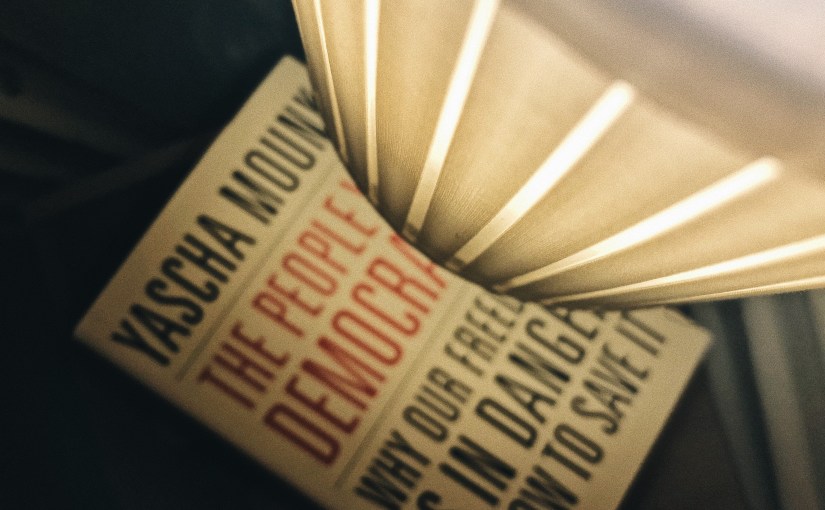
The People vs. Democracy – Yascha Mounk

15-3-19

Dear Partners in thought,

I would like to tell you about “The People vs. Democracy” from Yascha Mounk who is a rising star lecturer in Government (political science) at Harvard. YM is also a product of our global world as he is German-American, born in Munich in 1982, with Jewish roots and a mother who born in Poland behind the Iron Curtain. His book is one of many on the rise of populism and the attack against liberalism in the West but it is one of the most structured as to what the problems are in our Western landscape today and how we could fix them. YM’s book, which is very well crafted and goes to the core of what is behind the attacks against Western liberalism, is a call for action where ideally “doing” would eventually meet “thinking”. YM is definitely coming across not simply as a political scientist describing our times but as a defender of Western liberalism, his book being a clear incitation for readers to join in the active defence of the liberal story – very much along the lines of Desperate Measures if I might add – as if researching, writing and reading in academia or think tanks, even though very useful endeavours, were just not enough (in that one can see his younger incarnation as an active member of the youth wing of the center left SPD in Germany).  

YM confirming (what we know) that the West is going through a populist moment not only in the US but all over Europe (with Canada,  Australia/New Zealand and Japan being, to some extent, exceptions we should note) wonders whether this moment will turn into a populist age and cast the very survival of liberal democracy in doubt. Like Yuval Noah Hahari in his latest book he goes through the one “liberal story” mantra that led our world post-Berlin wall fall and its Fukuyama-inspired “End of History” spread globally in the 1990s and early 2000s. Of note most of the people who disagreed then with Liberalism’s ability to win the day in most of the non-Western world never thought that the liberal story would come endangered one day within its core Western geographic base, the belief being that any country above a GDP per capita of USD 14,000 (Argentina’s when it fell to a military coup in 1975) would be safe from a liberal status standpoint. Liberalism was “the only game in town” and “there to stay.” No ifs or buts. Political adversaries respected democratic rules of engagement, not violating the most basic norms of liberal democracy which also entailed not screaming to jail one’s political opponent on the campaign trail. Today democracy is not such a clear cut system for all when two thirds of older Americans believe it is important to live in a democracy and only one third of millennials do so or when in 1995 one in sixteen of Americans believed in army rule as a good system while now one in six does.

YM delves deeply in the relationship and indeed sacred link and mutual dependence between democracy and liberalism which for ages were a coherent whole. Dysfunction in one can bring dysfunction in the other like democracy without rights can lead to the tyranny of the majority, something the American Founding Fathers feared and is seen today with the rises of populism throughout the West. Similarly rights without democracy when billionaires and technocrats rule the waves and excluding the people is creating another type of disconnect. YM sees a slow divergence of liberalism and democracy first and foremost found in democracy without rights or illiberal democracy when far right (and at times hard left, like in Italy today) populists across the West push different but quite common forms of messages claiming easy solutions to the problems of our times, stressing that the establishments (old political elites, media) do not have the answers and that the mass of ordinary people instinctively would know what to do. A good example would be Hungary which YM depicts in detail the descent into illiberalism over recent years.

Looking at the other dysfunction, which would be rights without democracy or undemocratic liberalism, YM provides the example of the Greek crisis and the referendum of July 2015 which saw the Greeks rejecting the austerity plan put forward by the Troika of the IMF, World Bank and the EU for its government to finally cave in to the creditors demand after intense negotiations in Brussels, thus foregoing the people’s voice (YM will nonetheless note that the people of other EU member states were actually backing the plan). I am not sure that the two features of the democracy-liberalism dysfunction, regardless of the beauty of the concept, are equally systemically threatening as the gravest danger today, by far, is the rise of illiberal democracy or democracy without rights while its sidekick, rights without democracy, pales in comparison and can always be worked on (that the Tsypras government organised a referendum, this for domestic tactical reasons, asking the Greek people whereby they liked EU-ordered austerity in order to restore the country’s finances – which incidentally ended being the ultimate outcome for Greece as seen today – could not yield any other answer than a rejection, something the Troika could not accept in terms of precedent for the Eurozone, all the more with the fragilities of both Spain and Italy at the time).

While they never especially liked their politicians, Western citizens and voters by and large trusted them and the system as their lives were improving – until now. The periods of economic growth as seen since the post-war era, even with its bumps, seems to be behind us and anxiety about the future is rising. Today that trust vanished and many Western people see any gains for immigrants or ethnic minorities coming at their expense. This economic uncertainty fuelled a question of identity after centuries of old mono-ethnic nations in Europe and a dominant white society in North America that were immigrant nations.

In Democracy with Rights, that deals with illiberal democracy or what we see with illiberal governments (in Hungary or Poland) or illiberal developments (Brexit, Trump) in the West,YM takes us to meetings and demonstrations in Dresden of PEGIDA (Patriotic Europeans Against the Islamisation of the Occident) and the AfD (Alternative fur Deutschland) – the latter which scored its highest poll results in a location with the fewest migrants in Germany, reminding us of similar electoral fear-driven results in the U.S. and the UK – trying to understand these phenomena. The common feature of these illiberal leaders or developments is that they claim to speak or to represent “the people” against the establishment, the latter which has been self-serving and actually not working on behalf of the people. In the case of the two German political groups YM pays a visit to, they define themselves against immigration and grew strongly as a result fo the 2015 mass influx of migrants that was initially welcomed by the Merkel government. They represent throughout Europe far right and also far left political parties or movements that were once marginal or non-existent until a few years ago and became key fixtures on their domestic political scenes as with the National Front (now National Rally) in France, Five Stars in Italy, PASOK in Greece, Podemos in Spain, UKIP in Britain before its deliquescence post-Referendum, the Sweden Democrats (with roots in Neo-Nazism) with the far right parties having experienced a striking development due to identity and immigration issues Europe has struggled with since the middle of our decade. 

The striking feature of these populist parties is that they are not like the fascist or Nazi parties of old as they claim to be the true defenders of democracy as “directly” as possible (hence their love of referenda and plebiscites) so the “people” can be heard. YM rightly stresses that once the populists seize power democratically, then comes the illiberal phase where they will do their best to suppress opposition, particularly at the level of the institutions so the expression of popular will is not impeded even if they will tend to “disregard the people when its preferences seem to conflict with their own”, like we would think in Poland today. “Glib, facile solutions stand at the very heart of the populist appeal” across the democratic world and appeal to voters who do not want to think that the world is complicated and that common sense policies should easily deal with any problems their country face. Once in power their solutions far from resolving problems and responding to their voters’ anxieties usually exacerbate the problems that they are supposed to cure. With their appeal to the “real” people, they are positing an in-group, claiming a “monopoly of representation” which in the West is  usually the white natives who will share ethnicity, religion, social class and political beliefs against an out-group, usually foreigners and minorities whose interests can be disregarded. When seeking power, the populists will go strongly against ethnic and/or religious groups and once they accede to power they will turn against the institutions, formal and informal, that preserve liberalism that would be an obstacle to their monopoly of representation and gradually sheer power. Attacks on free press that could criticise the new power ensue with fake news today being the key element of discredit also for the consumption of their power base. Then foundations, trade unions, think tanks, religious associations and other non-governmental associations become targets should they dare opposing.

YM makes the point with others that the term “illiberal democracy” is not quite correct as while being illiberal and initially democratic (YM is very keen on stressing the initial democratic feature of populism) those regimes forget quickly the democratic aspect that put them in power to turn to various degrees into outright mild to hard dictatorships that retain the veneer of the democratic mantle for form. It should be clear today that both Hungary and Poland, both EU member states (creating increasingly tense debates with Bruxelles and other member states) and formally still democracies are espousing illiberal ways of government by controlling media outlets or curtailing the independence of the judiciary. Viktor Orban actually claimed the mantle of illiberal democracy as it it were a great model of government that citizens, like in Hungary, should live under. Democracy without Rights is definitely a must read to understand populism under its nuanced forms.

Rights without Democracy, which is a crafty word play with that of democracy without rights or illiberal democracy devised by YM and has some merits if only for the beauty of its construct, is however a harder case to make as it is impossible to find it an equal in terms of societal harm. In other words, YM looks at all unelected bodies, such as courts, central banks, government agencies (FCC, SEC, EPA and others in the U.S. or the Quasi-Autonomous Governmental Organisations in the UK)  and of course the likes of the IMF, World Bank or even the EU that can dictate the people and indeed entire nations what to do without having been elected by them. YM starts his perilous journey in quoting the old saying of “As long as we call the shots, we will pretend to let you rule”, going back to the Founding Fathers who were adamant not to have the people directly rule which meant a representative Republic first (Alexander Hamilton and Thomas Jefferson, the two arch-enemies on other key matters, were happily together in Federalist N. 63 to ensure that “the essence of the American Republic would consist in the total exclusion of the people, in their collective capacity”). Things changed a bit in the 19th century with major developments going on in America combined with constitutional amendments  with institutions being more willingly facilitating government “of the people, by the people, for the people”. YM feels that the “legislature” in the age of internet and social media (the latter a key culprit behind the rise of populism) comprises representatives, who have less strong ties to their local communities while indeed representing the people, has lost much of its power to “courts, bureaucrats, central banks and International organisations and treaties” to which we can add powerful lobbyists in the US but also around EU institutions. (on leaving Congress, U.S. Representatives or Senators seldom go back to their home roots, where they actually were born or in the district where they were elected, and go on living in the mega-centres where the lucrative jobs are). 

Dwelling on “rights without democracy” YM explains the shift of power away from national parliaments to unelected agencies staffed with experts yielding quasi-legislative power on complex regulatory and other issues. However YM agrees that such a gradual, imperceptible change is not the result of any elite conspiracy but a human response to real policy challenges that cannot be dealt with directly by the people or their representatives but constitutes an erosion of democracy (something we would all agree on in terms of political theory and practice but is hard to avoid, creating absurd comedy-like situations as with the famous Parliamentary exchange involving Sir Humphrey that YM borrows from the famed British TV series “Yes Minister”). YM points out that British civil servants quadrupled from 100,000 in 1930 to 400,000 in 2015 while the population grew by only one third (to which the standard Frenchman would say “only four times?” comparing it to what he knew back home while I would say the same thing but only to stress that the world having grown exponentially complex since 1930, the Brits are doing quite well in that respect). The point YM makes rightly is that government agencies have both gained power in the design of laws to be passed by parliaments and later in their applications, which most would agree creates some conceptual if not practical issues with democracy, though somewhat at the academic level as there is no other viable solution to run Western countries especially large ones. To be fair – and it is where we see that democracy without rights and rights without democracies do not carry the same level of illness – YM urges like George W to “make no mistake” as the FCC, EPA, SEC and CFPB just to name a few U.S. government agencies “have made the United States a better place” (I breathe better even if I am very sorry that Joe Smith in Montana or Paul Lefebvre in Paris cannot have direct influence on fighting climate change or regulating banks). However YM who is a true scholar reminds us that “yet, there is a real trade off between respect for the popular will and the ability to solve complicated policy problems”.

In his back and forth attack and defence mode, YM will still find there is a sound rationale for having independent central banks and not ministries of finance overseeing monetary policies as before WWII in most of Europe. Judicial review and the independence of the justice system, made specifically to act as a safeguard against the tyranny of the majority, will also be recognised by YM as a good thing, even if part of the undemocratic camp as non-elected, in defending and rescuing individual rights across the lands. At the end of the day, YM recognises the soundness of taking so many policy decisions out of democratic contestation but his point will remain that the people no longer have a direct say. To the risk of sounding elitist, it is however hard to wish for uneducated, untrained and ill-informed but otherwise well-meaning and perfectly reasonable citizens to take direct decisions on all matters of government, which is of course unpractical in the first place (unless one likes referenda which we have seen in Europe and particularly in the UK may not be the best way today to avoid massive self-harm driven by emotions and dreams of past grandeur. Having said this the Swiss have liked them as a great weekend pastime). It is clear that the lobbyists may be the exception where one would side with YM as money and special interests can indeed buy their way into legislation (YM has a great section on this item).

Having said all that and taking Brexit as a case study, one could see the dreadful saga and find that the politicians, including elected representatives (notably in the case of the hard-line Brexiteers of the Jacob Rees-Mogg kind) have been pushing outcomes the people who voted Leave in June 2016 would never have wanted as they never voted to be poorer, which a No Deal Brexit would likely produce, while facts now show that Brexit, whatever its form would cause economic pain to the British. There might thus be a case of “rights without democracy” overreach by some British politicians of the strong Eurosceptic kind, placing party ahead of national interest and ideals (or culture, or identity) ahead of the economy which would yield an outcome that would only be desired by a small minority. Then one could also argue, as these hard liners would, that it is imperative to deliver the result of the June 2016 referendum so as indeed to fully enforce democracy even if many (like me) would argue that three years later (almost the length of an American presidential term) and facts aplenty replacing emotions a new voice of the people would be the only democratic way to go to produce a legitimate way forward in what has been described kindly as a “mess” of historical and un-British proportions for the mother of modern democracy.        

As YM puts it “a system that dispenses with individual rights in order to worship at the altar of the popular will may ultimately turn against the people” – especially if seizing power on the back of non-facts and fear stocking as the illiberal democrats have shown – while “conversely, a system that dispenses with the popular will in order to protect individual rights may ultimately resort to increasingly blatant repression to quell dissent”. I would argue that while there is a great likelihood that illiberal democrats may turn into various forms of benevolent to harsh dictators once in power, the fact that our democracies are also involving bureaucrats, agencies, central banks and international organisations and treaties does not cause the same level of threat to the democratic liberalism model even if YM has a case about the impact of lobbyists and special interest groups in the shaping of legislative agendas. The beauty of the democratic liberal system is that it is improvable so “rights without democracy”, while artful in its construct, does not carry the same lethal risks as democracy without rights or illiberal democracy which closes the door to systemic improvement and leads to societal regression in terms of individual and collective freedoms. For us in 2019 the danger lies with the likes of Trump (however his policies may be liked by many voters who may not necessarily like the man, not willing to face the the reality of the overall cost to America and the world), Matteo Salvini and Luigi di Matteo (the Italian hard right and left twins who are upsetting the EU status quo), Marine Le Pen and Jean-Luc Mélanchon (a similar, though not yet in power, illiberal couple from the two extremes), Viktor Orban (the founder of illiberal democracy in the EU) and Kaczynski’s Law and Justice Party in Poland (YM has a very interesting history of how Poland the poster child of post-communism successfully managed economic transition but fell prey to easy populist solutions that now threaten liberalism in a key EU country with the caveat we know that there is also a strong and increasingly heard liberal democratic voice, especially in Warsaw and major cities).            

Looking at the future, one could be forgiven for thinking that the illiberal populist drive will collapse as the younger generations will not back them. Most of the young voted for Remain in the British referendum of June 2016 (even if only very few voted – only 26% of the 18-29 age group) while most young people voted for Hillary against Trump in November 2016 (even if a majority of young whites voted for Trump, sending a peculiar message). At the same time it is a well-known fact that the British population above 60 years of age voted massively to leave the EU and go back to an era which some saw as Victorian in what was a very emotional move. In fact, most polls would show that the millennials are increasingly not thinking that democracy matters at all, some (still a minority) even feeling that a military regime would be better than what some refer to as a parliamentary “swamp” (YM show some rather scary poll results and very interesting charts showing that the older you are, the more important democracy and liberalism are while the opposite is also true). The surprising millennials position is also explained by a lack of direct (they are too young) or indirect (they have no interest in the matter) historical memory, not only about WWII but also about the Cold War as they always lived in a safe and conflict-free environment, taking all the positive aspects of their times for granted. Hence the crucial importance of education.

This trend goes hand in hand with a strong decline in confidence and trust in the democratic liberal “system” across the Western world. Citizens (and one in four millennials) would be falling out of love with democracy and more of them would be open to authoritarian alternatives. The political discourse has changed over recent years, particularly since 2015-16, with political opponents becoming enemies, and thus regrettably becoming for Michael Ignatieff, the former leader of the Canadian Liberal Party and a political theorist, someone you not only want to defeat but whom you want to destroy. Norms are breakable and those who break them, often for tactical purposes, notably the populists, are widely appealing to many voters as they offer a clean break from their perception of an increasingly unsatisfactory and frustrating political system and landscape. YM points out to the reasons why liberal democracy was thriving in the past, which he feels was not due to its inherent, high-minded values, but more as it allowed the Western world and its citizens to live in peace (something they should remember in Europe) and “swelled their pocketbooks”.

Looking at current events unfolding on the political scene, it is clear that the two-headed Italian populism that is today in power is much in the news lately and fitting the illiberal story depicted by YM. While Luigi di Maio, a strong critic of anything French these days, is seen as directly supporting the Yellow Vests movement on French soil (unacceptably breaking good diplomatic manners of the liberal and EU systems but with the May EU Parliamentary elections in mind and lagging behind his twin in the polls), Matteo Salvini is attacking central bank leaders and wildly thinking of “using” for policy purposes the gold reserves of the Bank of Italy, threatening central bank independence. However we also see that some elected representatives, even in America, tend to be faithful to their local roots like State Senator and Queens native Michael Gianaris shows when fighting against the “unfair” and “self harming” tax breaks that were to be given to Amazon for its new HQ in New York State (people keep mentioning that while graduating from Harvard Law and potentially going to a great legal career in DC or Manhattan he elected to go back to the Queens of his childhood). On the subject of elected authority, one can also read points being made that the EU Commission, this oft attacked devilish anti-democratic and bureaucratic actor ruining Europeans’ lives (to take a mild version of the populist and Brexiter credos), if it initiates legislation, does not vote it, something the EU Parliament in Strasbourg (directly elected every five years and representing the member states’ voters) and the Council of Ministers (elected nationally and representing the member state’s governments) do, making it clear that the EU is not without “rights without democracy” even if facts find it hard to reach the people at times. Lastly when the EU Commission though Margaret Vestager decided to oppose the the Alsthom-Siemens merger, France (especially) and Germany reacted by pushing changes in EU merger legislation so the EU could have its own champions and compete with US and Chinese giants.    

While I will let you enjoy the rest of YM’s book and his going to the origins or the disintegration of democracy and liberalism as well as his proposed solutions, I will recap the three main causes (in the text as YM presents them) for the problems of our times represented by the rise of the populist wave across the West:

1. “The dominance of mass media limited the distribution of extreme ideas, created a set of shared facts and values, and slowed the spread of faked news. But the rise of the internet and social media has since weakened traditional gatekeepers, empowering once marginal movements and politicians”. We went from a few providers of news and facts to many, drastically changing the simple equation from “one to many” to “many to many”, the “many” not knowing what and whom to believe and retreating behind what they want to hear, allowing populists to flourish. I think that this tech development is key in understanding the rise of populism in our days.  

2. “All through the history of democratic stability, most citizens enjoyed a rapid increase in their living standards, and held high hopes for an even better future. In many places, citizens are now treading water, and fear they will suffer much greater hardship in the future”. The stop in the rise of well being (and the stop of the social elevator or lift) led to severe societal doubts and a great opening for populists to flourish. One can easily agree and would almost hear Bill Clinton and his “it’s all about the economy, stupid!”.

3. “Nearly all stable democracies were either founded as monoethnic nations or allowed one ethnic group to dominate. Now, this dominance is increasingly being challenged.” In a tried and tested approach and while understanding the rational demand for identity preservation, foreigners and minorities became seen as culprits, regardless of whether they were actually threatening jobs or life style, allowing the populists to seize upon those fears to flourish. I believe that identity is indeed a key factor that western liberal democracies should reflect and act upon without losing their souls though adopting a realistic approach.  

I wish you all a very good reading of a very relevant book, especially in its analysis of the populist rise, its causes and the solutions that YM would propose. Even if one will not agree with all of YM’s takes (as was my case), it is invigorating to read a book from an academic that is not merely academic but is also action-driven all the more as the barbarians are at the gate.
                             
Warmest regards,

Serge                                    

And then there will be only one…option

12-3-19

Dear Partners in thought,

Ms May’s deal was crushingly voted down as an expected chapter of the Brexit choreography even if the EU tried to help the PM in her last ditch effort – also to show some goodwill and to deflect the blame that will doubtless come from many quarters in the UK in the future.

As Desperate Measures, anchored into rationality and away from “the sound and the fury” (which may be a clear advantage) stated numerous times, the Brexit process still follows a path that should result in the last option standing that will be a second referendum. This option will not only be natural as the people three years later should decide on the fate of Britain in Europe but is needed after so many erratic developments from its representatives and facts aplenty.

As stated and as Ms May did honour her pledges, the next steps will be a rejection by a large majority of the “No Deal” option, removing the darkest abyss, which will be followed by a likely extension of Article 50. The remaining question mark about the latter will be the length of that extension. It is clear that the EU will only grant it based on a “plan” from the UK (as President Macron already stated) and, very importantly,  enough time for all viable options to be considered including essentially a second referendum. It is also clear that the people’s voice will be heard in the end as the EU will not renegotiate anything with the UK at this point. Parliament will only be too happy for the people to vote again with a set of clear questions (like Ms. May’s defeated deal and Remain) and clearer facts at hand as it would not be able to gather any majority for the very few remaining options on its own. The British people will then decide their future, whatever it may be (you know my views), and there could not be a better option. In doing so the British national interest will also be firmly put ahead of partisan politics and personal careers, the latter that have so much hurt the Brexit process and liberal democracy.

Warmest regards,

Serge

Liberal democracy should not be weak

11-3-19

Dear Partners in thought,

Having noticed the recent position of the Human Rights chief, I feel compelled to disagree with her strange views of the French government’s response following the recent Yellow Vests developments. Her take was very critical of the government measures voted by French Parliament to clamp down on violent serial protests so I presume people could be largely free to do what they want as basic freedoms, such as demonstrating, should not be unduly controlled by the State. While liberal democracy should indeed be the perfect environment to foster freedoms and ensure the right of peaceful demonstrations whatever their focus, it should strongly prevent and condemn violence, hatred and messages against any ethnic or religious community if it wishes to preserve its very existence. Similarly far right “dissidents”, as they are called in some think tanks focused on the preservation of freedoms, of a Neo-nazi or Neo-Fascist kind have lost the right at the cost of millions of dead to express their views publicly unless liberal democracy wishes to give them a forum on the altar of absolute freedom. Lastly in an age of fast-moving technological and internet developments, social media have been used to indeed propagate fake news, often of a hate flavour, and measures, involving regulation and education, are needed to ensure as much as possible that they do not take hold in the minds of people who may not have the time nor the background to fully appreciate them. France, which is not Venezuela, North Korea, Russia or China in its approach of freedom, collective and individual, is entitled to protect “moral norms” of societal engagement to ensure we keep living in a liberal democratic environment. The response of the French government and Parliament was amply justified in the face of extreme violence, ultra-left and right groups bent on pushing undemocratic views and ethnic hatred and the corrosion of the political discourse due to poisonous fake news. For freedom to survive and thrive, we need to ensure the moral norms of liberal democracy are upheld, even if restricting the freedoms of violent rioters, hate-driven extremists and the more recent news propagators focused on pushing extreme, illiberal agendas and creating chaos. Liberal democracy is not a synonym of weakness.
Warmest regards,
Serge

21 lessons for the 21st century – Yuval Noah Harari

1-3-19

Dear Partners in thought, 

I would like to speak to you about “21 lessons for the 21st century” by historian Yuval Noah Harari who has risen to fame over the last few years with his two widely-acclaimed books “Sapiens” that surveyed the human past and how an ape came to rule the world and “Homo Deus” that explored the long-term future of life. YNH has a PhD in history from Oxford and lectures at the Hebrew University in Jerusalem. 

“21 lessons for the 21st century” is probably the most ambitious book of the moment, focused on “today” and current affairs with a global focus, trying to explain where we are and may be going. It has five parts and 21 sections or indeed lessons, all inter-connected in an amazing tapestry for our times as follows. 

THE TECHNOLOGICAL CHALLENGE
1. Disillusionment 
(the end of history has been postponed)
2. Work 
(When you grow up, you might not have a job)
3. Liberty (Big data is watching you)
4. Equality (Those who own the data own the future)

THE POLITICAL CHALLENGE
5
Community (Humans have bodies)
6. Civilisation (There is just one civilisation in the world)
7. Nationalism (Global problems need global answers) 
8. Religion
 (God now serves the nation)
9. Immigration (Some cultures might be better than others)

DESPAIR AND HOPE 
10. Terrorism 
(Don’t panic) 
11. War
 (Never underestimate human stupidity)
12. Humility (You are not the centre of the world)
13. God (Don’t take the name of God in vain)
14. Secularism (Acknowledge your shadow) 


10. Terrorism 
(Don’t panic) 
11. War
 (Never underestimate human stupidity)
12. Humility (You are not the centre of the world)
13. God (Don’t take the name of God in vain)
14. Secularism (Acknowledge your shadow) 

TRUTH 
15. Ignorance (You know less than you think)
16. Justice
 (Our sense of justice might be out of date)
17. Post-Truth (some fake news last forever) 
18. Science Fiction (The future is not what you see in the movies)

RESILIENCE
19. Education (Change is the only constant)
20. Meaning 
(Life is not a story)
21. Meditation (Just observe)     

If you don’t know him, one of the key discoveries reading YNH is that he is not your typical historian. He is much “more” or as Nietzsche would have said, he is “the man of the future” or the one who can read into it as he is also the one with the longest memory, a feature that is not so common. 

I will only address one chapter or lesson – incidentally one reflecting why the blog exists – as the book is so rich that addressing the full YNH “course” would require a length that would far exceed the remit of one Book Note and might be unwittingly tedious. I also do not want to uncover all the pleasures of discovering his thinking process and why those lessons are what they are. One may not necessarily agree with his classification though it is hard to find his selection not relevant. One may not always agree with his conclusions but his approach is thought-provoking while, all the lessons being interconnected, his offering offers a truly encompassing perspective of the challenges facing mankind as we gradually advance to the mid-point of our transformational century. 

In Disillusionment (aptly ranked as lesson 1) YNH addresses the key point of friction of our days that relates to the rise of populism, anti-elite, anti-establishment, at times anti-capitalism and largely anti-“everything” about the Western liberal world we built since 1945. In many ways lesson 1 is an echo to Edward Luce’s “Retreat of Western Liberalism” discussed in mid-2018. YNH sees three “stories” that shaped the 20th century with Fascism, Communism and Western Liberalism, the latter having been the “last one standing” that celebrated the value and power of liberty and became the global mantra of the 1990s and 2000s. At the peak of Western liberalism, Bill Clinton told China that its refusal to liberalise Chinese politics would put it “on the wrong side of history”. The great disillusionment came with the global financial crisis of 2008, coinciding with a slowly vanishing unipolar world we had known since the fall of the Berlin Wall in 1989. Different walls, resistance to immigration and to trade agreements and rising illiberal democracy appeared while the Brexit process and the Trump ascendency marked a turn while exporting democracy at the barrel of a gun (Iraq, Libya) started “not working for Kentucky and Yorkshire”. In 1938, there were three competing stories. In 1968, there were two. In 1998, there was one. In 2018, there may be none, even if YNH believes that liberalism or the “Liberal Phoenix” is perfectible and indeed was able to mutate throughout its making, at times borrowing and actually implementing the best aspects from the two other stories like equality, welfare and social safety net from Communism even if they might have been mere political concepts and not realities. Liberalism is not at its first crisis of confidence as noted with WW1 that put an end to the first era of globalisation, fascism that seemed unstoppable in the 1930s until it was and Communism which was on global assent from the 1950s to the 1970s until the “supermarket proved far stronger than the gulag”. To be sure, YNH points out that the liberal offering was mostly for middle class Europeans (and we could add Americans and all whites globally) but was “blind to the plights of the working class, women, minorities and by and large non-Westerners”. On this latter aspect, YNH makes an interesting point, perhaps a bit unfair as to its target and circumstances, that the Dutch, pillars of Western liberal democracy as we know it, collapsed after four days of fighting in 1940 but still fought Indonesian independence after WW2 tooth and nail for more than four years, incidentally making a good business case for the Soviet message that could care less about freedom but seized the tactical advantage in the then colonial world.    

When YNH writes that the end of history has been postponed, he makes a reference to the likes of Stanford neoconservative Francis Fukuyama (without naming him (1)) and its “End of History” projecting the genuine beliefs that having defeated Communism (in its Russian Soviet version) all political and economic problems were settled once and for all, with Liberalism standing unrivalled, which it was, spreading its universal message globally as if it were a new, dominant religion. Liberalism is questioned now more than ever but does not face a rival story yet. Liberalism is now faced with a nihilistic Trump movement at the heart of its erstwhile leadership country which offers no plan and only exists in violent opposition to its core features, notably globalisation. Liberalism is faced with many attacks from a great diversity of people the Western world over (often nicknamed the left-outs by their geographic locations or inability to adjust to economic and societal changes), some who may actually still believe in elements of liberalism but reject its globalisation part and wanting to experience it behind walls, adopting illiberal policies against foreigners. Interestingly the Chinese have adopted a mirror image reaction by being champions of globalisation, as it also serves their interests, while clamping down on many individual liberties at home. As for Russia, which pretends to be a democracy, it really offers an oligarchic, media-controlled, model that endures and projects Russian nationalism and Orthodox Christianity that seem to be priority features, ahead of economic well-being, to most Russians, especially outside the main urban centres. Russia does not offer a coherent ideology that can compete with Liberalism globally. YHN stresses that with 87% of the Russian wealth concentrated in the top ten per cent of its people, it is doubtful that The National Rally’s Marine Le Pen voters would like this model if they ever realised the fact, even if they enjoy seeing Marine meeting one-on-one, as if conferring her an aura of leadership and respectability, with Vladimir in the Kremlin. In a funny jibe, YNH tells us that “people vote with their feet” and that to date he has yet to meet one person who wanted to emigrate to Russia (well, he forgets Edward Snowden of course).                

It is clear that YNH likes Liberalism and what he stands for even if his piece is not a staunch defence of its story as Edward Luce’s was, this on purpose as he explains in his chosen approach of the book. However, at the end of the day, YNH feels that we have it much better than in 1918, 1938 or 1968 and while the liberal story will always be “kicked angrily” along the way, it will not be abandoned, even if all the major world players are experiencing a drive to return to the past, which at times was not that great but looks attractive today even if not reachable (he goes through all the major countries and how they strongly aim at adjusting to changes via their own formula such as Brexit , Make America Great Again, the newly re-found Confucian imperial roots or the Czarist glories of yesteryear. YNH points to Obama rightly stressing that in spite of its many shortcomings, the “liberal package” has the best record of all stories by far, echoing one of the tenets of this modest blog that we as people easily forget the “good things” that we take for granted, like peace in Europe that the “dreadful” (for some) EU helped foster.         

One key amplifier of disillusionment for YNH that created a feeling of doom and disorientation is the accelerating pace of technological disruption as people never “voted” for nor understood the societal mutation that was driven by engineers more than political parties. The future also looks more challenging due to the limits of growth (and perhaps hyper-consumerism and its “never enough” frustrations as Rutger Bregman told us about) combined with tech disruption – notably in the fields of biotech and information technology – and man-made ecological meltdown, the latter that the current world leader does not want to acknowledge, on the contrary. These disruptions will require fresh visions, leading Liberalism, yet again, to reinvent itself (which we should believe it could as it is an improvable story). At present and while we still live in the phase of disillusionment and anger (well not for all of us I would like to add), YNH suggests we should shift from panic mode, which is a kind of hubris, to bewilderment, which is more humble as to what we are going through with our wonderful but challenging world.

I could cover a few more lessons but it would not do justice to the excellence of YNH’s craft so I will let you discover for yourselves the words of wisdom he has put forward in his book. I also think it is important not to say everything that might lead you not to read his 21 lessons that are worth reflecting upon. And again we would need a very long Book Note to cover the whole book…

Not everybody liked this book even if reviews were overwhelmingly positive, like for his two previous books. Some of you, like the FT’s John Thornhill, will be dazzled by “the flashes of intellectual adventure and literary verve (I sure was) though will find that he might have “recycled” many of his observations from “Sapiens” and “Homo Deus” (I did not read his first two books so was taken, lock stock and barrel). Some, like Gavin Jacobson of the New Statesman, felt that his new book  was “a study thick with promise and thin in import” with little advice actually given. For my part I found it a book whose weaving was astounding, full of key interconnected matters to reflect upon, making us better equipped to look at our challenging future and as YNH stresses in his common thread – our globalised civilisation – with hope. Definitely a must read. 

Warmest regards,

Serge    

(1) Francis Fukuyama’s latest book, as if to redeem himself thirty years down the road, is focused on identity (aptly named “Identity”), dealing with the rise of populism and going back to the work of past philosophers in what is indeed another chapter of our… history.     

When the Brexit tide is finally turning for “good”

26-2-19

Dear Partners in thought,

You will remember that once I gave you my likely step-by-step scenario on the Brexit process back on 18th January I decided not to post anything more on the subject given the sensitivities involved and the personal relationships at stake (as I have so many dear Tory Brexit friends I enjoy lunching with!).

However it is worth stressing the importance of Jeremy Corbyn’s decision to back a second referendum and the shadow foreign secretary adding that Labour would back a Remain vote. This decision was doubtless prompted by the courageous and far-sighted Labour defectors (joined by the three lady Tory MPs) who created a shock to the system well beyond their sheer number with their Independent Group (Britain would do well to put them at the pantheon of those patriots who chose national interest before party interest). 

While there is always the issue of arithmetics involved with getting a Parliamentary vote backing a second referendum at least on paper, I would wager that there will be enough MPs on both sides, still formally undeclared, who will make the people’s vote happen as it is the only rational way forward. The next step will be very shortly to see the No Deal option killed by Parliament and the Article 50 extended, something that even Theresa May was already somehow preparing her troops for before the last bombshell, all while still strangely sticking to her odd “No Deal or My Deal” mantra with her five minute before midnight tactics. 

I wanted to add this short Interlude not to rejoice in an “I told you so” mode even when it was becoming fashionable (as well as prudent or even boastful for some) to prepare for a No Deal outcome and its abyss, but as I felt happy that Britain might start eventually to regain it full senses and think at long last in terms of its national interests away from passion and fury. Again a second referendum may not change the outcome of June 2016 though very likely would, for the benefits of Britain, Europe and the world.

Warmest regards,

Serge  

Why Europe needs to go strong on (its very) defence

19-2-19

Dear Partners in thought,

My generation has relied on Pax Americana and U.S. leadership in making the world safe for democracy and indeed the West, especially Europe throughout the Cold War and beyond. 

The younger generations, like the Millennials, not enjoying the same direct and indirect historical memory of World War II and the Cold War may not realise how key for peace and prosperity the Western Alliance and indeed NATO were for all of us year in year out so we could go on about our lives and building our own dreams.  

The Munich Security Conference this week (which my friends at Tortoise Media aptly described as “like Davos but for people who speak in three letter-acronyms (TLAs), have unusually detailed knowledge of Afghan mountain passes and CVs with suspicious gaps”) saw VP Mike Pence getting the frostiest of silences after offering Donald Trump’s best wishes to the participants, something which was repeated when he forcefully instructed Europeans to withdraw from the Iran deal. Only two people stood up to clap with excitement and admiration: Ivanka Trump and Jared Kushner. The contrast with Angela Merkel and her frank and unusually energetic assessment of the US approach to world affairs and its “America First” mantra, reminiscent of the 1930s and Charles Lindbergh, could not be more vivid as well as her exhortation for Europe to be the beacon of multilateralism in the world. 

While Joe Biden (which I hope will run, if only to offer a credible alternative against Trump in 2020, even for one term and to put things back on track if at all possible) and the legislative (Democratic) delegation stressed that they “will be back”, the time is now for the Europeans to take things in their own hands. They have for too long being complacent with their defence, relying too much on a benevolent America in what both sides saw as a win-win (which it was). While we should work with America when “it comes back” to its principles, Europeans should build their own defence and bear more of the costs of freedom when the Trump tragedy ends, hopefully in 2020. And regardless of what happens with Brexit, we should do so with our British friends, which combined with France, the other European defence player today, should lead the charge and ensure that Germany forgets its past and rise to the challenges of the day in building this crucial element of European strength and independence, together with the other 25 EU members states. Europe can no longer rely on America as Pax America is virtually dead now, as stated with sorrow by NYT’s Roger Cohen, but as America comes back, Europeans should act responsibly as strong and credible partners in the Atlantic Alliance in a true win-win way. This approach should start now with deeds and not only words. 

Warmest regards,

Serge 

PS: When I write that Germany should “forget its past” and rise to the challenge of the day, this is in the context of collective European defence in 2019. It is not about erasing its Nazi past from its national memory. Germany, the wealthiest EU nation, should meaningfully and at its level contribute to collective European defence. Germany should do so both in financial and actual military terms, something that it was always reluctant to do due to its militaristic past and while, under the American umbrella, it unwittingly channeled most resources to the building of its economic might, an area which admittedly has made the country as well as Europe strong at a different level.