Posts

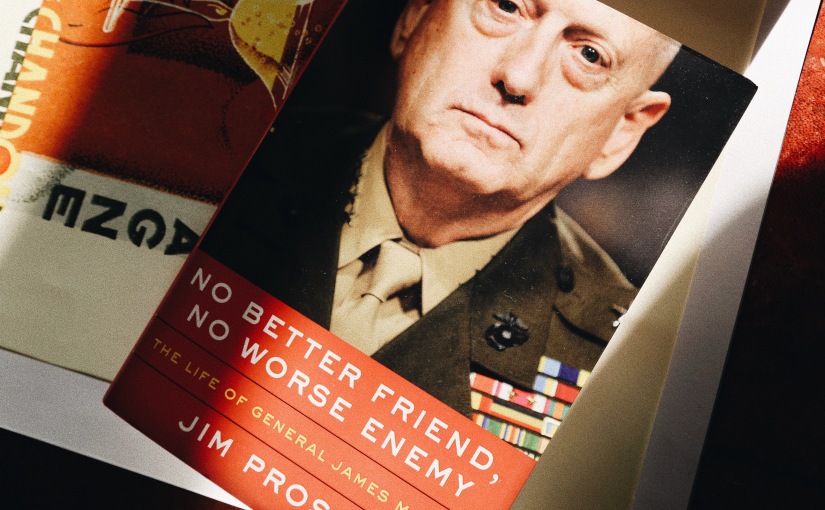
No Better Friend, No Worse Enemy – Jim Proser

15-9-18

Dear Partners in thought,

I would like to tell you about a modest and highly able man who stands out – literally – as the senior beacon of wisdom in the Trump Administration and the reason why we probably can also sleep a bit better at night. I would like to tell you about James Mattis, the U.S. Marine Corps General who presides over the Department of Defense since January 2017. “No better friend, no worse enemy” is a book by author Jim Proser, who is a familiar fixture of the American military having written in 2011 “I am staying with my boys” which is still on the Marine Corps’s Commandant Professional Reading List.

JM conveys a mix of seriousness (easily gained from looking at him; I would not want to cross that man), balance and resolve as demonstrated by his line to the enemy in the Ambar province of Iraq a few years ago: “I come in peace. I did not bring artillery. But I am pleading with you, with tears in my eyes. Fuck with me and I will kill you all”.

From day one of his nomination, I only heard good things about Jim Mattis, including from Democratic friends who have known him personally and were despairing about Team Trump. JM was the first presidential cabinet nominee who also received unanimous bipartisan congressional support, which was an oddity amidst the hyper-partisan environment following the 2016 presidential elections. The book is about the qualities of the man behind the role and attributes such as humility, deep thoughtfulness, courage, insight, humour, fierce compassion and experience in the real trenches facing all enemies. “No better friend, no worse enemy” is not just the title of a book. It is the motto of the First U.S. Marine Corps Division drawn from the Roman general Lucius Marcellus Sulla who once said: “No friend ever served me, and no enemy ever wronged me, whom I have not repaid in full”.

Jim Mattis is a composite of George Patton and Omar Bradley, the famed warriors of the Western European front in WWII – the Yin and the Yang, the hussar and the planner. JM is seen today as the leading military commander in post-WWII together with David Petraeus, who was also once revered for his Roman classicism (down to his name) and new breed of warfare though fell from grace as he was only too human and kept showing he indeed was – in a more acceptable sense – when he joined the world of private equity as a senior adviser to KKR.

The book depicts JM’s life from his childhood in Richland in the State of Washington (his father was working as a power plant operator at the nearby top-secret Hanford nuclear facility and his mother Lucille, a homemaker as they said then had been a U.S. Army intelligence officer, thus providing a background from which to discover a path). JM graduated from high school in 1968, which was an epic time for the young and restless generation (on the Berkeley campus as in the Quartier Latin in Paris) and their bewildered post-WWII parents. He was also growing up in the midst of the Vietnam War when young men were drafted. His Richland friends were not war protesters and simply enjoyed the local doughnut shop, movie theatre and their Columbia High School in the usual tradition of kids there. He joined the ROTC (or Reserve Officer Training Corps) when he attended Central Washington University while not thinking about joining the military at the time. As a sophomore (second year) he walked into a Marine Corps recruitment office (like in the movies) and signed up for the Marines’ Platoon Leaders Course at the same time as the Tet offensive in Vietnam that killed 10,000 American soldiers and Marines. He decides to pursue his higher education through the Corps, now wearing the Prussian “high and tight” haircut marking him as one of “the few good men” and at a time when “baby killers” are screamed throughout the U.S. including at returning soldiers at airports. He gains a Master’s degree in History from the Marine Corps Command and Staff College, especially enjoying the readings of Sun Tzu. While he will not fight in Vietnam, he will be in the military after the 1975 fall of Saigon and feels the trauma of defeat which was not an American experience before Vietnam. In 1978, Captain JM takes command of the Third Marine Battalion of Kilo Company of the Third Marine Division working under men who had fought in Vietnam. He leaves the classroom for good and starts “deploying” mostly in the Far East staying with troops on bases in Asian ally countries in the midst of the Cold War. He is part of the men mobilised by President Carter in response to the Iranian uprising and Teheran Embassy seizure but the forces never go into action following the loss of the two helicopters in a failed Operation Eagle Claw rescue mission that brings down the morale of the troops.

Mattis would never marry but is known to be a “Ladies’ gentleman” (I am still doing research on the meaning of that). There was a girl, Alice, whom he met in Hawaii during a deployment, who said after a nice romance that she would marry him if he left the Corps, not feeling she could bear the month-long deployment of her young Marine officer husband. JM started going through resignation procedures though his fellow Marines stopped him, lobbying Alice to change her mind as his future was deemed by them too bright. Alice agreed and a wedding date was set. After another deployment, JM comes back and, while working on catering arrangements, receives the news that his bride-to-be has reconsidered, not wanting to go through the waiting game of a Marine’s wife’s life. In July 1881, JM is promoted to Major and goes to the Pacific Northwest. He will never marry anyone but the Corps.

The book is not for everybody as it is for a great part quite military-flavoured. The book navigates back and forth through his life and the Operation Iraqi Freedom showing us the extricate details – at times hour by hour – of how the Marines took Baghdad and what JM did during the long (though they did not know it then) occupation phase. If we remember that early military phase of the war back in 2003 there was that feeling of a walk in the park, enhanced by the Hollywood-like pioneering (and brave) embedded media reporting as if part of a TV reality show. It was of course not a walk in the park but the swift result of excruciating preparation and faultless delivery largely due to the leadership of men like JM (one would have liked that this glorious episode of U.S. military history had stopped there and that the occupation morass been avoided). The book, due to its detailed description about military action may not be for everybody without an interest for the matter though it is also the best way to get to know JM through what he was actually doing until 2013 when he retired from active duty. He was involved in the two Iraq wars – as a Lieutenant Colonel in 1990 and a multiply starred general in 2003 and beyond. Back from Iraq I he worked as Marine Recruiting Station in Portland not that far from his childhood state, “recalling the raucous pub crawls through ports of calls with the 3/3 with fondness and amusement” (somehow not what you think that JM would do). He enrols in the Marine Corps Command and Staff College moving to Quantico, Virginia (also home to the FBI training grounds), writing a dissertation on “Amphibious Raids: An Historical Imperative for Today’s Marines” both pointing to America’s growing confidence in President Reagan and arguing that Marines should expand their historical role as warriors from the sea, a tenet that is yet once tested by Saddam Hussein’s invasion of Kuwait in August 1990 and the need to deploy massive American military assets to a new theatre that will mark the country forever. We go through the whole Iraqi campaign led by the memorable and colourful duet of Generals Norman “Storming” Schwarzkopf and Colin Powell under the prism of Task Force Ripper with yet again an hour by hour account of the deployment of the American and allied invasion force. JM enjoys a hero’s welcome when he returns, as all American soldiers do while George HW Bush basks in the highest, never equalled, presidential poll rating in the history of poll ratings (Who would have thought that an obscure Arkansan governor from the opposite party would unseat him a few months later?).

We also learn interesting facts in the book such as that Osama bin Laden had offered King Fahd to help push Saddam out of Kuwait with his 100,000 devout Muslim fighters (pre-Al Qaeda, even if the number looks huge) but was rejected in favour of the Americans by the Saudi King, this leading ObL to never forgive his king and eventually side with the defiant Iraqi strongman and visionary of an Islamic caliphate, devoting his life to Jihad with the consequences we know. After Iraq 1, Lieutenant Colonel JM goes in May 1991 back to Quantico to be the assistant to the head of the Marine Corps Enlisted Assignment Branch, which we learn is the nerve center of the Marine Corps, “where the big decisions are made in relation to recruiting”, which he will lead within a year. We go through the period marked by the 1993 bombing of the WTC, while JM graduates from the War College. We then go through the gradual increase in terrorist attacks such as the June 1996 Al Khobar bombing in Saudi Arabia marking the beginning of such attacks that will see the US embassy in Kenya and the USS Cole being targeted, all these events leading to 9-11. We know the following stories centred first on Afghanistan right after 9-11 and in March 2003 with operation Iraqi Freedom which will see again the Marine Corps and JM going back to a well known theatre. These events area also described with an angle on the arduous relationship between the Department of Defense (Don Rumsfeld) and the military commanders. In 2007, JM became Commander of the U.S. Joint Forces Command and, replacing David Petraeus, Commander of the U.S. Central Command. Iraq will take the last ten years of JM until he retires in March 2013 after 41 years of service in the Marine Corps.

A few months following his retirement JM was invited by the young entrepreneurial prodigy turned infamous fraudster Elizabeth Holmes to join the supervisory board of Theranos (read my book note on the excellent “Bad Blood”), together wth former secretaries of state George Schultz and Henry Kissinger as well as former secretary of defense William Perry, former Senator Sam Nunn, former Wells Fargo CEO Richard Kovacevich and Riley Bechtel, Chairman of the Becthel engineering group. This is the dark spot for JM as if he was no longer as good outside the confines of his military environment. He retreats behind the high walls of the Hoover institution and Stanford (incidentally all the Theranos board members with a public sector background were linked with the Hoover Institution). He joins another think tank dealing with public policy and the board of General Dynamics and then the U.S. Naval Institute which look more like the right trenches for the old warrior. He keeps receiving awards (“Semper Fidelis”, also the Marines motto, from the Marine Corps University – which most of us discover the existence), honorary degrees (Doctor of Laws Degree from George Washington College), volunteers for his local food bank back in Washington state, join more boards (The Center for a New American Security, from which he will testify before the Senate’s Armed Services Committee about global challenges and security matters, warning about the growing threat in Iraq). At the Hoover Institution he takes part in a book “Blueprints for America” that is edited by his friend George Schultz and he participates in many college commencement ceremonies and the usual speaking tours. He will co-author “Warriors and Citizens: American Views of our Military”. JM is not actively involved in the 2016 presidential campaign (probably the old soldier’s duty of reserve, which is not the case with former general Mike Flynn as we remember). Late in the campaign as it seems DT might possibly win against Clinton, he gets a call from the campaign team. The rest is history and he is smoothly confirmed as Secretary of Defence. He will agree with DT that there will be no public discussions of American military plans and timetables. JM will go back to Iraq in a different capacity.

The book, while published in 2018, does not touch upon the role of JM as Secretary of Defense or his work relationship with the President. We can speculate as to why this soldier of soldiers, at the pinnacle of glory, decided to accept such a role in such an atypical Administration. It is undeniable and not partisan to recognise that JM and DT are polar opposites in style as well as substance. Did he join as he wanted to still contribute other than “speaking”? Did he join out of fulfilling a great career and finishing it with (one of) the top role(s) in his sphere of expertise? Did he join out of duty, knowing that he could temper the policies and decisions of a very “different” President (the recent books whose accounts seem very plausible given who is the individual focused on have indeed mentioned an assassination order that was ignored by JM). Maybe JM went ahead because of all these combined reasons. We will never know and it is not very important to know. The only memorable exchange we know as it was well covered was when asked by DT whether waterboarding worked, JM replied that it did not work as offering a detainee cigarettes and a beer (also, he could have added, if you wanted solid intelligence not borne out of pain and fear). What is clear to me and many others is that we can sleep better at night knowing the great military might of the U.S. is under control and that we could not have hoped for a better outcome given the odd circumstances.

I dedicate this book note to Adrian, my former “boss” at the greatest, now gone, merchant bank, and a life-long friend, who shares many of the attributes of JM even if working for DT would have been “a bridge too far” (by the way, as we talk “shock and awe” you should all read the recent “Arnheim” book by Sir Anthony Beevor, the great British military historian. I am sure JM will).

Warmest regards,

Serge


Serge Desprat- 15th September, 2018 (Prague)


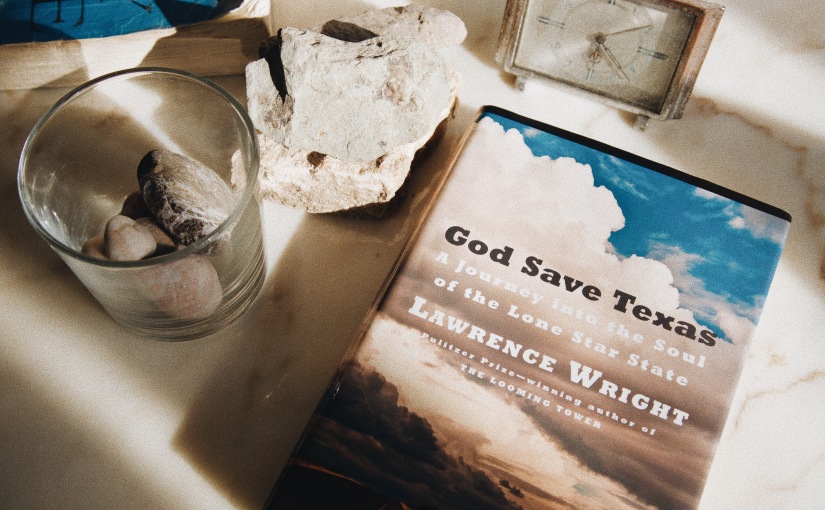
God Save Texas – Lawrence Wright

5-9-18

Dear Partners in thought,

I wanted to share with you “God Save Texas”, a new book by Lawrence Wright about “A journey into the soul of the Lone Star State”. LW is the Pulitzer-winning author of “The Looming Tower” (now also a TV series on Hulu) on the US inter- intelligence agency struggle of the FBI New York Bureau’s counter-terrorism chief John O’Neil to thwart the Al Qaeda threats that ultimately led to 9-11. LW is a liberal, cosmopolitan Texan from Austin (of course from Austin) so not part of the ultra- conservative crowd which has reshaped the state from blue to hard red since the early 1980s but nevertheless a Texan first who can go across the aisles (not too deeply admittedly) and has friends everywhere, making his book fascinating. He covers the key issues that are very dear to Texas today and have a great impact on America and, as such, the world at large.

Texas is the second largest U.S. state after California, forecast to double in population by 2050 with already three of the ten most populated cities with Dallas, Houston and San Antonio (and Austin, the capital city in 11th place). Texas is a story of contrasts, always big ones in any segment of modern society. While ultra- Republican now after having been very blue (think LBJ) the state has actually turned into a “minorities” state in 2004 which some say does not bode well for the Texan GOP’s future and may explain the very systematic and intense fight of these past years with the U.S. and within the state to roll back some of the most liberal directions taken at the Federal level. It may be a rearguard battle based on demographics assuming that minorities and the urban, cosmopolitan crowd go to the poll booth going forward. While Texas is very “red” today and always compares itself with California that is very “blue” and sees it as as the antichrist (California does not compare itself to Texas, being cool about that and other things – too much surfing to do), it was not always like that when Reagan was Governor in Sacramento and Texas was still part of the LBJ legacy. Today one of the rallying cries of the Austin GOP-dominated legislature is “Don’t Californicate my Texas!” applying that motto inter alia to abortion, birth control, gun control (or laxity), transgender toilets and immigration laws and regulations.

To me Texas was America from a very young age. My father took me to the movies when I was not even 10 to see a rerun of “The Alamo”, the 1960 movie with John Wayne (Davy Crockett), Richard Widmark (Jim Bowie) and Laurence Harvey (William Barrett Travis), a movie that embodied Texas and its indomitable spirit, known even before 1836 with its “Come and get it” slogan about an old cannon that the Mexicans wanted to take from one of its old Spanish missions as a prelude to the siege of the Alamo (Ted Cruz famously wore a “Come and get it” pin during the Senate debates on the failed repeal of Obamacare). We did not know America so well in Europe but through Hollywood and John Wayne in his many Westerns we loved those Texan cowboys with their Stetsons and palominos where the land and many things had no limits as they made us dream.

Texas is about the boots, the pickup trucks, the guns, the attitude – all part of the stereotype which are also a masquerade according to LW, serving to enforce a sense of identity, but also adding to the alienation that Non-Texans often feel about the state. He quotes the New Yorker’s John Bainbridge who wrote extensively about the state in 1961 for his book, “The Super-Americans”, and how Edna Ferber’s own “Giant” novel made into a movie at that time with Rock Hudson (the super cattle rancher), James Dean (the roughneck rising to make a fortune) and Liz Taylor (the civilised Easterner who cares for the Mexican slave laborers who don’t get the profits of their work) shows the codified archetypes still colouring the perceptions of Texans by both outsiders and themselves. Bainbridge stressed the popular disdain for Texas outside the state as a combination of “hostility born of envy” and “resentment born of nostalgia” with Texas being a mirror in which Americans see themselves reflected, not life size but, as in a distorting mirror, bigger than life adding that the condescension of non-Texans toward the state echoes the traditional Old World stance toward the New. According to Bainbridge then, the faults of Texas, as recorded by most visitors, are scarcely unfamiliar for they are the same ones that Europeans have been taxing Americans with for some three hundred years: boastfulness, cultural underdevelopment, materialism, and all the rest. LW feels that what happens in Texas tends to affect disproportionally the whole nation as “while Illinois and New Jersey may be more corrupt and Kansas and Louisiana more dysfunctional, they don’t bear the responsibility of being the future like Texas”.

LW tells us about oil and Texas and more precisely the boom and bust sagas that Texans have learned to live with for years. In many ways this boom and bust culture goes with the psyche of Texas, a larger than life state that embodies so much of America, is loved and hated by Americans (non-Texans) and admired at the same time, often for the same reasons. LW starts the book about the roots of Texas which are of course found in March 1836 at the Alamo in San Antonio, which he visits with us (you can still see there a rifle owned by Davy Crockett and the eponymous knife of Jim Bowie). The Alamo is Texas and its “never surrender” attitude forged a “persona” leading to thinking big and walking tall throughout its history. A land of big dreams, a land without limits, a land of immoderation. A (larger) Republic first, then a (smaller) state but never happy being part of a larger concern. A land of small or no government. A land of the cowboys and their individualism. A land of pioneers in all fields. A land that does not care much for those who can’t hack it and is not keen on anything welfare-like. A land of winners where losers suffer. A land where God runs high at the side of the true Texans. A land of freedom at any costs.

It is a wonderfully multifaceted book so rather than going through it, something you can do at your leisure should you wish to know the Lone Star State better, I will give you some fun facts (and some not so fun). One thing to bear in mind is that LW is a liberal Texan, the type you might meet more likely in Austin though he is also broad- minded and loves Texas so his portrayal should be fine for all as its fact-based (even if today that may not be a great argument for all).

  • Singer Phil Collins, having being fascinated like me by the Alamo story as a child, became one of the most important collectors of Alamo memorabilia in the world. There are now discussions about the creation of a museum to host Collins’s collection, involving George P. Bush, former Florida Governor and Presidential candidate Jeb’s son, who is the last elected Texas Land Commissioner. As an aside, the great Texan dynasty goes on.


  • Legendary Sam Houston, avenger of the Alamo and unlikely crusher of Santa Anna, the Napoleon of the West, at San Jacinto was not a forgone conclusion. A Governor of Tennessee in 1827, SH was a Jacksonian populist and a rising star with hopes for the White House. He ran into “problems” (that are still not very clear) when his wife of 19 (16 years younger than him) left him 11 weeks after their wedding, making him resign citing “sudden calamities”. He fled to live with the Cherokees (who called him “Big Drunk”), became a Cherokee citizen and took a native wife. In 1832, trying to find a way out and forward in an aimless life, he took the command of a rebel mob and headed for the Mexican colony of Texas in search for new adventures and meeting his destiny.


  • Later on, after The Alamo, Goliad and the 18 minute blitzkrieg at San Jacinto (the Lone Star flag of Texas is said to have been born of a painting of Santa Anna’s surrender to SH that supposedly depicted the scene at San Jacinto), SH became the first President of the Republic of Texas (apparently, though it may be a legend, Santa Anna was too busy trying to seduce Emily Morgan, a “Texian” serving girl that he could not rise up to the other occasion). SH was twice elected President and after Texas entered the Union in December 1845, he was one of the two U.S. senators of Texas, siding with the Union as the new Governor when Texas joined the confederacy in 1861, a fact that is rarely mentioned, leading to his eviction.


  • Texas was in true tradition a provider of the fiercest warriors for the Confederacy during the Civil War of 1861-65. John Bell Hood’s Texas Brigade was one of the most valiant units in Robert E. Lee’s army. Out of its 4,400 men in the brigade, only 600 were left standing after Appomattox in April 1865. Terry’s Texas Rangers, a corps that would gain fame later on and still operates, were the shock troop at the battle of Shiloh and other key engagements. Confederate monuments are found all over the state, facing an uncertain future owing to the removal pressure from activist groups, notably on campuses (like U of Texas at Austin), so history can be revisited (at my own great sorrow) with today’s lenses and values even if tragic events like in Charlottesville last summer also remind us how sadly they can be used by white supremacists and neo-nazis to advance un-American, unspeakable causes.
  • John Connally, the governor of Texas who was in the car with JFK/Jackie in Dallas in November 1963 and Secretary of the Treasury under Nixon suffered a humiliating four day bankruptcy auction as a result of the savings and loans collapse throughout the Southwest. He had to dispose of luxurious possessions, including ceremonious saddles, extensive gun collection, Persian rugs…In the end, Nellie, his wife, salvaged a cardboard box so he could have a bedside table for his alarm clock.


  • Stanley Marcus was the man behind retail chain Neiman Marcus in Dallas, a city so historically anticommunist that it cancelled a concert of Shostakovich because he was Russian and once ripped a bed of poppies as they were red. Stanley Marcus single-handedly desegregated the famed store by welcoming black citizen to shop and, by 1961, by serving two black couples in their top restaurant. He changed Dallas. His PA became a very successful local politician working on all the matters that Stanley Marcus had fought for at the level of his famed department store.


  • Houston got its biggest cultural modernisation…by the French when Dominique de Menil, the heiress of the Schlumberger oil-field services company immigrated in 1941 following the Nazi occupation of Paris. The collected 17,000 paintings and work of art centering on cubism, surrealism and pop, bringing artists and filmmakers such as Marcel Duchamp, Max Ernst, Roberto Rossellini, Michelangelo Antonioni and Bernardo Bertolucci and broadening the city’s relation to culture. (By the way, Texas was part of France briefly, between Spain and Mexico).


  • In 1948, a decorated WWII naval aviator, Yale graduate, son of a future U.S. Senator from Connecticut and an aspiring young oilman moved his family to a little duplex on a dirt road in hot and dry Odessa, sharing a bathroom with a mother and daughter prostitutes as neighbours. This was the humble beginning of George H.W. Bush and one of the great political dynasties in U.S. history. Of note, most Texans love the Bushes regardless of their political affiliations due to their ideas of service (LW, while an avowed liberal, was close to George W and often a guest at the mansion when he was Governor in 1995-2000).


  • Houston’s economy was 80-85% oil and gas in the mid-1980s as we would think. Today it is only 50%. The Houston medical center – the largest medical complex in the world – has more than 100,000 workers in 59 institutions. Houston’s port is the second-busiest in the country, adding 700,000 jobs between 2004 and 2014 or twice the number in NYC. Houston was ranked by The Washington Post as one of the top five restaurant cities in the country (knowing it was the blue collar cousin of Dallas in that respect years back). It has an excellent opera and more theatre space except (for good measure) NYC. By the way, the best museums in Texas are in Fort Worth.
  • Friendliness is a sort of mandate in Texas. Friendship is the state motto. When traveling on a two lane road and seeing a vehicle coming the other way, the protocol is to raise an index finger about an inch of the rim of the steering wheel in a laconic salute. Texas is a rare state when passengers thank the bus driver when disembarking. And if I may quote the famous line from Nelly Connally: “You can’t say that Dallas doesn’t love you, Mr. President.” were the last words that JFK heard in life.


  • Hollywood adored the Texas myth with John Ford, William Wyler and Howard Hawks with John Wayne embodying every Texas hero. The Kennedy assassination put an end to the era of heroic Texas movies with Hollywood, according to LW, picturing the state, somehow blamed for having killed the Camelot dream, as an asylum of rednecks, yahoos, drifters and chainsaw massacrers, starting with Slim Pickens as Major “Mad” Kong in Dr. Strangelove and his personal rodeo on the bomb that falls with him from his bomber plane.


  • Lyndon Johnson – LBJ – once in a passionate moment said to reporters that his great-grandfather died at the Alamo (as LW said, in Texas it was like a Muslim saying he descended from Prophet Muhammad). The reporters knew the truth but LBJ, larger than life, said he never had said such a thing, even though he had been taped and that they still did not get it. LBJ complained he never had had the time to finish the story: his great-grandfather did not die at the Alamo; he died at the Alamo Hotel in Eagle Pass!


  • Lady Bird, LBJ’s wife, (who was always worried about her less glitzy image compared to Jackie) lived a very long life and stayed very involved in the affairs of Texas notably ensuring that the state roads were brilliantly carpeted, having founded the National Wildflower Research Center in Austin in 1982 at age 70. She was known as a very self-deprecating woman whom in her nineties, then suffering from muscular degeneration, at a party in the honour of Shakespeare’s birthday was telling LW that she had been trying to strike a conversation with what turned out to be a “very unresponsive gentleman although I was being my most charming self”, only to add in good spirits that she realised she had been speaking for a couple of minutes to a bust of the Bard.


  • We have a view of Texas today as a gun free state but it was not always like that. It remained illegal for Texans to carry guns outside their home or vehicle until the mid- 1990s. Gun laws were actually more restrictive than in 44 other states. Then in 1991


  • George Hennard, a 35 year old, drove into Luby’s Cafeteria in Killeen where 150 people were having lunch. He shot 50 people, killing 23, most of them women whom he had especially targeted. Suzanna Hupp, one of the survivors, whose parents died during the attack, got elected in 1996 to the Texas House of Representatives and passed a law allowed for concealed weapons – to let citizens respond and save their lives in the event of another Killeen. “Open and carry” became legal in January 2016 prompted by the gun lobby and in spite of two-thirds of Texans being opposed to it like most if not all police chiefs and as the rate of homicide by guns had gone down from 16.9 per 100,000 in 1980 to 4.8 in 2015. (the book provides amazing stories about gun legislation in Texas and incredible stats on gun laws by states where we learn that there is not even a need for a permit to conceal and carry in…Vermont).
  • In 2003, the Republicans took over the Texas legislature (they had controlled the Governor’s mansion since George Bush beat Democratic incumbent Anne Richards in 1995) for the first time in…130 years. Tom Craddick, the new Speaker, was a Midland Republican, who when he got elected in 1969, was part of a team of 8 elected Republicans, who could not even introduce a bill as they were Republicans and too small a group. At now 73, Tom Craddick is the longest-serving legislator in Texas history. He was key on “redistricting’ the political map to ensure that the GOP would not wait 40 years to get back on top (as an aside the Texas legislature meets for 140 days only, reflecting the state’s native aversion to government, though it should be said its budget is always balanced).


  • It looks mean to mention the story but Governor Greg Abbott, the current very conservative GOP Governor, who was a great race track star in his youth had a tree falling on him in 1983 leaving him paralysed from the waist down and in a wheelchair. It is a tribute to him that he mustered the courage and will (very Texan indeed) to have a successful political career ending at the Texas top. He had won a USD 9 m judgement from the homeowner whose tree had fallen and from the tree company that had failed to recommend its removal post inspection. As a later member of the Texas Supreme Court and Attorney General, Abbott supported measures to cap pain-and-suffering damages medical malpractice cases at USD 250,000.


  • Governor Rick Perry (the one before Abbott and now in the Trump Administration as Energy Secretary) vetoed a bill in 2011 that would have banned texting while driving on the grounds that it was an attempt to micromanage adult behaviour. The Texas Department of Transportation admits that 400 Texans are killed every year in crashes related to distracted driving, often when texting. There have been many substantial crashes in recent years that came back haunting Rick Perry who pushed for libertarianism over safety when in Austin. Strangely the sponsor of the bill was none other than GOP Speaker Tom Craddick who was putting it forward for the fourth time in 2017 comparing it to the “very unpopular” seat belt law that 95% of people now respected and had saved many lives. It also shows that the Texas GOP is not as uni-dimensional as one might think, bringing some hope to many.
  • Texas, which has a long history with anti-abortion stances and uneasy access to birth control, has the highest rate of repeated teen pregnancy in America even if it is slowing down, costing the state USD 1 bn year in low wages and increased social services. This is one of the salient issues pitting Democrats against Republicans (I will let you read the two sides’ positions on abortion and birth control issues in the book). The funny point, if I may say without offending anyone, is the proposed House Bill 4260 “The Man’s Right to Know Act” sponsored by a female liberal Democratic legislator (mimicking the GOP’s passed legislation in relation to family planning and stressing it on purpose as being for the men’s “own good”) that required a sonogram and a rectal exam before prescribing viagra. In addition there was a section 173.010 that is focused on “Fines Related To Masturbatory Emissions” created in health or medical facilities that need to be stored for a current or future wife though making it clear that “emissions outside a woman’s vagina or created outside a health or medical facility will be fined at USD 100 and considered an act against an unborn child and failing to preserve the sanctity of life”. Only in Texas, where clearly the whole spectrum of the political landscape can be truly amazing…The bill never made it to the House floor but may have been a good topic at the bar of the legislature.


  • President Trump complained about illegal voting during the 2016 election, mostly as a way to weaken the shocking (for most non-Americans for sure) near 3 million vote difference with Hillary Clinton, not being able to justify anything. In Texas they take illegal voting very seriously and Ken Paxton, the Texas Attorney general made it his pet project. Rosa Maria Ortega, a 37 year old mother of four with a sixth grade education in Fort Worth, was found to have voted illegally. She came to the U.S. as an infant and was a legal resident, able to serve in the military and paying taxes, the latter which she did. She thought she could vote and actually did not only in 2016 but also in 2012 and 2014. The local prosector decided to make an example of her and she was sentenced to eight years in prison with the prospect of being deported back to Mexico, an unknown country for her at the end. In an ironical twist she was a Republican supporter and had actually voted for Ken Paxton for Texas AG.


  • Texas is the largest red state with 38 electoral votes (for the presidency), likely to go to 41 or 42 after the next census. New York has 39 electoral votes and continuously declining. If Texas went blue, Republicans would never gain the White House in any presidential election in the future. Texas is a young, urban state with a majority of minority citizens which means it should be solidly blue according to current voter preferences. Today Texas is de facto a blue state that does not fully vote. However most of its political stars are Republican with five Texans in the latest Republican primaries (Ted Cruz, Rick Perry, Jeb Bush, Rand Paul and, pushing it, Austin-born Carly Fiorina) or 25% of the pack of 20 and by far the largest state contingent.

When all is said and done, At last, perhaps the key-est point as stated by Evan Smith, the founder of Texas Monthly, who has to be on the same side of the spectrum as LW, is that “White people are poking a bear with a stick. In 2004, the Anglo population in Texas became a minority. The reality is, it’s over for the Anglos”. It sounds harsh and final. I do not want to believe that the two main parties are destined to speak for definite ethnicities and tribes, hoping that people can follow concepts and policies based on facts rather than beliefs that replace them. It would be a tragedy for Texas and America if by an infernal spiral the GOP were to become the party of white Anglo America and the Democrats the party of the minorities, racial and otherwise. I believe that there is a way forward when a less fear-driven conservatism relinquishing easy and unworkable populism of many Republicans can gradually evolve into a more sensible common political agenda across the aisles while still considering the identity and the soul of Texas – making its citizens working more together so they keep building this great state at a critical time for America. I also believe that it is possible to work on making Texas and the rest of America working in unison as during all the LBJ years. Nothing is set in stone and Texans, used to great challenges, could even lead that valiant charge. Where there is a will there is a way.

“God Save Texas” is a wonderful book (with many, many more stories that you can discover like the one about unlikely Austin resident and maker of kings Karl Rove or Texas’s key, multi-faceted relationship with Mexico – Imagine if Mexico still incorporated Texas today) that helps understanding one of the most important, if not the most important state in America. Having read it and not being supportive of many directions Texas has taken under his recent governorships, it is clear to me that if Texas is not America, America needs Texas to be. Texas provides America with this extreme existential flavor, at times asperity, that needs to be tempered often but is also the necessary ingredient that makes a great nation.

I dedicate this book note to my two favourite Texans, Anne (again I know and even if from Central Park for years now, but she deserves it for bearing so gracefully with me) and Lou, who is my real pal from El Paso and Dallas and even if he gambles a tad too much with his voting power, knowing he always means well and the divide is not that deep.

Warmest regards,

Serge


Serge Desprat- 5th September, 2018 (Prague)


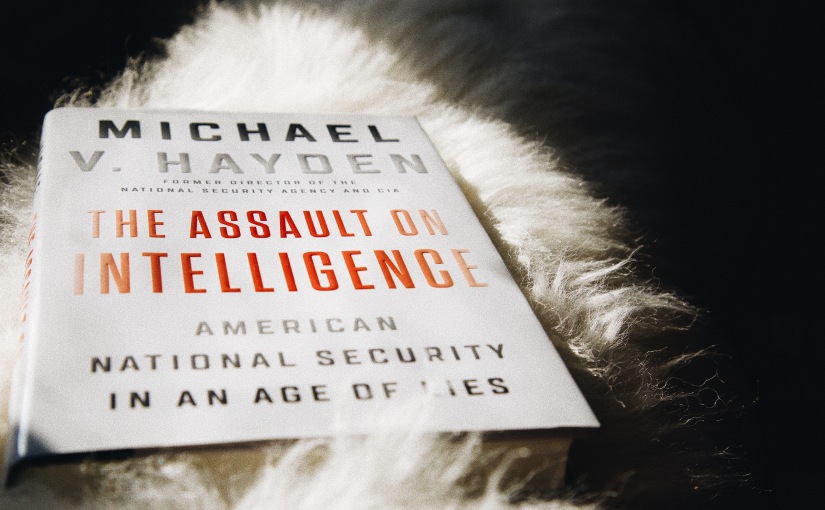
The Assault on Intelligence – Michael V. Hayden

30-8-18

Dear Partners in thought,

I wanted to tell you about the “The Assault on Intelligence” by Michael V. Hayden, former Director of the NSA (National Security Agency) and CIA under George W. Bush. Unlike former Obama’s Director of National Intelligence, Jim Clapper’s book (“Facts and Fears”), MH’s is not a memoir of service in which the author also complains about the dire straits of American leadership and its approach to the intelligence community (“IC”). MH is squarely focused on the latter and the matters of truth and facts, also as they apply to the intelligence tradecraft and political leadership in general. While MH was a Clinton and GW Bush appointee, he is a Republican and was part of the foreign policy team of Mitt Romney’s presidential campaign in 2012 in charge of counterterrorism. In his role at NSA, MH was at the forefront of the nascent cyber warfare and all the hacking campaign against American interests and their responses, notably, at the time, on the part of China.

The book is focused on the state of America and the IC, the 2016 presidential campaign, the transition period and the first hundred days of the Trump Administration (defined as “chaos on steroid”), the impact of DT as President on several core national security issues, the relationship between DT, truth and Russia while ending with some conclusions from an evolving story about truth, intelligence and America. To summarise the feelings of many of his intelligence colleagues, MH quotes Robert Kagan, a conservative like Trumpocracy’s David Frum clearly stating at a gathering set up for the Republican congressional caucus at the onset of the Trump era: “Look! What’s going on here is the melting down of the post-World War II, American liberal, Bretton Woods, World Bank, IMF world order. Get it?”.

MH’s starting point with his book is that he wants readers to look at facts and realise that while civil war or societal collapse was not imminent or inevitable, the structures, processes and attitude relied upon to prevent those were under stress and many of the premises on which are based U.S. governance, policy and security were now challenged, eroded or simply gone. He goes on explaining that the craft of intelligence, as practiced in the Western liberal tradition, which is where there is a link with our overall book notes theme, pursues the Enlightenment values. MH explains that intelligence gathers, evaluates and analyses information and then disseminates its conclusions for use, study or refutation, concluding that the erosion of Enlightenment values would devalue or even threaten the practice of good intelligence.

There was clear evidence for MH that there was convergence of a mutually reinforcing swirl of presidential tweets and statements, Russian-influenced social media, alt-right website and talk radio, Russian press like RT and even mainstream U.S. media like Fox News that helped the DT campaign and Russia’s desire to see DT in the White House. MH made a specific effort to understand how and why DT got elected in November 2016. Being a Pittsburgh native, he even went on to organise a meeting with some of his old friends from his neighbourhood, all DT’s supporters, who were finding DT as “an American”, “genuine” and “authentic, not filtering everything or parsing every word”. His old friends were simply not interested in facts, very much along the same lines as, much later, DT’s supporters, even some decent people with high religiously-based principles would give DT a pass on his colourful life as long as he was pushing forward an agenda they liked ranging from the move of the U.S. embassy in Israel to the reshaping of the Supreme Court. He had a chat with Salena Zito co-author of “The Great Revolt” and a Pittsburgh native who confirmed the rationale for DT being in the White House, even if an electoral fluke. In 2016, the U.S., home of free markets and the world’s largest, most integrated economy went populist, nativist and protectionist. MH going through Walter Russell Mead’s classification of American Presidents between Hamiltonians (Romney if he had won in 2012; an America strong thus prosperous); Jeffersonian (Obama II), Wilsonian (George W. Bush; let us free the world of its ills) and Jacksonian (America first; a long time ago) clearly states that DT is more Jacksonian than Andrew himself though at a time where that presidential style family was the least to work well. When the incoming Tea Party wave of new congressmen went to Congress in January 2011, MH was to brief them on international affairs, noticing that it was not their main area of focus and barely prompting him to ask them how many held a passport. MH felt that the U.S. was for a change to come that took place later due to the increasing duel between: internationalist-nativist, nuanced- blunt, informed-instinctive, no drama-all drama, studied-spontaneous, fully formed paragraphs-140 characters, America as an idea-America as blood and soil and free trader-protectionist.

MH quickly found that the campaign was about the truth or more clearly DT not telling it, or at least not bothering to find the truth in order to speak accurately while his campaign normalised lying to an unprecedented degree, routinely disparaging critics with a large number of invectives ranging from lying media, so-called judges, “intelligence” fake news, Washington insiders and the deep state. MH is going so far as mentioning the potential matter of metacognition in relation to the candidate not knowing what he was talking about and not knowing that he did not know. Borrowing from Tom Nichols who teaches national security at the Naval War College he stresses that “the U.S. is now a country obsessed with the worship of its own ignorance, Google fuelled, Wikipedia-based, blog-sodden…with an insistence that strongly held opinions are indistinguishable from facts”. From an intelligence and foreign affairs standpoint, MH and his like-minded internationalist civil servants had many reasons to worry about the rising nativism in DT’s campaign ranging from the alienation of a Southern friend, limitations of the bounty linked to the entrepreneurial vigour of new arrivals, easy confusion between Islam and terrorism, the distance from important allies and cooperative foreign sources and the redefinition of the essence and values of the American nation.

MH makes it clear that American intelligence professionals, through a process of self-selection and acculturation, like their diplomatic counterparts (before many resigned) trend overwhelmingly internationalist. This was seen as the natural order of things with the deep belief that American disengagement rarely made things better anywhere. MH is going through the rising concerns about the candidate during the campaign and the response from the foreign policy and intelligence establishment

with the famed Elliot Cohen letter signed by 122 prominent practitioners (incidentally which might also have helped DT as they were indeed seen as the “establishment” by DT’s supporters, enhancing their beliefs that their candidate was the target of a conspiracy). MH did not sign the Cohen letter as he was on a book tour and thought it might be seen as self-serving. He signed however the John Bellinger letter put out by the former senior legal adviser to Condoleezza Rice at the NSC and State Department which stressed that DT never made any effort to educate himself in, and was displaying an alarming ignorance of, basic facts of contemporary international politics. All the signatories were clearly putting themselves off any role in any future DT Administration should he win, which at the time, was a worry but far from a certainty.

MH visited the relationship that needs to be based on trust between the President and the IC, making some very valid points. The IC deals in “facts” that are stolen, elicited or otherwise acquired to inform executive decision-making. Intelligence is focused on the world as it is while the President and his team dream of the world as they want it to be – especially in the DT era. Intelligence is inductive, swimming in data and attempting to draw conclusions while policymakers are deductive, following first principles, the ones they were elected for, to fit specific situations. Intelligence trends pessimistic, with intel analysts as Bob Gates, once said, “stopping smelling the flowers and looking around the hearse” while policymakers need being optimistic as otherwise they would never have pursued the job. The President is the “first customer” with DT being a challenging one for any IC given that his main objective is to find rationale for the views he holds dear and tells his core electoral base. MH spends much time dealing with the IC trauma of telling DT what he does not want to hear in relation to Russian meddling in the 2016 U.S. electoral process, itself the cardinal sin for DT which would shape his views of the IC and would never changed his basic views of Russia and its leader. This DT posture continued as the aftermath of the Helsinki July meeting with Putin and later mentions of the “Russian hoax” would show (on that matter, MH’s account of the timely Wikileaks release of the DNC’s John Podesta emails, courtesy of “Russia” that provided the goods, thirty minutes after the Washington Post’s publication of a video of DT speaking in explicit terms about groping and kissing women, is very puzzling at the least).

MH has an interesting take on the Transition (the period between the early November election and the late January inauguration) with a focus on intelligence. He is stressing that the intel transition team was not heavily populated (as a result of all the intel segment signatories of letters denouncing DT’s profile) though was lead by Mike Rogers, a former House intel committee chairman selected by Chris Christie, who led the Transition Team before disappearing (he was with Rudy Giuliani, one of two senior Republicans having joined the campaign team but had also prosecuted Jared Kushner’s father for tax fraud, sending him to jail, some years earlier, making it an issue with the First Family). Mike Rogers gave hope to the old intelligence hands as he was seen as giving DT some directions in the field but did not stay beyond transition, leaving the radical wing represented by the Mike Flynn, Steve Bannon, Sebastian Gorka or young Ezra Cohen-Wattnick in lead positions dealing with intel matters. MH goes into some examples we remember about his ignorance of international affairs and his pride in not reading much about issues (“I never (read). I am always busy doing a lot” as he stated on the campaign trail in the summer of 2016). DT was wondering about the meaning of the word “triad” when asked about nuclear forces during a debate. He did not know the names of the leaders of Hezbollah, ISIS and al-Qaeda, not knowing their distinctions, confusing the Iranian Quds Force with the American-friendly Kurds. All these huge gaps created problems to the IC in terms of where to begin to well inform the “first client” all the more when he started by not wanting daily intelligence briefings (“How do you connect for him things that he does not connect himself and he is not aware that they are key?”). The other issue came quickly to be what mattered to DT in terms of facts, the key feature not being accuracy but that “many people agree with me when I say that” as DT told ABC News during the Transition, making it a nightmare to deal with someone who may not distinguish between truth and untruth and being primarily driven by reassuring his core electoral base that feels he can say no wrong, all the more under the assault of the political and media establishments. The relationship between the President and its IC was off to be one of the worst ever in American history, which prompted DT to go to Langley to meet with the CIA staffers one day after the inauguration, conducting according to MH, “the worst presidential visit to an intelligence agency in the history of the American Republic”.

As the DT Administration was now in charge and passing its first hundred days, MH saw a few key policy tenets as follows: i) Immigration will be treated more as a threat to American-well being than as a strategic advantage; ii) Alliances will be seen more as transactional than as strategic relationships; iii) Despite being the global champion of free trade for three quarters of a century, the U.S. will turn more protectionist; iv) The relationship with China will be reset and v) The fight against terrorism will fundamentally be about more combat power. As the new administration goes into motion, MH provides us with testimonies from recently retired intel veterans “happy to have taken the king’s shilling for doing the King’s work”, some happy about the gradually stated more aggressive posture of the new administration but also worrying about what the intel agencies might be asked to do going forward, even if many chaffed about the overlaying, indecision and restrictions imposed in a post-GW bush world during the Obama years. MH felt after 100 days that the IC had helped Team DT realise that “China was not a currency manipulator, NATO was not obsolete and maybe Vladimir Putin sometimes did bad things”, also because the NSC team put together at that point had been receptive and helpful in a post-Mike Flynn era. H.R. McMaster, who replaced Mike Flynn after his reluctant firing (that would lead to serious legal problems for him) was seen as a very positive change by the “professionals” given his status as a thinking military leader built through his PhD thesis-originated book “Dereliction of Duty” on the military leadership failings during the Vietnam war. However H.R. M did not have the gravitas of previous NSC advisers like Kissinger, Brzezinski, Powell or Scowcroft which, dealing with a mercurial leader, would ultimately take its toll as would be seen later.

Besides H.R. M, another good news for the professionals was Jim Mattis at the DoD whose main nickname was not “Mad Dog” but “the warrior monk” closer to General George C. Marshall than to an aggressive George S. Patton combat commander and someone who appreciated intelligence and would work well with the IC via his own DIA. Rex Tillerson at State would be more challenging as while he appeared a positive addition, he ended up alienating both the White House (with his f… moron comment and his questioning, unusually for a cabinet member, of DT’s IQ) and his own department as he wanted to reshape it, prompting a record, mass exodus of needed, long-serving, diplomats. Of note, even those like well known like Eliott Abrams, ex-NSC head of the Middle East under GWB, was crossed out by DT to be Tillerson’s choice for deputy at State as, while he never signed any of the “never Trump” letter, he had published a milder “When you can’t stand your candidate” in the Weekly Standard. John Kelly, (another marine general, stressing the rise of the military – as safe pairs of hands) who was applauded as a great choice to lead Homeland Security, was seen as great news for White House Chief of Staff. MH found that Mike Pompeo as the designate to lead CIA was a sound choice also as he was to be seconded by highly respected CIA veteran Gina Haspel who was to succeed him to lead the agency when Pompeo went to State in 2018. Lastly Indiana Senator Coats, former Ambassador to Germany, was seen as an excellent choice as Director of National Intelligence, overseeing 17 agencies. When thinking of it, the people around Trump were not to his image and could be counted to restrain him while providing him with sound views. MH goes through the Syria, ISIS and Iran approaches developed by DT and the Administration, the latter subject leading to the breaching by the US of the “Iran nuclear agreement” (or JCPOA) followed by the reinstatement of sanctions in August 2018. On North Korea, MH tends to agree with DT that he inherited a mess (reminding us he is no a fan of the Obama era, notably of the US policy towards Syria and the lack of action following the red line crossing after the alleged use of gas on its own population by the Syrian regime).

MH deals with the subject of Russia and its alleged meddling in a focused manner throughout a chapter entitled “Trump, Russia and the truth”. He narrates how the “meddling” in the electoral process started with the Wired magazine in the summer of 2017 that reported a European study finding that the main Russian objective was not to change minds, but “to destroy and undermine confidence in Western media”. MH stresses the convergence and similar degree of ferocity between DT and Russia in their attacks of American institutions while staying away from arguing the facts (DT in a tweet stressed that “there is no truth, so you should just follow your gut and your tribe”), all with an echo chamber between Russian news and American strong and far right-wing outlets. MH deplores that Russia was able to influence the outcome of an election that was ultimately decided by the Americans but unsurprised as the expertise and craft of Russia given his own experience dealing with this matter over the last twenty years, notably in the cyber space and at the NSA. MH goes though how social media played a major role in shaping voter perceptions and helping DT as a candidate, with developments we are seeing only recently and having further consequences even on the stock of Facebook, shaving USD 120 bn in one trading day in July 2018, due to the aftermath of the privacy issues we now are more familiar with.

MH looks at the divided land that he sees as America today, feeling that Russia would be mad not to continue to play as it faces no real costs with Americans making it easier and the government being frozen in its response. He quotes Lenin and his “What is to be done?” which is of course identifying the problem which can be summed up as two intertwined issues: i) the declining relevance of truth as traditionally understood, derived from the evidence-based patterns developed during the Enlightenment; and ii) Russia both exploiting and exacerbating that phenomenon. The latter clearly depends on the former and could not exist nor succeed without the former. Fixing the first point makes the second go away, something that MH sees in Russia having been less successful in manipulating less fractured societies such as Norway, France or Germany. While technology has been a medium of destabilisation of American society, MH feels that the remedy is not to be found in technology, the excesses of which need to be controlled (as we see happening with Big Tech) but the long term cure dealing more with principles and basic political health. He also sees the private sector and notably Silicon Valley (for tech) and Hollywood (for image creation) as being useful partners in the fight with leading figureheads in both joining it (on cybersecurity, it is worth noting MH credits the current administration with good marks, which is encouraging given the new axis of warfare). While focusing on these areas, MH sees the IC as doing not an unimportant role in addressing the declining relevance of truth. He believes that intelligence professionals will keep to their professional duty to collect and analyse intel but is more concerned about the issue of the presentation of that intel and not only on the Russia question. He sees it as crucial that the IC keeps being able to push back against preferred policy narratives, which would not be uncommon with Team Trump when it matters and when they slip the bonds of objective reality, this being a question of simple honesty. All that being said, MH is now recommending younger colleagues not to join Team Trump and not to put themselves at risk for the future when they could still contribute to shaping policy meaningfully under different conditions and leadership. He also reminds us that while the “sound and the fury” are at play, Bob Mueller keeps working at his DoJ investigation and will one day report, this with potentially devastating consequences for DT and his close team (on the time Mueller is taking that DT is irate about, it should be noted that his investigation seriously pales in terms of the time spent in comparison with those of Benghazi or Watergate and that such investigations are in no way linked to any electoral calendars such as that of the November 2018 mid-terms).

MH’s book is a fascinating account focused on International affairs and America from the standpoint of the intelligence professionals and without falling easily into irate criticism of DT and his administration on every point. In writing about the future, MH focuses on the future of truth which he sees as the fundamental item to look for and after with the current American administration. He rightfully stresses, with many of his colleagues, on the strong desire from many foreign countries to find again the America they are now missing. He hopes for a time when the media will not be under attack from an American President undermining the American constitution. He wants a President, paraphrasing Lincoln, who appeals to “the better angels of our nature”. MH quotes Timothy Snyder’s “On Tyranny” (also a former book note): “To abandon facts is is to abandon freedom. If nothing is true, then no one can criticise power as there is no basis to do so. Post-truth is pre-fascim”. MH concludes his book with a sentence formed when visiting Langley to celebrate the retirement of a CIA veteran (and where he met a young and enthusiastic, trained cryptologic linguist who then joined the agency to put his skills to good use but would not have entered the U.S. had the administration ban being in place): “We are accustomed to relying on their truth telling to protect us from foreign enemies. now we may need their truth telling to save us from ourselves”.

I dedicate this book note to my friend, Rufus the IV, and his father Rufus the III, Virginians with a long family line since Plymouth Rock, the latter having been “present at the creation” to borrow from Dean Rusk, from the Yale cradle that was so key in those early years of the Cold War (as depicted in “The Company” by spy novelist Robert Littell).

Warmest regards

Serge


Serge Desprat- 30th August, 2018 (Prague)

Unhinged – Omarosa Manigault Newman

29-8-18

Dear Partners in thought,

I know that going from Madeleine Albright to Omarosa Manigault may be a steep shift (I did not say decline) though her book “Unhinged” is very interesting (how British of me) at many levels. It could be a memoir of a colourful TV reality star turned political activist but it is not. It is a rehabilitation attempt book cum preemptive Trumpian shield from a loyalist who either grew genuinely disappointed and/or sought revenge for her ultimate Trumpland treatment, which makes it valuable to read if one focuses on why she says what she says and how she does it. It is actually quite an enjoyable read and I dare say, against all expectations, actually well crafted and rather fluid. To be sure, O’s book is not about policies (beyond those related to the African-American community she focused on) but more about DT’s (or DJT’s as she would write) style and behaviour which are defining features of his presidency and clearly as a way to get back at him for having been disappointed and/or dismissed. O’s book is in the high critical tradition started with journalist Michael Wolff and followed by insiders like Jim Comey and now Sean Spicer. As she stayed in the Trump WH before being pushed out, it is hard to know whether she really objected with so many of DT’s wrong features as described in her book or she was mad at being dismissed, hence the tell all book.

While O tells us about her very poor background in the “projects” – something that is also meant to offset the image of the nasty TV reality star we know (well, those who watch this type of entertainment) – she focuses on various key periods which are her early and long – 12+ year – Trump history mainly with “The Apprentice”, the 2016 campaign and the White House up until her forced exit by Chief of Staff John Kelly assisted by the WH legal team on rather dubious grounds (if we believe O – as she would have transgressed WH car transportation rules). She clearly wants to portray herself as a good person, who just seized the American dream to propel herself out of poverty to the riches and of course with a clear focus on improving the plight of all African-Americans on the way. And she now decided to tell the world how her former mentor was a terrible person.

Interestingly we learn that O was very involved in White House matters way, way earlier having worked there in the last year of Bill Clinton (describing her role as “mid-level staff” which is to the say the least “remarkable” at age 25 then!) and then joining Al Gore’s presidential campaign in 2000. O is actually a registered Democrat (interestingly at the time so was DT). Apparently, many accounts say she was not very good at any of the roles she had for Bill and Al, something she does not mention in the book (having said this, these accounts may be DT-driven too so one should be cautious in our age of easy news). The fun part on the political angle of things is that O worked hard to being part of the Hillary campaign in 2015 but was forgotten for another lady out of doing a favour for a congressman close to HC, making O ultimately rooting for her old boss and against the “swampy” manoeuvring she felt victim of. She tells us that she also joined his campaign team all the more easily as she felt DT was a lost cause with no hope of winning, which looks a bit too rearview mirror easy even if the odds were long at the time.

In 2003, she found in DT a father she lost too early and while making a great TV career with national reach, joined a cult where loyalty was the key driver, making her a very faithful cheerleader and, as time went by, a partner of DT, never questioning his shortcomings. She saw many objectionable traits of DT, notably in relation to women over the years that she never, admittedly, challenged as he was just “like that” (his relationship with Ivanka made her very unsettled, with DT’s wandering hands and claims he would date her should she not be his daughter, though apparently O tells us the first daughter was playing on that trait to manage or control her father). It is clear that O fills her book with the bad aspects of DT that she otherwise clearly found very manageable over fifteen years, creating a terrible image of the President. Faithful no more…

She was the only African-American on the presidential campaign team that was led by white men (and Kellyanne Conway at some point) and in charge of the African- American outreach. Her goal was for DT to do better than Mitt Romney in 2012 who had attracted 6% of the African-American vote (in the end, DT got 8% while HC got far less than Obama had achieved). She wanted to run the Office of Public Liaison (OPL) part of the Executive Office but Reince Priebus who had run the Republican National Committee (wanting DT “out” after the Hollywood tapes, something that would stick) and now, as Chief of Staff (we almost forgot) in charge of “roles” in the early DT White House did not think she made the cut so gave her a communications role at the OPL (focused on African-Americans), which she finally accepted (she really wanted in). O describes her daily schedule of meetings in the Reince galaxy at the WH including all the tenors from the times including Ivanka, Jared, Bannon, Kellyanne Conway (a future nemesis she always likes to beat hard on) and the A team. She sees DT two to three scheduled times a day and in fact many more times due to his Trump Organisation’s legacy of the open door policy and “his need to fight loneliness and to see familiar faces”.

That section on the WH is part O’s memoir, part attacks on DT (which would never had been aired before her dismissal). We learn that DT does not read and he is “just side of the functionally literate”. O stresses unequivocally that DT “has never read from beginning to end any piece of legislation, policies even some executive orders that he has signed” or that advisers “spoon feed” him five to ten bullet points notes about legislations, forgoing any discussion of their complexities. There is little doubt that even if true these statements are there to hurt or to show what could come next, like with the famous tapes including the N word and many other things (as an aside and regardless of DT, that O would tape these meetings and conversations is also educational about her true personality for whom the loyalty she talks so much about may have been purely tactical). DT would “struggle with complex documents or complex briefings” and the senior WH team knowing he is the messenger, not the writer of the message would rely on his charisma and make excuses for his faults in true cult fashion. O gradually seemed to have felt that she was not considered core as she was asked to take the blame supposedly for mistakes of others like Kellyanne Conway, “the chameleon”, who becomes one of the chief villains in O’s book (a status not hard to achieve when seeing her in action, but a common feature of many in the Trump WH if one is to believe O). She goes at length about DT’s lack of impulse control and the team’s problems to control and tally his tweets, which have become the stuff of legend and start losing their impact even if they help change the level of the acceptable political discourse and hence general civility (based on a number of live experiences, I believe DT’s poor communication style has had an impact on how many Americans feel they can behave and communicate in society). We learn that one of the erratic aspects of DT would be when he would correct one of his most terrible earlier tweets as his team would work on managing its fallout though without telling the team. We also learn that not one – “not a single one” – top person in the WH agreed with DT’s firing of FBI Director Comey on loyalty grounds. She insists upon DT’s mental decline which she says she was able to notice as having known him for years and noticing his many lapses in the WH (also lambasting the WH doctor Ronny Jackson “who would go on to declare an obviously obese, sleep-deprived man in excellent health”). She also dwells on the Don Corleone loyalty expected by DT from all his staff while he treats them as he wishes. She tells us about DT’s dismissive, critical and mocking behaviour toward some of the staff, especially with Sean Spicer, the first Trump WH press secretary and communications director nicknamed “the spokesman from Men’s Warehouse. Cheap and tacky”. There are some expected savoury tidbits as when Anthony “The Mooch” Scaramucci having just been fired after only a few days in the job goes into a cubicle and starts crying “like a girl” (again if we believe O).

It is clear that her race and the fact she was the only senior black woman in the Trump WH was a key issue for O, making us know that she felt like being the “token black” in Trumpland (even if there was Ben Carson as HUD Secretary). Certainly the “token black lady”. It would appear that she genuinely worked hard to ensure better race relations and improve the conditions of black students, particularly at black colleges (she received a Master’s degree from Howard in DC, a beacon of “black college” education which she is deservedly very proud of). That latter mission where she tried working with Education Secretary Betsy DeVos (Blackwater’s Erik Prince’s sister en passant) and her for-profit education mission seems to have rattled O. In addition the dramatic events in Charlottesville in the summer of 2017 are reported by O with a personal angle and clearly shook her to the core as an African-American and the official in charge of OPL communications in relation to African-American matters – one feels that this event may have dampened her loyalty to DT given his response to the tragedy (as an aside and more generally O seems to have been conflicted between her image of the “strong black woman” – her words – which served her well in reality TV and also drove her to the WH and her perceived continuous offenses in private on the part of most senior white male staffers dealing with a senior African-American woman though knowing that she could not defend herself adequately lest she passed for an “angry black woman”).

It is really difficult to know whether O is a genuine person, so much she is a TV reality one and whether she really believes in the causes she advances in her book. She was, given her background, the odd duck in the WH team but then there have been many others, who if they had a more formal, elitist education and background, would not be considered top tier among civil servants or politicians, as if the word “expert” was definitely out, allowing for other “managers” to come in and work as if beliefs were facts. Her account of her time with DT, during the campaign and at the WH is definitely interesting if only from a sociology point but smells of revenge and unwittingly depicts a shark tank, well beyond the usual norms of politics. That a faithful TV reality star and partner got a role at the WH says everything about the nature of the Trump WH. That she, unwittingly or not, took what looks like her revenge the way she did, adding to what most observers would know and have read from others “leavers”, does not add much to our understanding of the current workings of the WH but reinforces the feeling we have for this WH. That she accepted to work for DT while being so offended by so many aspects of his presidential style and stayed does not show great spine but is what one would expect – she really enjoyed working at the WH and would have probably stayed much longer if not pushed out. If anything the book is an extension of TV reality and O is indeed very good at it. When all is said and done, the prevailing feeling is that it is indeed a book about revenge and as DT would say, accurately for once, also about betrayal if we accept that Trump made O as she writes herself.

If I may say, I am not dedicating this book to anyone out of fear of offending but it does not mean it should not be read. I was hesitant to add to O’s royalties but decided that it is always educational to do such an exercise and trying to understand what goes in their minds. As Ed Luce wrote in the FT recently, 90% of Republican voters (not the independents) still support DT in spite of “all” we know about him. This is the true enigma. Why do good people – and most Republicans certainly are – still support DT after all we have read from a variety of people, his lack of dignity for the role, style, behaviour, tweets, not to mention erratic, ill-thought policies and lately the McCain flag controversy that says it all? This is the baffling point which the current state of the economy, unemployment level and stock market cannot explain given the harm done at so many levels and the future at stake.

Warmest regards,

Serge


Serge Desprat- 29th August, 2018 (Prague)


Prague in Winter & On Fascism – Madeleine Albright

21-8-18

Dear Partners in thought,

I wanted to tell you about two books from Madeleine Albright, the former Secretary of State under Bill Clinton and a personality whom we know well and is always very engaged in the defence of Western liberal values. She is 81 years old now and still very active, having written a recent book on “Fascism” that depicts her fights for democracy worldwide as part of her long mandate (in another time for U.S. diplomacy and leadership) and “Prague Winter” about her childhood in Prague and also London as a Czechoslovak child born in 1937 (in Smichov, my very neighbourhood), something that some people (not us of course) do not realise or have forgotten but is a key aspect of whom she became and she is.

“Prague in Winter – A Personal History of Remembrance and War – 1937-1948”, published in 2012 narrates her life in Prague (based on family accounts that she researched in the nineties and later) and in London during the war before returning to Prague in 1945 and then finally going to America in 1948. She was not just a Czechoslovak child like any other. She was born Marie Jana Korbelova, the daughter of Josef Korbel, who was a senior Czechoslovak diplomat, working as the right end man to Jan Masaryk, himself the son of Tomas Garrigue Masaryk, the founder and first President of Czechoslovakia in 1918. Jan went on to become Ambassador to London during the Munich Agreement, (I recommend you the great 2017 movie “Masaryk” with top Czech actor Karel Roden in the lead role), then part of the London-based government in exile during the war and Minister of Foreign Affairs in 1945, only to fall from his window at the ministry in the Bohemian defenestration tradition after the Czech Communists won the parliamentary elections in 1946, setting the stage for a long and dark journey. Josef Korbel, his main aide, who had gone to be Ambassador to Yugoslavia after the war, then emigrated to America and taught International relations while settling his family in Denver. The University of Denver’s school of foreign policy is now named after him. One of the strange aspects of MA’s story is that she had not realised by the age of 59, when she became Secretary of State, what her true roots were and that she was actually Jewish (having been raised a Catholic and having converted to Episcopalianism for her marriage to Mr. Albright in 1958). MA only discovered this rafter defining fact while traveling to the country of her birth in her role of top American diplomat, which led to the writing of her book. “Prague in Winter” that became a personal journey into her Jewish roots as well as into totalitarianism in her country of birth and gradually all of Central & Eastern Europe. One part that is especially gripping is the period of 1945 to 1948 when all was still possible for the future of Czechoslovakia which then went into the post-war Communist and then Stalinist camps, following the local Communist party win and gradual takeover of the young, reborn, democracy following the Nazi occupation. There are great accounts of this period and I also recommend little-known Boston University’s Igor Luke’s “On the Edge of the Cold War – American diplomats and spies in postwar Prague”. The American legation in Prague was always a place with interesting game changers such as George Kennan, who became famous for his “Long Telegram” from Moscow in 1946 and was actually stationed in Prague in 1937. The period before the fall in 1948 was indeed one of intense activity by American diplomats in Prague to try to keep Czechoslovakia from falling for the then highly popular Czech Communist Party basking in the key role of the Soviets in defeating the Nazis. Of note in today’s debate about immigration, MA became a U.S. citizen only in 1957. One criticism, echoed by the late Philippe Kerr, back in 2012 was that MA did not have in her book a word of thanks for Britain, which while arguably tainted (like France) by the 1938 Munich agreements, ensured that MA and her close family were rescued and did not end up in Theresienstadt or Auchwitz like some other family members. The book is a first hand account of a period not well known by most unless one lives in Prague, though with memories vanishing or not wanting to be triggered locally. It is a must read for lovers of history, particularly about the onset of the Cold War. I also recommend you the excellent “Iron Curtain – The crush of Eastern Europe 1946-58” (2012) by Anne Applebaum, the well-know commentator of that period and also spouse of Radek Sikorski, the former Polish Foreign Minister in the Donald Tusk government from 2007 to 2014, also in a different time for Poland.

“On Fascism – A Warning”, which was well reviewed in the FT earlier this year, is about MA’s experiences dealing with totalitarianism while being Secretary of State and afterwards. This is also based on exchanges with her students as she went on to teach international relations at Georgetown University after her role in the Clinton Administration. The book deals with the main question that is: “Can it happen here?” and is of course linked to the rise of populism and the attacks against Western liberal values and our democratic system. She focuses on Europe and America looking at the needed ingredients allowing the rise of fascism which she sees as economic, social and political chaos as in the case of interwar Germany and Italy with their high unemployment and left and right wing gang battles in the street (developments when incivility takes root in the political discourse) that lead to despair for the citizenry of these countries. MA looks at parallels with Hugo Chavez’s rise to power in Venezuela, Viktor Orban’s economic backdrop in Hungary, Recep Tayyip Erdogan’s gradual suffocation of democracy in Turkey or Vladimir Putin in Russia which, even if he was desired to restore order and dignity, also benefitted from a country having lost half of its economy in the 1990s. She thus sees problems being opportunities for fascists and other anti-democrats. She also mentions the connivence of the conservatives who always think they can control fascism and can use its popular support to achieve their own goals. She hopes that Democrats and Republicans will work together, worrying that Trump’s isolationism, protectionism and fondness for dictators are weakening America’s ability to solve international challenges (which may no longer be a goal), while deepening divisions among allies and strengthening anti-democratic forces. In the end, MA remains hopeful, looking at Abraham Lincoln and Nelson Mandela as guides who did save their countries when they were going through immense and irreconcilable challenges in their own times. She feels strongly that we need to recognise history lessons and should never take history for granted. As she says: “The temptation is powerful to close our eyes and wait for the worst to pass, but history tells us that for freedom to survive, it must be defended and if lies are to stop, they must be exposed”. It is clear that MA also writes thinking much of Trump and the direction taken by America on a number of key topics. She would also advises, like me if I my say, that those who like Trump because of a low unemployment rate and good economic growth, all of which are temporary and the result of many factors, not to think that style and values no longer matter in the way freedom, democracy and indeed the indispensable country should be conducted.

I dedicate this note to Bert, born Hubertus in the low countries, Yale Law School graduate and a great globalist who has done so much for impact investing in emerging markets from his great firm and with his amazing team in DC, the latter which I also salute chapeau bas.

Warmest regards,

Serge


Serge Desprat- 21st August, 2018 (Washington, DC)


Cyber Wars – Charles Arthur

12-8-18

Dear Partners in thought,

I wanted to tell you about something I will work on when and if in Strasbourg (the European Parliament).

Cyber warfare and cyberthreats are omnipresent in our lives and a key issue for government, military and business communities not to say society today. These asymmetrical warfare and threats allow for “enemies,” whoever they may be, to inflict losses and disrupt far larger organisations than they are and for a very cheap cost. Cybersecurity is now an essential component of protection of not only our financial and strategic assets but also of our very Western liberal way of life like in the context of our democratic electoral process.

As you know, I have been a founding investor in the UK’s Cyber Essential Direct (CEDL), a start up, chaired by Lord Blunkett, formerly Home Secretary to Tony Blair and set up to assist the SME sector in the UK, but also internationally to cope preemptively with cyber risk. As such and while I can barely turn on my laptop as the 19th century man I always will be, I have become quite enthralled by cybersecurity tales over the last two years, helping me understand the geopolitics of the field and feeling a bit more part of my era (on this latter point, one does not need to be a tech expert, to study the dynamics of cybersecurity very much like those liking the matter of submarine warfare do not need to know how to pilot a sub).

With this in mind, I would like to recommend a short book “Cyber Wars” by Charles Arthur, a freelance journalist and former Tech Editor at The Guardian, the UK newspaper where he covered related topics such as Wikileaks and Anonymous amongst others. His book does not require any tech knowledge or cybersecurity expertise and is a great introduction to the field focusing on the major cyberattacks and the hacks we all have heard of over the last few years. This well-crafted book is mostly focused on the business targets of cyber attacks though these may emanate from governments or directed or abated by them. There is also a useful summary page after each case study, also comprising helpful tips for the reader’s own usage in case she may find herself dealing with similar situations in her daily life.

The main cyberattacks covered are as follows:

  • Sony Pictures

How North Korea exerted punishment on Sony Pictures in 2014 for a satiric movie, “The Interview” involving Kim Jong-un

  • Anonymous attacks/HB Gary

How Anonymous, the activist network, hacked into HBGary, and destroyed a leading cybersecurity company for revenge

  • John Podesta and the 2016 Democratic presidential campaign

How a presidential campaign was derailed by Russian “patriotic” agents (for some) and likely “led” by Russia (for others)

  • TJX

How adopting new technologies, a natural development, led to serious customer problems for TJ Maxx, a major retailer

  • Ransomware

How malware can take over computers and threaten harm unless a ransom is paid

  • TalkTalk

How teenagers infiltrated the systems of a major internet provider to then call its clients to fix problems from its supposed call centres

  • Mirai

How the “Internet of Things” is not really safe, making our daily lives at risk

CA goes into the future of cyberwar offering very interesting viewpoints on a matter which is in constant evolution.

I would like to make a few comments, seemingly pell-mell, aimed at touching upon some key features of cyber threats and cybersecurity. It is fair to say that while we often hear about the attacks against Western institutions, be they public or private, the West also can be found on the offense and taking preemptive strikes against governments and entities, particularly in relation to China, North Korea, Russia and Iran to name a few. China was definitely the main culprit of cyber attacks in the past and this before all the publicity given to non-governmental “Russian patriots” being involved in interfering in elections in the West as often claimed and always publicly disavowed in the cases of the U.S. and French presidential elections of 2016 and 2017. Cybersecurity is now a major segment of offense and defence for governments, big and small, given the dynamics of the matter. Large corporations have taken the threat very seriously (notably banks whose payment integrity is essential but also energy companies and those involved in running the power grids that is one of the weakest link of our vital infrastructure) and are now ensuring that their supply chains, involving many thousands of SMEs, are appropriately protected, diminishing the risks of “own goals” by following the likes of Cyber Essentials guidelines promoted by HM Government in the UK and, increasingly, Commonwealth. One interesting feature of cyber warfare is that when the enemy has been penetrated, that victory is often not heralded as one waits and takes advantage of that enemy not knowing it has been compromised, an approach often taken by the West while parties attacking the West are more focused on disruption, ransom or theft and dont’t care whether they are caught as long as they reach their primary objective (some that can be hard to pin down precisely in terms of impact, like with elections, as opposed to when banking account or credit card numbers are accessed and stolen for profit). Cybersecurity is a complex area which requires attentive analysis, which the book, while; giving an easy-to-read tutorial, helps achieving.

We can’t be safe and the only way to be would be not to use email and unhook our computers, which is the conundrum of our times. Cybersecurity can help readiness, reduce losses whatever their nature, but is a constant fight where the defence struggles catching up with the offense, the latter which benefits from cheap asymmetry.

If any of you or the companies you work for or with wanted to know more, I would be happy to put it touch with John Lyons, the founder of CEDL, who would expertly and efficiently guide you on matters cybersecurity (without going into heavy marketing, I would recommend for example to all my PE friends that they should make sure their investee companies are preemptive about cyber attacks as they could end up feeling the pinch).

I actually dedicate this book note to John and Steve, partners not only in thought but also in the active defence of our values.

Warmest regards,

Serge


Serge Desprat- 12th August, 2018 (Prague)


Why Liberalism Failed – Patrick J. Deneen

9-8-18

Dear Partners in thought,

I wanted to share briefly with you a book close to a topic I often write about, “liberalism” but this time taken from the other side (which I have not called “dark” as the beauty of Western liberal values is that there is nothing like a good and respectful debate regardless of the strength of opposing beliefs). There is thus a book called “Why Liberalism Failed” which is a good capture of its theme written by Patrick J. Deneen, a professor of political science at Notre Dame, the famed Indiana university, not only glorious for its football team but also the alma mater of President Joshua Bartlett in “The West Wing” (whom by the way would never have followed PD in his stance). PD is a Rutgers graduate, having being an Associate Professor at Princeton and a frequent contributor to The American Conservative blog. The American edition has a nice cover with the image of an antique Greek pillar showing its age and probably, let’s wager, uselessness in PD’s mind, though this is good communication and fair game. This is not a light book and it is much focused on concepts inherent to liberalism and its opposites, even if PD gives us many live examples, mainly from the American landscape, to make his case.

It is interesting to note that PD was published as part of the politics and culture series at Yale University Press (YUP), that is not the kind of place where one would think he would be but then it is not surprising they would adopt a fair-minded approach. YUP believes that self-government, what is the West including of course the U.S., is increasingly ailing globally and has entered a crisis of legitimacy, with no agreement on the best treatment. It has failed a growing number of people, not delivering its historical promises, with various key symptoms being noticed such as unequal wealth distribution, institutional decay, loss of trust in authority at all levels and among citizens, polarisation among those wanting open and closed societies with new political tribes and a redefinition of political landscapes arising. This premise led to PD’s book that puts the blame of the legitimacy crisis on liberalism itself, something that runs contrary to those of us who believe that we should keep promoting liberal values that made us “who we are” in order to relaunch our democratic system. His approach is scholarly and much focused on the philosophical foundations of liberalism and the developments that according to him make them failed. PD argues that liberalism needs retirement and cannot be reformed as its original sin, centred on the Kantian elevation of individual autonomy, was inherently wrong, something that the passing of time has shown. PD’s radical and disruptive critique of liberalism comes after Marx and Foucault on the “left” and Nietzsche or the Catholic Church on the “right”, among others. It is obviously coming at a turning point in the West with the rise of populism and major developments such as the election of Donald Trump or Brexit.

PD believes that the demise of liberalism started ten years before Trump or Brexit, creating a ripe environment for these developments. He felt that the “inherited civilised order” derived by family and community values and crafted through religious and cultural norms, would gradually vanish through the influence of the liberal social and political state in spite of a rising opposition of the people, who are no longer benefitting from a liberal system, in turn potentially leading to authoritarian illiberalism. PD adds that the people want increasingly a strong leader to take back control over cultural norms, political habits over a bureaucratised government and a globalised economy that have now grown remote from them. He stresses the energy spent on mass protests rather than self-legislation and deliberation faulting liberalism to have created its own nightmare and not being able to correct its course. He quotes my once neighbour, Vaclav Havel, who stated that the remedy can only be found first in the polis – lives shared with a common purpose and not the system first (“A better system will not automatically create a better life. Only the opposite is true: only by creating a better life can a better system be developed” as stated in The Power of the Powerless).

PD takes a 500 year historical journey into liberalism starting with the Enlightenment, making it clear that all really started 250 years ago with the American liberal experiment that is now coming to an end. He explains the historical bases of liberalism represented by a limited government devoted to securing individual rights within a free-market economic system. Political legitimacy is based on a social contract ratified by fair and free elections. Key words are limited but efficient government, rule of law, independent judiciary, responsive public officials and again fair and free elections. However he stresses that 70% of Americans (his book is focused on the U.S. and its “experiment”) believe that their country is going in the wrong direction with 50% of them believing that the past is best. Public trust in institutions has markedly declined. Future generations for the first time will be less prosperous than the previous ones. Cynicism is running amok. Elections are seen as evidence of a rigged system. The political system is broken. The social fabrique is fraying with the widening gap between the “wealthy haves” and the “left out have nots”, this being enhanced by geographic divides (the two coasts and the heartland in the U.S. and London vs. the Rest in England). The hostile divide between the faithful and the secular people (religion seems key to PD in terms of providing societal norms). The promises of liberalism have been shattered as the liberal state expands to control many aspects of life while citizens feel powerless in front of a rootless globalisation. Rights can only be secured by wealth and status, the liberal system favouring a new meritocracy based on generational succession.

For PD liberalism has failed not because it fell short but because it was in fact true to itself, achieving not its stated objectives but what was always in store, producing ruins as being its very successes. In other words, instead of promoting greater equity, multiplicity of cultures and beliefs, human dignity and expanding liberty, PD feels that liberalism fostered inequality, uniformity and homogeneity, material and (again) spiritual degradation while undermining freedom. PD believes that America is at the end of the natural cycle of corruption and decay that limits the lifespans of all human creations, including its biggest one which is liberalism (in other words, all things come to an end). Liberalism is one of three “isms” (with Fascism and Communism) that took center stage and the only one left standing after 1989, while the one with the claim to legitimacy is in fact insidious as it does not sell itself as an ideology but as an invitation more than a coercion to enjoy freedom, pleasure and wealth.

The failures of liberalism are exemplified in four distinct yet connected areas which are i) politics and government; ii) economics; iii) education; and science and technology. Looking at these four sectors, PD makes the main points as follows:

  • Politics: Citizens revolt against their own governments which they elected, the “establishment” and the political class, feeling too much distance from them. Government is deemed to be an entity separate from the will of the people and constraining the very rights of conscience, religion and association. Government is too big and Orwellian in nature for PD with unsurpassed capacities for surveillance and control of movement, finances, deeds and thoughts, while the people, being actually lost, ironically and perversely demand more intervention from the government.


  • Economics: Civic unhappiness is mirrored in economic discontent as citizens are reduced to being “consumers”. They can buy everything and increasingly so but consumerism does not erase economic angst and unhappiness of over-anxiety. All the while PD recognises that there will likely always be inequality in society, especially at the geographic level and this, increasingly, globally (with a gap between metropolitan elites and rural populists, very much as described by Gideon Rachman in the 1st August issue of the FT). Similarly PD believes globalisation will not stop and is an inevitable process as “the wages of freedom are bondage to economic inevitability”. 


  • Education: The rising generation feels forced to adopt an economic and political model they fear, making them cynics about their future and being part of an order they despise. They play the game, but without joy or love, as they have no choice, feeling (en)trapped. They have to become “meritocrats out of a survivalist instinct”. Advanced liberalism and elite universities are eliminating liberal education and    reducing students, citizens in the making, as followers of a system “sifting the        economically viable from those who will be mocked for their backward views on trade, immigration, nationhood and religious beliefs”. Universities focus on practical learning outcomes with the only goal to make students immediately employable.


  • Science and technology: Students are encouraged today to study a STEM discipline (science, tech, engineering and maths) as the greatest tools of liberation from various forms of bondage and effectively to “control or master nature” finding its roots in Francis Bacon arguing that “knowledge is power”. PD believes we hold the  incoherent view that science can liberate us from some human limits. He feels that we are too used to follow science on issues like climate change, ignoring that “the crisis is the result of longstanding triumphs of science and technology”. PD believes that tech and its multiple tools make us prisoners instead of liberating us, foregoing  long simple reading and meditation that we can no longer afford due to tech addiction. Connecting tech de facto makes us alone together.

PD goes in more details in these four areas in six chapters which are: Unsustainable liberalism; Uniting liberalism and statism; Liberalism and anti-culture; Technology and the loss of liberty; The new aristocracy; and The degradation of citizenship.

These chapters are very rich in arguments about PD’s demise of liberalism and are indeed worth reading.

PD of course offers in his last chapter a raft of recipes to correct all the ills created by liberalism which I will let you read and fit his very conservative nature and tendency to go for “small is beautiful”.

Not so fast, Pat…

Clearly we are not on the same page, even if I feel PD is not wrong (for me) on all issues (like some of Trump’s policies could be agreed with, if never his style). While the point here is not to make a counter argument to PD’s, I would like to throw in some less sophisticated though fact-based realities to his well argued but somewhat dry academic postulate.

PD’s approach strikes as being very scholarly with the likely objective of giving credibility to his arguments, even if at times conveying a sense of artificiality to his reasoning, as if wanting to provide his captive audience, who badly needs a rational basis for their destructive stances, with some academic veneer of respectability. While well argued scholastically, PD’s book seems detached from reality today while claiming to be so close to the “real people” and what they feel, as if our world not upholding all the tenets of ancient Greece or all of the fundamentals of the Founding Fathers were proof enough that we were doomed and that liberalism should be sent to the dustbin of history. This feel-good populist tutorial as to why we are so wrong about the world we live in – a.k.a. liberalism – feels a bit easy even if well argued on the surface, though with too many self-evident truths lacking in depth evidence. “All things come to an end” is easy and again simple as a message. Who could argue? PD’s book is an answer to a rising scream of the left outs and discontents for change and a demand for alternatives, not knowing how to evaluate what they could be (he tries hard for them) and wanting simple answers to complex questions they at times don’t fully see nor grasp, so much the existential anger is a driver.

Liberalism to put it simply has been behind the massive historical rise in GDP we know especially in the West, the empowering of many, the lifting off poverty of millions if not billions, the best answer to tyranny, indeed the right of vote for all in many countries (sadly not all) but also the American civil rights achievements, and peace in Europe for 75 years…The list of achievements is too long here and you get the drift. It is very easy to forget these. We are all getting richer as a group and GDPs keep growing. That there are disparities (with the famed one percent getting richer) and some feel left out and forgotten by growth is undeniable. However, that liberalism can and will be perfected (like say the European Union to my British friends) is clear. While having been a bulwark against tyranny that is so easily forgotten, liberalism can be perfected as it is based on humanity that is imperfect (think of me) but can always redeem itself. Liberalism has always been a work in progress that is adaptable to ever-changing times as we, the citizens, shape through it, our destinies.

Elections should actually not be seen by liberalism’s haters as rigged given DT’s and the Brexit wins (a FT reader and Brexiter shared recently his belief that democratic decisions should be upheld, thus backing a very liberal concept even if one can argue in that case that democracy can also allow voters to change their minds two years and thousands of facts later). Democracy keeps producing unhappy voters as they are rarely happy as a state of being, with a gap between promises and reality even if the system works well incrementally (Macron, while bringing much needed improvements to the French Republic, is at a 32% satisfaction rate one year later). Big government which is the main target of PD is there to stay as it is hard to believe that national, not to mention regional issues or the Moon conquest could be dealt with by small Phalansterian communities, which if charming in nature, would have little clout to effect real and durable change on major issues.

PD’s views on education, while interesting, are a bit simplistic. Liberal education, which rightly needs to be fought for, is far from dead and still allows students to know “how to think” leading them to a vast choice of avenues in further education or the job market. PD should read Fareed Zakaria’s “In defence of a liberal education” as while they share the same view as to its importance, Fareed also focuses on why there is the world “liberal” in liberal education. The decline in liberal education may have been a temporary matter and clearly has been noticed with steps being taken even if there are great market needs for STEM graduates. I can only think of the many young college graduates with a History major I know and whom I struggle to debate with so much their thinking have been crafted by the best, and by the way many of them are also going into and much desired by strategy consulting (the “investment banking” of today for grads) in what would be an upside down way for PD. Meritocracy, another enemy, is also about hard work, not sheer money or roots – or “generational succession” and even today, regardless of financial considerations, allowing more or less all to succeed particularly in well-endowed elite U.S. universities if they work for it. And yes, one’s background matters. And yes, parents want their kids to succeed and if they come from good universities, they will be more likely than not to wish their offsprings to follow their paths (which does not mean that so-called “legacy” is great and it should not be left out, which in practical terms it is by and large the case judging from many irate parents I know). And let’s be clear, as Churchill could have said, selection is the fairest of all the unfair tools at our disposal. There are less slots in elite institutions than they are talented candidates and admission committees often follow their “reason that reason can ignore”, making it like a black box as to why Julie is in and not Max. And even looking more broadly at the whole spectrum of higher education, not everybody is gifted for it so trade schools should be re-emphasised, also as there is a great need for special tradecraft and many people would reach a satisfied professional existence if following that path. Finally not everybody in the world can make it to and at university as there are circumstances that fate gives us that one cannot overcome – but again the nice idea in some quarters that university should be for all actually means it would be for no one (lowering standards, like what may have happened with the French “Bac” at the end of high school some years ago made for happiness with a piece of paper but frustration later as both universities and the job market naturally reacted, showing for the former a staggering percentage of first year students not being able to go further and being lost on an unclear path). We live in an imperfect world though one where liberalism has allowed a large number of students to learn how to think as well as, if they chose to, to learn a practical trade and contribute to a growing society. At the end of the day, education, even in a competitive liberal world, is the single most important passport that parents, if they can, should focus on early on for their children, this at every level and regardless of socio-economic conditions, so they are best prepared for what is life.

PD’s views on science and education can resonate in part. Tech can indeed bring a sense of efficiency while it does destroy many things that makes our lives, some of which many of us would argue should likely not be sacrificed on the altar of progress and evolution. Amazon comes to mind. While it is hard to negate science and the advancements it has given the world at large, it is true that some aspects of the tech revolution can be of concern in terms of lesser interaction and thinking, focusing on the medium and not the substance. One does not need to hate liberalism to agree with the “Alone Together” as Sherry Turkle, the Harvard-trained and MIT professor did a few years back. However it is hard to follow PD on science and climate change as if something called fact-based rationality was in the way. If we cannot use science to assess climate change, would the tea leaves do?

I was not sure Yale should play that “fair” in pushing forward such an articulate yet quite dangerous piece of thinking that unwittingly or not lends credibility to populism, something it is dead set against value-wise. However once again, the approach of liberalism in its opening the debate to its would be destroyers is its inherent strength and guarantor of success, if citizens can understand fully the stakes of the game.

To be fair, PD does not attack everything linked to the Western liberal world and liberalism as we know it. One can agree with him on many of the ills but not on his views that liberalism needs to go to the graveyard. Liberalism can be constantly improved, which many if not all of the other applied philosophies and programmes of easy answers to complex problematics, however attractive and soothing, cannot provide.

I wish you an enjoyable and focused read (as it can be arduous at times), believing that the opponents to liberalism should be heard (and they certainly are today) and their philosophy known also so it can be fought equally fiercely with facts and not just scholarly tenets.

I dedicate this book note to Michael and my dear friends who felt that “whom should govern us” was the key issue, with their heads saying “yes” and hearts “out” on that key June question, hoping that all goes as well as it can (for all) next year and beyond, though hoping even more that the sovereign people can indeed revisit the matter given the “facts” they now should know better.

Warmest regards,

Serge


Serge Desprat- 9th August, 2018 (La Bernerie en Retz)

The Gabriel Allon series/The Other Woman – Daniel Silva

1-8-18

Dear Partners in thought,

As we are in mid-summer, I wanted to go back to novels but still keeping the international affairs feel to these book notes, I decided to go the spy novel route. One of the best spy novelists today in my book (pun intended) is American author Daniel Silva who since 1996 has nearly written a book a year, the last 18 focusing on Gabriel Allon, the now legendary Israeli “Office” agent (read Mossad). DS publishes his book every year in mid-July and just released “The Other Woman”, which is the 18th book of the Allon series. To me DS is the new, though less with an axe to grind, great John Le Carré to whom he resembles greatly in his ability to project the world of intelligence, mixing strategy, tactics, atmosphere, tradecraft, services interactions and indeed sheer action, the latter which is always a by-product of the story and not its main focus (in other words, the Allon series is for the thinking man and woman, who “also like” some action along the way but are more into the “hunt”). His latest novel “The Other Woman” particularly shows DS’s strong reliance on intelligence history with a focus on one of the most famous 20th century British spies (I will say no more but his mix of fiction and history is especially unique and credible, this in his dealing with all the major intelligence players globally).

DS went squarely away from the traditional CIA, MI6 or fictional intelligence service hero. Instead he chose to depict the adventures of Gabriel Allon, a veteran agent of the Israeli external intelligence service and also a top art restorer, giving us a very original blend of hero. Allon is working with a tightly knit team comprising well-depicted characters all of whom have grown with us over the last 20 years (I confess I started reading DS back in 1996, even corresponding with him on details of his pieces, giving him then some needed guidance on France). Not surprisingly he was a journalist with UPI and then joined CNN, with stints in the Middle East, which explains the wealth of his story crafting, attention to details and historical accuracy that is topped up by a great writing style making reading the Allon novels a real pleasure for the eye and the mind. Selecting the Mossad (well, The Office in the books), entrusted to protect the interests of the state of Israel, was not easy so much the intel service is unsurpassed and the country always “different”, to treat with care, especially today given its current premiership and some of the policies of Israel, which may not make it the most popular country in all quarters globally. However DS, never taking a strong side on policy matters has kept stressing the reasons why Israel always benefited, especially early on and in the West, from much support and admiration, partly driven by guilt, partly by respect for its many achievements, often alone against many. DS is a Catholic by birth, converted to Judaism (as he married Jamie Gangel, then a well known CNN reporter), who went deeply into Jewish matters as shown with his board membership of the Holocaust organisation in New York City.

Gabriel Allon, his main character, is a “Sabra” whose first language is German and was raised a secular Jew in the valley of Jezreel. His mother, Irene, is an Holocaust survivor from Berlin while his Munich-born father (not much mentioned) would die in the Six-Day War in 1966. He is a fluent speaker in many languages (helpful in his trade). His grandfather was a well known Expressionist painter from Berlin passing his talents to Irene before being killed at Auschwitz in 1943 while his mother kept the tradition and bestowed Gabriel with very special skills that will make him an art restorer. He comes out of art school in 1972 to be part of one of the Munich massacre revenge hit teams, hired by Ari Shamron, a putative father, to go after Black September terrorists. He will then live as Mario Delvecchio in Cornwall as an art restorer, leaving his Office past behind. His life however is changed when his family is victim in turn of a revenge terrorist car bombing in Vienna in 1991. He will then come back to work at the behest of Shamron and Western intelligence leaders in need of his particular skillset and experience, until he becomes head of The Office in 2016, having been one of its most senior members and souls. Of note in Judaism, the archangel “Gabriel” is the guardian angel of the State of Israel and is often “sent” by God, also at times to deliver His wrath, which is befitting Allon’s profession and origin.

Allon, although a fictional character (though is he?) operates in a world where leaders are who they are in real life even if never named by DS (In the latest opus, we know the American President is a departure from the standard White House leadership while the Israeli Premier is dealing with personal financial matters risking derailing the longest tenure of a PM since David Ben-Gurion). Allon and his team project teamwork and professionalism, facing many foes ranging from Middle Eastern and Iranian terrorists, to bad Russian oligarchs, to elements in the Russian SVR (my profuse apologies to all my Russian friends part of the network though I am sure there must be good Russian spy novels where the Westerners act as baddies), to neo-nazi organisations, shady Swiss bankers and rogue Vatican outfits, while working closely with the CIA, much with MI5 and 6 and even the French DGSE, very much part of the Western team. There is an element of continuity as the characters grow with the books over the years. Allon, whose three main residences, depending on the story, are Venezia, London and today Jerusalem, is also an art restorer with art as a key theme being often the initial focus of the stories, at times quite deeply ensconced into the international intrigue, with the looting of art pieces during WWII being often visited.

I know many of you, like me, have been fond of the recently departed Philip Kerr’s Bernie Gunther novels. I think Silva has the same authorship quality even if his hero is more of a hero than Bernie could ever be (indeed a anti-hero if there was ever one, though possibly explained by his German nationality and background role in Nazi Germany even if not a Nazi himself) and does not ask himself existential questions as you would expect from an efficient Mossad leader. However the art dimension gives Gabriel some humanity which may equate that of Bernie’s conscience in hell on earth.

DS’s books, published about once a year since July 1996, are as follows:

The early books

The unlikely Spy (1996) – Early 1944 before D-Day. A female German intelligence sleeper agent will try to know where the landings are planned. A game of cat and mouse is on with the fate of the war at stake. This novel made DS but he was still searching for his “genre”.

The Mark of the Assassin (1998) – Michael Osbourne, CIA, investigates a plane bombing off Long Island and risks everything to uncover the truth. DS tries to find a way and has the will for it.

The Marching Season (1999) – Michael Osbourne, retired from CIA, comes back to work on rescuing his U.S. Senator father in law in line to be the next Ambassador to the Court of Saint-James’s. This will end the literary career of Osbourne with DS focusing next on something he “feels” more about.

The Gabriel Allon (“GA”) series

The Kill Artist (2000) – Gabriel Allon, Israeli art restorer living in England, comes back from his retirement from intelligence, to assist his former boss, the legendary head of The Office, Ari Sharon, to hunt for the killer of the Israeli ambassador in Paris, who is also GA’s nemesis. GA who was part of one of the Munich 1972 teams that went after the killers of Israeli athletes and paid a terrible price years later for his involvement is going to settle some accounts once and for all.

The English Assassin (2002) – GA now works part-time with The Office though is framed for a murder he did not commit in Switzerland, getting involved in the matter of looted paintings during WWII and dealing with a secretive elite group of Swiss bankers and businessmen determined to protect the reputation of Switzerland at all costs, leading to fierce developments.

The Confessor (2003) – GA investigates the murder of Jewish scholar Benjamin Stern in Munich and, doing so, gets involved with The Vatican and his new Pope who wants to candidly shed light on the role of the Church during the Holocaust, prompting some strong feedback from the conservative wing of the Vatican that will defend the reputation of the Church at all costs.

Death in Vienna (2004) – An Israeli-run Holocaust research office in Vienna is destroyed. GA gets involved in the dark world of Nazi war criminals and neo-nazi organisations that protect them, finding some very personal reasons to go after the culprits. The Vatican gets involved again, together with Langley, confirming some post-war odd friendships of circumstances, and a hunt leading to Argentina ensues, while GA needs to deal with a professional killer sent to stop him.

Prince of Fire (2005) – The Rome Israeli embassy is bombed, leading GA to take a fuller role at The Office, working with a team that will be seen in later books. The team finds out that a descendant of Palestinian warlords, now a carefully reconstructed renowned French archeologist, may be the leader of the Rome bombing and other terrorist attacks.

The Messenger (2006) – GA uncovers a plan to kill the Pope, which drives him to investigate likely terrorist suspects among Vatican staff and infiltrating the network of a terrorist financier, leading to the man behind many terrorist activities and the plan against the Pope. It turns out that the main target also involves another major world leader.

The Secret Servant (2007) – GA goes to Amsterdam for a routine mission of purging the archives of a murdered Dutch terrorism analyst who was also an asset of Israeli Intelligence and discovers a conspiracy festering in the city’s Islamic underground targeting the American diplomatic community.

Moscow Rules (2008) – GA is approached by the editor of Moskovsky Gazeta about imminent threats to the West and Israel where a well known Russian arms dealer may be involved and senior members of the FSB play on all sides.

The Defector (2009) – GA continues his Russian adventures, trying to rescue a kidnapped Russian defector who sets him on a lethal course with the Russian arms dealer of Moscow Rules.

The Rembrandt Affair (2010) – GA and his team seek to recover a lost Rembrandt painting whose previous owners have included both Holocaust victims and terrorists. The book is focused on art theft and its links with terrorism and related activities.

Portrait of a Spy (2011) – A pair of bombings in Paris and Amsterdam have erupted while GA is unable to stop a third attack at Covent Garden. GA will face the new face of terror in an American-born cleric of Yemeni descent, once a paid CIA asset. GA will need to work with the art collector daughter of an arch-enemy who can traverse the murky divide between radical Islam and the West.

The Fallen Angel (2012) – The book is mostly set in Italy with GA helping Monsignor Luigi Donati, the Pope’s private secretary with a murder case that is troubling the Vatican given its location beneath Michelangelo’s dome in St. Peter’s Basilica. The story taking its roots in the art world leads to a smuggling art network with links to terrorists planning a major attack with apocalyptic consequences.

The English Girl (2013) – The mistress of the British PM is kidnapped in Corsica, prompting Sir Graham Seymour, Head of MI6 to request the assistance of GA in what is a delicate matter. GA starts working with a colourful Corsican crime boss and Christopher Keller, a new recurring character, former SAS officer believed dead in Iraq. All is not what it seems.

The Heist (2014) – Once again, this book is focused on the recovery of stolen art. GA is in Venice restoring a Veronese and will rescue an old friend, St. James’s art dealer, Julian Isherwood, unwittingly in the grips of Italian justice for being at a grisly murder scene. The dead man is a former British spy doubling as an art trafficker having dealt with one Caravaggio too many. Another hunt where shady Vienna bankers, Marseilles and Corsica criminals abound.

The English Spy (2015) – An iconic member of the British Royal Family is killed when a bomb explodes on her yacht. British intelligence asks GA to investigate, leading to targeting Eamon Quinn, a master bomber and mercenary. Christopher Keller, joins anew the ride in what they will find out they face old enemies.

The Black Widow (2016) – GA is now expected to become the chief of Israel’s secret intelligence service though on the eve of his promotion a massive ISIS bomb detonates in Le Marais district in Paris, killing an old relationship of GA. Enters Saladin.

House of Spies (2017) – GA is still on the hunt for Saladin, shadowy ISIS mastermind, four months after the deadliest attack on American soil since 9-11. He will soon go to Southern France where terrorists share the company of art dealers and models in Saint-Tropez.

The Other Woman (2018) – GA is about to organise the defection of an SVR agent in Vienna when he is killed with a set up to make the world believe The Office and GA did the deed, making him and New Russia engaging in an epic, final struggle, where a KGB mole of old, still in place, stands at the doorstep of the ultimate power.

You will discover alongside Gabriel Allon a cast comprising regular “friendly” characters who indeed grow with the books. Some of the key ones are Ari Shamron (legendary, on and off, now retired head of The Office, Polish-born from Lviv); Julian Isherwood (né Izakowitz, St. James’s art dealer and GA’s often partner and main link to that other world); Eli Lavon (Head of the Watchers at the Office and professor of biblical archeology); Chiara Zolli (now Allon, retired Venice-based Office agent); Uzi Navot (Ex-head of Paris station and Western Europe, then DG of The Office prior to GA in 2016); Christopher Keller (ex- SAS officer presumed dead, resurrected and now part of MI6); Mikhail Abramov (Moscow- born special forces officer at Sayeret Matkal and one of GA’s enforcers); Yaakov Rossman (Office head of special forces); Rimona Stern (Shamron’s niece, ex-IDF Intelligence Major and Iran nuclear specialist); Dina Said (Head of research, the encyclopaedic memory of The Office); Graham Seymour (cautious Oxbridge educated head of MI6, having had an extensive intelligence career in the defence of the realm); Adrian Carter (longtime deputy director of operations now head of clandestine services, CIA – Langley through and through); Paul Rousseau (Pipe-smoking head of the counter-terrorism section of Alpha Team, French DGSI); Don Orsatti (crime lord, from some remote location with high walls in Corsica); Sarah Bancroft (Engaging CIA case officer, in an on and off relationship with Abramov). One point which is amusing is that GA has never been a young guy, being around since 2001 so the maths are a bit on the tough side here though he seems to be permanently in his late 50s which, being 58 myself, I find eminently acceptable and reassuring. When one reaches that noble age, one obviously stops getting older.

Just so you know, if I may be facetious and as I am sure you were wondering, like DS I am a born and raised Catholic, quite secular these days even if applying many of the faith’s principles (except the other cheek). However, we never know our roots too well, and quoting my better half’s very witty grandfather, himself from the Jewish faith having married Catholic Sophie in a second wedding for both: “Well I don’t know whether Serge is Jewish or not but I only have one question…Ashkenazi or Sephardic?” As it turns out, I discovered only a few years back that my maternal grandfather was such as a result of a post-war re-marriage and that my real grandfather was a a sculptor who died at a young age in 1943 (ok that is quite short and there would be no female bloodline, but…). Maybe I am GA’s forgotten brother after all? 😉

I dedicate this note to Ron, a thinking leader among leaders and one of the most private and caring men I have been fortunate to know. I also dedicate this note to Alain, the “real thing”, a patriot who inspired me so much as a young man. Stay well, cousin.

I wish you all a great read and wonderful escape in the dark world of contemporary espionage with an unusually differentiated flavour.

Warmest regards, or should I say Shalom!

Serge


Serge Desprat- 1st August, 2018 (Prague)


What is wrong with Trump – The definitive list

31-7-18

Dear Partners in thought,

Having been born and raised in Paris in the land of Descartes, I like to think things always came naturally with some degree of clarity and logics to me (I hear some laughs), even if I was likely delusional and some of my countrymen arguably could not spell the philosophers’ name at various points of our history. As such, I thought it would be good to draw up a clear and Cartesian list of what most “men and women of good will” would object with DT as President of what is still and not fully yet was the leader of the free world. Strangely enough, while we are subjected daily to a deluge of DT news, usually worrying, I found very little by way of a summary that would show a full picture of why DT does not work for America and the world. Here is an attempt at a list that would have the merits of simplicity and clarity.

There are obviously two main “issue” areas to look for: personal and professional but as the two are rather intertwined in that type of role you will forgive me for doing just one list that will include both.

In order to be fair, I think it is good to state DT’s positive features (or perceived as such), that are very key to his core electoral base:

  • He is very clear, using simple, common, language and as such his voters and supporters understand him, probably better than they would the usual politicians. Even if what DT mainly wants is to be heard so he can please rather than to convey anything that is meaningful for America or the world, this preferably to ensure that his voters will keep backing him. He has the means without the ends.
  • He does what he says he will, this being the most crucial test of being a great politician for his base and which he passes with flying colours. The contents and outcomes of policies come second and those are not very well understood in any case. However a man who does what he says he would is a true leader for many and is a political rarity which is invaluable to most.
  •  He showed he won against all odds, this being a pet theme of the “left outs” be they in the Rust Belt or passed for promotion time and time again on Wall Street or in Big Tech. “Losers”, some very good but unlucky people, some squarely undeserving of success, unite behind Trump as he gives them free and easy hope. DT is proof that when “one wants, one can”, all the more slaughtering on the way the obviously rigged system. And if he has done it once, he will do it again, also showing the world his mettle.
  • He is actually lucky. The U.S. economy is showing strong developments, especially on the job fronts and DT can boast that he is responsible even if those developments are global and the result, for a good part, of pre-Trump policy decisions. Luck indeed favours the audacious and he has plenty of that blended with some good NY chutzpah.
  • He has a great hairdo. OK I wanted to make sure you were reading.

To be fair I am now at a loss to find other key redeeming features, hoping I do not fall into any partisan mindset (a hard one for sure considering the subject at hand…)

Looking at the negatives, the list sadly is a bit longer and heavier in substance: 

  • No role model.Stormy Daniels, the Playmate of the Month, the bus tape – just for illustration – all speak for themselves in terms of image as an individual. Respectable father and husband is arguably a bridge too far. Father of the nation he cannot be. He promotes no admirable values to the younger generations. He is a destroyer of Western and any values. He is the chief reducer of America’s standing in the world. He is transforming America into a continental island with limits aplenty. Nobody wants to be Trump. He is a killer of the American Dream. And fewer and fewer want to become American or even study there as leading graduate school enrolment shows since the 2016 election.
  • Leadership no more.
  • The opposite of a leader, he attacks allies and cajole enemies, destroying the system set up by America for America and the Western world as we know it. Who needs enemies when you have friends like DT? While international trade ensured countries did not make war, tearing it down and ultimately hurting Americans, has become great (in a short term MAGA kind of way, though wear the cap) as many of his voters like those war cries as if it were a soccer game where their team was “back” at long last. Instant gratification matters, forget about the rising tax cut-driven budget deficit that is too far down the road and we won’t pay for.
  • Putin forever. Time and time again, DT has professed admiration for the Russian leader, going out of his way to promote Russia, lastly at the G7 in Canada in forgetting Crimea, eastern Ukraine and the recent developments involving the resurgent Western foe. He is, unwittingly or not, the “useful idiot” (expression of another time, Soviet that one) aggressively helping Putin’s Russia to the surprise of his baffled but otherwise compliant party leadership too many of whom sold their soul for reelection. While one may understand why keeping a line with Russia has merits, DT’s over-the-top Russian drive is giving strange credence to the Manchurian candidate scenario and the existence of some file crafty people at Dzerzjinsky Square may have on him post-Moscow Universe pageant 2013. And it is hard to blame Russia not to enjoy the benefits of a friend in high Western places.
  • Poor language on steroids. As Timothy Snyder would agree, he is naturally aggressive very fast, using a style of language that demeans the political discourse and makes it gradually more acceptable societally. The latest post-G7 Tweets are clear examples. He casually abhors facts and actually makes them up, preferably using Twitter that allows for outbursts but not structured thought. What matters is not the message but his base as if the end was to feed them a daily dose of reassuring Trumpism in the appropriate and direct tongue and style, that does away with café society ways and shows that he is still manning the parapet for all of them at all time.
  • Incompetence as badge of honour.He does not know much about anything, which stresses he is no “expert” – very bad word in populist land and times – stressing his experience in real estate as his magic tool box as in “The Art of the Deal”. He does not listen much to advisers who by and large are (those who remain) not first rate (Yes, Larry Kudlow, his Chief Economist Adviser, whom we wish a prompt recovery, does not have any economics degree nor any graduate one and please do read his partner, hell raiser Peter Navarro, if you can and enjoy fiction). It would be fun to actually review DT’s grades and cursus at Wharton (also junior/senior college years and not an MBA by the way), if there were any traces left of his stay there, but then that check would be too elitist while emphasising the benefits of education and why it matters.
  • Erraticism as tested tactics He says one thing and changes his mind, to come later to his previous stance. It is a way of negotiating. He also displays uncertainty so the other side does not know where they stand, foes and friends alike. Being an ally has little value as it depends on which matter while being a rival, even a foe, gives better status and strangely consideration (maybe with the exception of Iran, the only true Evil Empire in DT’s world, which by the way is hard to reconcile with his Russian propensities but I am probably and unfairly thinking too much here).
  • Institutions matter sometimes.DT shows his little understanding of the institutional process and tolerate it only when it serves its purposes, flying hot and cold, depending on the week with the Mueller investigation, now promoting its lack of relevance and validity mainly for his core base, then ensuring that sacking he will not, but forgiving himself he could do technically, not caring about the impact on America and the world.
  • Actual results don’t matter. A really good result is when a document is signed with Kim whatever the contents and whether it is clear or not as long as it shows they talked and agreed on broad and noble goals. This Singapore outcome exemplifies what matters to DT: action more than substance, especially when well-timed after a less than positive G7, which was almost crafted that way for the likely benefit of Kim and ensuring he would not be another Justin Kim. Even if Kim gets a great deal with exposure and recognition (NK is no longer crazy) and concessions (no war games) for actually…what? The list of pet projects with no results that come up and down with the news is actually not small. Think the Wall or NAFTA. When we see results they usually are negative for all parties like the trade wars and the establishment of tariffs.
  • Unhinged and counter-productive ego. His outsized ego gives DT his drive – and some like that – while landing him into an appreciation of domestic and international developments in which he takes part mostly tainted by his role in having shaping them. The oddity for a President, who presumably would have little to prove, is that he has no problem stressing that he shapes events, something again more important than their substance or outcome. To be topical, think the Nobel Peace Prize he shouted he should get well ahead of any Kim meeting or listening to DT post Singapore Summit that Kim told him that he was the only President who could have made their summit a success. Again (his) form over substance is what matters.

It’s so good to review those points and, let’s admit it, frankly therapeutic. The list, though it claims to be definitive, may not be complete even if a good attempt at capturing the full picture. I have also tried to be fair and am aware that I can only come across as hard on DT. There must be a reason would surely say…Descartes.

Warmest regards, 

Serge

Serge Desprat- 31st July, 2018 (Prague)


Bobby Kennedy – Chris Matthews

22-7-18

Dear Partners in thought,

I would like to tell you about another book while giving you some personal context as to why this one.

When I was a teenager growing up in Paris in the 1970s, I had a natural attraction for that country far away that I only knew through the movies and made me dream: America. Nothing represented this vague but powerful American dream as the Kennedys, that Boston political dynasty of whom we knew only the beautiful aspects in an age of other media. I like to think that my first memory as a child, even if dreadful, was that of JFK’s assassination in Dallas when I was three years old in the middle of a dinner with my parents and friends, though perhaps I crafted that memory to fit my later bond. When I was 20, my first trip to America was to Harvard so I could improve my deplorable English language skills, a place I am sure I primarily selected for its link to JFK and RFK. The brothers had a knack to enthuse with their one liner like “Don’t ask what your country can do for you, ask what you can do for your country” or “I dream things that never were …and say why not” reflecting nobility and leadership by example befitting that American aristocracy and limits constantly pushed further embodying what America should be for me.

In the 50th anniversary of the Los Angeles assassination of RFK, which marked many, cross-generation, as America at the time was going deeper into Vietnam and through a soft civil war of its own, I would like to recommend you to read “Bobby Kennedy – A Raging Sprit” from Chris Matthews, the well-known MSNBC “Hardball” presenter and Kennedy biographer. CM wrote this book to “commemorate” at this juncture but also, unsurprisingly, “in the hope that our country can find its way back to the patriotic unity he (RFK) championed”. The fact that I was also in Boston and Cambridge, MA in July is of course not foreign to my wanting to remember and discover.

One of the nice features of the book, that reads very well, is CM reminiscing about his parents and himself about the era, watching the various Kennedy developments that he narrates in his book. His Catholic Irish American roots were also another element of closeness with the Kennedy saga at the time and help us understand the historical stint of “discrimination”, still floating at election time, and the impact of Al Smith’s 1928 defeat in the Irish American psyche. He was also part of the “Movement” generation in the late sixties, expecting to go to Vietnam after his draft deferment, though ending up in Africa for the earlier JFK-created Peace Corps, then working as an aide in Washington, eventually for Tip O’Neil, the veteran Democratic legislator from Boston, before joining the media world where we have known him over the years. While most of us will know about RFK as Attorney General in JFK’s team, the book unusually sheds light on his early years, his role in the McCarthy “red” hunt and the years after Dallas, – making appear as less of a liberal than we remember – while providing insights on the particular Kennedy family dynamics.

Going back to CM’s appellation, “Bobby” was fourth generation Irish-American from Boston, the fifth child and third son of his large family led by patriarch Joe Sr (Joseph P. Kennedy) who had married Rose, the daughter of a former Boston Mayor, John “Fitz Honey” Fitzpatrick. Joe Sr had gone to Harvard, class of 1912, establishing the family as a prominent one (he was in his own words, the youngest President of an American bank at age 25) though still not included in the Boston elite world run by the WASP establishment of the Cabots, Lodges and Lowells, due to his Irish “off the boat” heritage. This Irish origin would have a big impact on Bobby, who felt it the most in his family generation, feeling vividly the meaning of discrimination (in the late 19th century, shops would have job offers in Boston with “Irish need not apply”) and would lead the family to migrate down to Bronxville in the vicinity of Manhattan for 12 years to more fully benefit from their status in society. Bobby went to many schools, unlike his brothers Joe Jr and Jack (JFK) who stuck with Choate, the Wallingford, CT-based elite boarding school. He suffered most from a lack of love and support from his father who much preferred Joe Sr as the future family leader, being the eldest son, and Jack also as the two were seen as tougher individuals than Bobby, who would look for approval from him all his life. Unlike his father, Bobby was also interested in helping the “forgotten” (we’d say the left-outs today), be they from the black minority (as seen later in the civil rights fight), white miners from the Appalachians or farmers from Kansas. He saw it as the duty from the members of his privileged class to help the less privileged ones and not squander their wealth on futile matters. While his father and then Jack were the two most important family figures for him, Bobby could not manage to be close to the latter much due to the eight year age gap and the fact that Jack and Joe Sr were away at boarding school nine months of the year, prompting his mother Rose to make up for the neglect displayed by his father. Bobby found in his Catholic faith, the strongest in his family, the moral rectitude that guided him all his life and also defined some of his key, highly principled, political fights, like that against Communism as the Cold War took hold (that also explained his role with Joe McCarthy and his famed subcommittee) in later years.

When young, Bobby, like the whole family, followed the steps of his father’s career, the latter that was now heavily influenced by politics. Joe Sr who backed Republican Hoover in the 1928 elections against his roots and historical party affiliations, went back to the Dems backing FDR as the safest choice to “preserve my own interests” in 1932 during the financial crisis of the times. As a close ally of FDR and while he did not get his rewards quickly, he was nonetheless appointed as the first Chairman of the new SEC in 1934 (the thinking being that as one of those responsible for the crash, he would be able to know how to prevent the next one), then Chairman of the U.S. Maritime Commission in 1937 and in the late thirties, while aiming for Secretary of the Treasury which FDR rejected, he finally obtained, after much pressuring of the President, the Ambassadorship in London, taking the whole family with him across the pond. This post defined Joe Sr in inglorious terms and ended any hope he would have of a subsequent senior political career, having a very adverse impact on the whole family and deeply wounding young Bobby. As the war was looming, Joe Sr became a lead Appeaser (more Chamberlain than Chamberlain) in relation to the Nazi territorial demands at a time when America was officially neutral. He was recalled by FDR after two years, becoming then de facto a voice for America First, close to famed (Transatlantic!) flyer Charles Lindbergh, and against any U.S. intervention in the war, the latter that became unavoidable after the December 1941 surprise Japanese attack on the Pearl Harbor U.S. Navy base and Pacific Fleet. Both Joe Jr and Jack went to war as officers, Joe as a bomber pilot, Jack first in Army intelligence in DC, then in the U.S. Navy in the Pacific theater where his team rescuing exploits with PT 109 became legend and eventually paved the way for what was not thought yet as a political career. Joe Jr was the one destined for politics, with Joe Sr preparing the grounds, though the former was consumed with family redemption and flew mission well beyond his quota, turning down leaves, to meet death over France during a very perilous mission targeted at a Normandy V2 missile base. Jack then became the anointed Kennedy to lead the family to an even greater future. Bobby, who had started college at Harvard, wanted to fight but was too young and was sent to Officer Training in DC on the recommendation of Jack who thought him too young and unprepared to join the fight, something that Joe Sr engineered, also to keep him away, against any of his son’s expected urges, from the battlefield. WWII ended in Europe and then in Asia before Bobby could fight which marked him deeply, feeling like a failure, making him getting released from officer school following a direct approach to Secretary of Defense James Forrestal, joining in early 1946. Being his usual bold, Bobby enlisted as a regular seaman (I wonder about Dad’s reaction back in Hyannis Port), joining the new U.S. Navy destroyer named after his lost eldest sibling: USS Joseph Kennedy Sr. While serving he wrote his best friend about his Southern shipmates that ” possessed a lot of something a lot of guys at Harvard lacked” (writing to his parents in a more diplomatic that he was “certainly meeting people who had a different outlook and interests in life”), reminding some of us who did our military service of similar, useful feelings. Back at Harvard, Bobby went straight to his junior (third) year and seemed to focus on football, an unlikely activity for someone of his frame where he mixed with “real guys” who were at Harvard primarily due to their football prowess (including Ken O’Donnell, another hard-nosed Irish American who would end up going on to work with JFK at the White House, leading the Irish pack while Ted Sorensen led the “Intellectuals”) and were from the wrong side of the tracks but all veterans. This experience, which was an integration process for him and a way to get the fatherly respect he craved (he would never surrendered on the field, always getting back up), cemented his interest in American society as a whole, well beyond his socially-secluded Beacon Hill and Hyannis Port, leading to his future profile as a politician.

Upon graduation, Bobby went on to graduate school, not at Harvard, as he rejected the family tradition (even if none had gone to graduate school), but at UVA (University of Virginia) Law School in Charlottesville. Upon graduation and while marrying old relationship Ethel (having first dated her sister long ago), he went on to join the Department of Justice, an association that would stick, to work on a major fraud case. In the meantime, his brother Jack, who had won a Boston seat (where Harvard is also located, but full of working class voters) in Congress on the back of good looks, charm, family money and a great war record was in Washington with many freshmen veterans, like Californian Republican Richard Nixon (with whom he shared a seat on the Housing, Education & Labor Committee and already engaged in a debate in the Spring of ’47 on the Soviet Union like in a prelude of the 1960 presidential race). While he was suffering from then a severe case of Addison’s disease (he was given the last rites three times before the White House), Jack was fulfilling his father’s family master plan, which he naturally liked very much, with all siblings being unwittingly shadowed by his successes. In 1952, Jack decided to run for the Massachusetts Senate seat held by an older war veteran who had relinquished briefly his seat to fight: Henry Cabot Lodge, a Boston Brahmin who was running for reelection (interestingly both their grandfathers had fought for the same Massachusetts Senate seat in 1916 with the WASP winning). As the campaign was faltering, in part as its manager could not handle Joe Sr and his desire to be “involved”, Ken O’Donnell, previously introduced to Jack by Bobby, planted the seeds of the idea that the latter should help the former in managing the campaign. At that time, Jack did not really follow what Bobby was doing and vice versa, while Bobby was keen on crusading against fraudsters. In the end, family ties prevailed and Bobby, initially grudgingly, got involved in the world of politics, also mutating into what people described as a “hard-driving, take-no-excuses street fighter”, the man who was doing the bad things for Jack, sheltering the candidate in the process. This first step into the political arena, crowned by a hard fought victory for Jack (given Lodge’s longstanding representation and wide popularity, also a a veteran who unusually had relinquish his seat to fight), changed Bobby while enabling him to find a path to fight to redress the wrongs he perceived in society.

In spite of his father’s pressure, Bobby, having had a taste of it, did not want to enter the political arena as feeling neither interest in public speaking nor backslapping and despising opportunists and self servers (one of whom being Lyndon Johnson, Senate minority leader and Jack’s ever nemesis, though in his case daily due to the fact that a younger LBJ was present in the Oval Office when FDR sacked Joe Sr, making fun of the event with his own network, something Bobby could never manage to forget). Thoughts of Bobby in the Governor’s mansion in Boston for 1954 were equally dismissed. Bobby just “didn’t like politics”.

In February 1950, Wisconsin Senator Joe McCarthy, a close friend of the Kennedy family as part of the Catholic Irish-American clan, started his hunt to unearth Communist sympathisers in the wake of the Alger Hiss “scandal”, denouncing on the way “the most treacherous…those bright young men born with silver spoons in their mouths…”. Of relevance to Bobby, who had developed some hatred of FDR’s late foreign policy leadership and whom he saw as responsible for gifting Central Europe to Stalin (Why did we fight the war?), McCarthy was structuring his crusade in a fight between communist atheism and Christianity, something that was bound to resonate deeply and did. Then the Korean War erupted when the north sent 90,000 troops down South that year and seized Seoul, prompting UN resolutions and the dispatch of Douglas McArhur and American troops only five years after WWII, directly making the case for hunting the “Reds” at home more vivid. On the back of a Republican sweep, Joe McCarthy became head of the Committee of Government Operations and thus its Permanent Sub-Committee on Investigations that could investigate anything it wanted, including whether there were spies and traitors in the midst of the U.S. government. Bobby had much respect for McCarthy, which was mutual, also due to clan-like Catholic Irish American-based family ties and as the latter was close to Joe Sr and had indeed dated sisters Eunice and Pam in the past (on Eunice’s later wedding day, he sent an engraved gift stating “From the one who lost out”). Seventeen years his junior, Bobby was enthused about working for one of his father’s friends while fighting the good, black and white, anti- communist fight. While he was angling to becoming counsel to the sub-committee, the job went to contemporary Roy Cohn, a Columbia Law whiz kid and son of a judge, who became McCarthy’s infamous enforcer and whom Bobby, who ended up being a mere assistant to the Committee’s general counsel, never liked personally, also due to his expeditive investigation and interviewing methods with suspects literally dragged down in front of the sub-commmitee with little regards for damages to careers and lives regardless of any proof of actual guilt. Bobby kept on working with McCarthy out of respect and belief in the mission but also as he felt that the latter was also the subject of bigotry and early roots on the wrong side of the tracks, features he felt vividly about. Bobby nevertheless ended up resigning in late 1953 as he could not go on with the subcommittee’s methods which he felt were not reflecting American values even if he felt that the purpose of its fight was noble and necessary.

Bobby then went on to work for the former President Hoover Commission to promote the efficiency and economy of the Federal Government of which Joe Sr. was a member and likely helped get him a role with. He was quickly back on the McCarthy Commission as it was decided that counsels should originate from both main parties and not just represent at the time the Republicans. Bobby, who felt he could play a role fostering more fairness in its methods, then became the Democratic Counsel on the subcommittee he had quit before, working closely again with McCarthy but being able to deal with Roy Cohn, at times “very physically”, from a status of equals. McCarthy went into a feud with the Army on a case related to one medical officer suspected of being a communist sympathiser that put him on a collision course with the Undersecretary of the Army Robert Stevens, whom he vowed very directly to him to destroy. Ultimately this fight was one too many with Stevens in turn releasing files about the preferred treatment Roy Cohn would have engineer in strongly pushing for his supposed “boyfriend”, a matter that was handled with all the ways of the prevailing times (the terminology “gay” would come later). The fight went on with McCarthy who was subsequently censured in December 1954 by the Senate for his methods, losing his political clout (also in the American opinion, previously having reached great poll heights), going into depression and heavy drinking, coming several times to Committee hearings drunk and finally dying of liver collapse in 1955. Of note, the colourful Wisconsinite at the time of his demise was still respected if not admired at the personal level by both Jack and Bobby, the latter who went “confidentially” to his funeral mass in DC, showing the bonds of friendship and that of the Irish clan. Jack and Bobby liked the “tumult” in the man and his rebellious spirit that led him, finally, too far. (As an aside, Roy Cohn went on to work eventually with and for DT as his personal lawyer – pre- Michael Cohen – in the 1980s though it can only be a “fun fact”).

Joe Sr. now wanted Jack to go the next steps, offering in 1955 to LBJ to fund his run for the Presidency in 1956 against an Ike reelection as long as Jack was on the ticket, an idea that LBJ dismissed outright. Instead Jack went on with his idea to be on the ticket with Adlai Stevenson who would have another go at the top job though in the end chose to let the Convention select the VP. In the end, five men competed for the VP slot, with Jack initially ending up second behind Estes Kefauver, a Senator who had gained national fame in his televised hearings against organised crime in 1950 and would ultimately secure the nomination against a late-coming anti-Catholic drive that was fatal to Jack in the primaries. Bobby ended up campaigning for Adlai Stevenson whom he thought had great qualities at the beginning but could not decide anything during the campaign, not relating to his audience like with coal miners in West Virginia where “he was taking above the heads of people”. In the end, Bobby voted for the Eisenhower-Nixon ticket so despondent he had become, preferring to stick once again to values he though they would best defend. Late in 1956, Joe Sr. and Jack agreed that 1960 would be Jack’s time and that Bobby, as his top enforcer, would be his campaign manager. In the meantime, Bobby went on to work as Counsel on the Senate’s Rackets Committee where he went against the Teamsters, whom sister Pam, thought was another word for mafia, such the reputation of the labor union organisation had been well established in the minds. Bobby’s targets were David Beck, the Teamsters President and Jimmy Hoffa, the man who was seen as the future of the Teamsters and ran it all. Hoffa was subsequently entrapped by a sting operation where money was given to a Government informant in exchange for intelligence on the government plans and Hoffa was indicted, leading to a criminal trial in 1957. He got off against all odds as the jury was swayed by a testimony (apparently indirectly bought by the Teamsters) from boxing champion Joe Louis who vouched for Hoffa and the fact that the case was based on what was successfully demonstrated reasonable doubt, a verdict that hit Bobby who could not accept such an escape from a just punishment in his black and white world world (making the defense lawyer remind him that the white hats don’t always win). Bobby went on after Hoffa, whose internal status had grown with his court win, and while “getting” David Beck, could not secure a conviction against Hoffa with the two actively duelling very directly during the hearings, this for three years running (Hoffa would be convicted during two trials in 1964, sent to jail in 1967 and then physically (being) “vanished” in 1975, and declared officially dead in 1982. Good movie with Jack Nicholson, “Hoffa” in 1992).

As the 1960 presidential race was profiling itself, Bobby went to LBJ, the two being natural enemies by then albeit from the same party, to ensure that LBJ would not run against Jack, would do nothing against his run and would not support another Democratic candidate. While LBJ agreed to all three points for tactical reasons, he was mulling supporting Adlai Stevenson for a third run, the latter which fizzled out. His lieutenants, including John Connally, then Governor of Texas, started to make statements about Jack’s Addison disease and the risk associated with a President affected with it, a subject that was addressed by the Kennedy camp and did not stay in the news long. As the LBJ support had vanished, Jack was not surprised to see him throwing his Stetson in the ring. Jack would eventually win the nomination, overcoming the Al Smith Catholic syndrome after having clinched states like Protestant Wisconsin in the primaries. Thinking about his ticket, he thought LBJ could bring in the South and balance his own Northeastern patrician profile even if his charm and war record would help nationally. Bobby was adamant for Jack not to chose LBJ due to his poor relations with organised labor and his own distaste for the Texan but in the Jack prevailed in one of the most difficult issue to manage among brothers. JFK-LBJ would face Richard Nixon-Henry Cabot Lodge, the latter, also a ticket balancing act, having lost his Senate seat to Jack eight years earlier. There were a few debates, including the one where Nixon “sweated” too much in a new age of television and while Ike started to make rousing speeches supporting Nixon, his VP, it was too late. However the result was very much closer than anticipated by the Kennedy camp with Jack getting 34,108,157 votes against Nixon’s 34,108,157 though with no electoral college surprises like in 2016, prompting Jack to think that the Catholic and Irish roots might have not totally disappear as factors for many voters. Bobby was seen as a major driver of victory when Jack offered him a copy “The Enemy Within” that he’d written with the ironical inscription “For Bobby – The Brother Within – who made the easy difficult”…while Jackie added “To Booby – who made the impossible possible and change our lives”. Bobby went to become Attorney General, which was not an easy call, given the nepotism issue (see today, knowing that 1961 was even worse for such a case), but Jack was adamant about having Bobby by his side and (unlike in the 2017 case) he had shown a clear knack for the top DoJ role in his good fights against the teamsters and assorted mafias, while preserving the rule and spirit of the law.

JFK dealt with two major topics during his presidencies (Cuba – bay of Pigs and nuclear standoff – and the Soviet Union – Sputnik, Berlin) and two nascent matters which LBJ would be involved with (Civil rights fight and the Vietnam War escalation). We all know those key moments that showed JFK flat-footed by his intelligence team (Bay of Pigs), showed extreme leadership (Cuban missiles crisis and its nuclear standoff), the New Frontier and “the man to be on the moon” (post-Sputnik) and Berlin (its wall and “Ich bin ein Berliner”). In all these major events, Bobby was close to his brother, assisting him in the decision-making, also true to his belief that cabinet members should contribute well beyond their sphere of competence, getting David Halberstam to write his famed 1972 “The Best and the Brightest” (also showing they can make mistakes, this with the ease of the rearview mirror, like for Vietnam) and the mythical spirit of Camelot as was described the JFK White House. In mid-1963, the Catholic Diem brothers, ruling South Vietnam since 1955 and a 90% Buddhist population, were slaughtered in a coup with the rise of a military leadership taking over with the North showing increasing plans to reunify the country by force . JFK would not have the time (literally) to deal with this development, which the DC establishment, remembering Korea, wanted to stop by any means, including military. In the meantime, Dr. King was in the news to champion the nascent civil right movements which would later see him dealing closely with Bobby, the latter who was increasingly involved in that fight as Attorney General (exemplified by the well known case of the enrolment of James Meredith into the University of Mississippi, Ol’ Miss, triggering a violent clash between U.S. Marshals and then White Supremacists but winning the day – or actually the night then). The Dallas assassination on 23 November 1963 was a terrible shock to Bobby already a “brooder who carried the agony of the world” by nature, who lost a brother but also a raison d’être so much his life had been focused on making things happen for Jack. He eventually would leave the White House, not feeling close to LBJ, its new occupant, in spite of their deep-seated, mutual hostility having been kept in check for public affairs reasons. One event of the first year of Jack’s Presidency that marked both brothers was the stroke of Joe Sr that incapacitated him fully. At this stage and while they rushed back to Hyannis Port, there is a feeling that Joe Sr., post 1960 election victory, had stopped being a major factor in the evolution of the lives of both Jack and Bobby, who had reached a stage where their omnipresent father and Deus ex-machina could no longer dictate, least influence the course of their own future. The stroke just confirmed a gradual vanishment in the sunset, with the brothers being now focused on running the Western world.

While he was not a natural politician, not wanting to play the game and time and time again putting principles ahead of politics and partisanship, he nevertheless decided to go for the junior New York Senate Democratic seat in 1964, knowing he would come in as a carpetbagger and admitting it in meetings. Funnily at the time, younger brother Ted was the senior senator of Massachusetts, having taken the seat from Jack, who had won it in 1952. Bobby was a Democrat in the Senate though not part of its liberal faction, especially on foreign policy matters, while he was increasingly very progressive on domestic affairs going even more deeply in the defense of downtrodden Americans he kept calling the forgotten, be they white or blacks at the time. He was very involved in the lunch of Bedford-Styvesant rehabilitation project in Brooklyn in early 1966. It was a real challenge for him to decide whether to run for President in 1968, not that he did not want to exert retribution regarding LBJ but as Minnesota Senator Eugene McCarthy was taking the lead on the anti-war front, a subject that was also evolving for Bobby, an erstwhile cheerleader for full engagement, and where he finally expressed its strong opposition as a war morally wrong, focusing on principles as well as inefficiency. He felt that he had no room to get in, which changed when LBJ decided to not go for another mandate, officially preferring to focus on the conduct of the war (unofficially as McCarthy was to trounce him 2-to-1 in the Wisconsin primary, also getting fixated on Bobby’s potential run, knowing that it would create a strong following based on the Kennedy mythical aura). While getting in late in the primaries, Bobby won a series of them, being at a rallye when Dr. King, MLK, was shot dead, strengthening his resolve and being faced with a dual message on the need to unify America while enforcing law and oder in face of the race riots that ensued the assassination. His primary journey, also marked by his only defeat in liberal Oregon, culminating in the fateful victory in California and that tragic June post-election result night at the Hotel Ambassador. CM does not go into Bobby’s assassination (many books, particularly on this sad 50th anniversary, have and we remember the pictures of he fallen hero in the hotel lobby with his eyes, fully open, but not seeing anymore) as he did not go into Jack’s in Dallas, preferring focusing on their accomplishments and lives rather than the grim details of their demise.

Bobby was very different from Jack. As Arthur Schlesinger, “Intellectual-in- Residence” at the JFK White House elegantly put it: “John Kennedy was a realist brilliantly disguised as a romantic; Robert Kennedy, a romantic stubbornly disguised as a realist.” Bobby was whole and a stern fighter while Jack, still majestuous, was more at ease with what would we know today as the “swamp” and its trade offs. Bobby gradually became RFK against all odds (and maybe due to his father he needed to prove something) as he dutifully followed his older brother’s career and to a great extent managed the key parts of his political life while he was campaigning but also being the uber confident to Jack, the one giving him the unvarnished truth, as Jack wanted. After Jack died, Bobby felt it would never be fun as it once was, regardless of whether he became President while deep down he needed his own Bobby he never found in spite of close friendships like with Ken O’Donnell and others. His is a story of moral rectitude, empathy for the forgotten, upholding defining values as well as class and personal duty above any personal ambition – probably why he marked so many and his example resonates all the more in 2018 and with the American leadership we know.

His story is that of a President that never was but could have been. We will never know whether he would have been a game-changer for his times. However it’s no wonder why 50 years after the Hotel Ambassador, people write about him and the “dreams” that never came through.

Coming back to 2018, the comparison between the message of RFK, even if it was idealised by us, and that of Steve Bannon and its “Movement” set out to disrupt the forthcoming EU parliamentary election is absolutely amazing. Whilst dealing with a likely collusion in their own election, the U.S. Administration is planning in its National Security Advisor to influence elections in Europe and promote anti- European Union parties that would fulfil DT’s dream of not dealing with Europe but in the end smaller countries. I am without words and an orphan. What cannon does not get is that America is not a country, it’s a state of mind and while stealing its dream he reduces it to a mere country which will be increasingly irrelevant.

I dedicate this note to Anne, the truly amazing lady I met at Thunderbird, epitomising my American dream, and thought I was part of Camelot so Boston-preppy I was on that intro day. I would like to say more but I will stop here.

Warmest regards,

Serge


Note: As an aside, it is astounding to realise that of the eight children of Joe Sr and Rose, five died before their times and in terrible circumstances: Joe Jr., Jack and Bob but also daughters Rosemary (years later following the lobotomy she was subjected to by Joe Sr. to improve her “condition”) and Kathleen or “Kicks” who had married a British Lord who died in the war and then died in 1948 in a plane crash of her own. There is a distinct Greek tragedy feeling attached to the Kennedys, something that Jack’s son, John-John, sadly confirmed when piloting his own plane which crashed en route to a Marha’s Vineyard family wedding in June 1999, killing him, his wife and sister in law on a flight he should not have taken but, in true family tradition, wanted to beat the odds. Interestingly, Rose, their mother and grandmother, lived to reach the great age of 104, passing away in 1995. One can only think of the traumas she must have endured as a mother.


Serge Desprat- 22nd July, 2018 (Prague)