Posts

The World’s Panic – Thomas Gomart

6-6-19

Dear Partners in thought, 

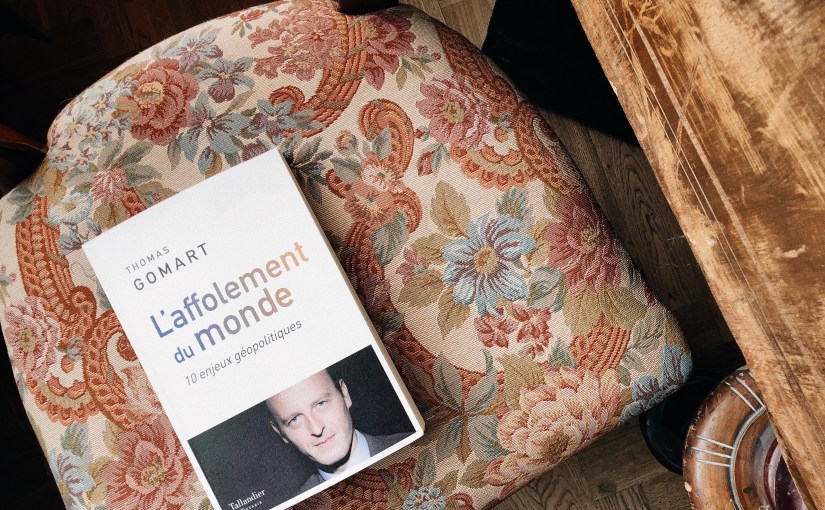
I wanted to speak to you about “The World’s Panic” (L’affolement du Monde) a book published in 2019 (in the French language for now) by Thomas Gomart, who is Director of IFRI (Institut Français des Relations Internationales), the leading, Paris-based, international relations think tank and de facto number two behind Thierry de Monbrial (TdM) its founder and perennial leader. IFRI was ranked in late January by the University of Pennsylvania that is known for such rankings as the second international relations think tank in the world after Washington DC’s Brookings Institution and the first one in Europe. It was set up by TdM in 1979 following his leadership of the Centre d’Analyse et de Prévision(center of analysis and forecast) of the French Ministry of Foreign Affairs, also known as Quai d’Orsay where it is located in the 7th arrondissement of the beautiful left bank of Paris. I have always followed the works of IFRI, at times closely and at times from a distance, having been a member, on and off, since 1981. IFRI is a remarkable achievement of a French institution that was unusually able to reach a true international outlook and status while fully retaining its French roots. At a time when President Macron symbolises the future of Western liberalism in our challenging times, IFRI stands out as a major actor in the fight for ideas that will shape our world.     

TG addresses the challenges the human race is facing and provides a useful recap of those developments that have shaped the world we know. His approach is especially useful by its recount of the history of each great power which also explains the respective foreign policies that were developed in the past until now. In many ways TG’s book will not unearth any new aspects that should be known by students of international relations but will provide a very coherent and quasi-academic piece on these key actors mixing history, geopolitics and current affairs. Of particular interest is TG’s classification of the ten sections of his book that encompass key actors (five) and themes (five) that will shape our tomorrow. TG’s book is first and foremost a very well covered and concise survey of our world today, even if a bit too academic at times, with many references to works published by historians in the past as a way, albeit useful, to provide historical grounding for his book. His habit of stating the birth and death dates of each key actor in all ten sections may also be a bit odd even if educational for those, among younger readers, with no or little knowledge of these men and (few) women.

I will cover only a few of TG’s ten sections as follows below. 

China’s reach to world leadership

TG gives us a very useful historical perspective on China, which comes “first” in all of his ten sections, stressing that in year 0 of our era the world was then controlled both by the Roman and Chinese empires (something few of us are aware of) with the latter being responsible many centuries onwards for a substantial chunk of the world’s GDP. Once the leading exploring nation, China suddenly decided in 1433 for domestic reasons to take an inward course which ultimately led to the rising European powers to control it, notably in the 19th century. Humiliation then became the engine of ambition with dates like 1949 (victory of the Communists and creation of the PRC), 1972 (re-establishment of direct links with the US via Nixon and Kissinger, following a rupture with Moscow in 1962) and 1979 (being the start of the Deng Xiao Ping era and its policy of structural reforms that took precedence over the ideological fight) being hallmarks of new Chinese history and its climbing back to super power status. 1989, with this week the thirtieth anniversary of the Tiananmen protests and massacre, would be another key date with China having ever since continued its economic, though against all hopes and forecasts then, without the instauration of a Western-flavoured democracy.  

The last 40 years have been marked by China and the Communist Party leadership gradually focusing on building economic power combined with strong political control while making the country (and some Chinese usually close to the leadership line) the leading economic power in the world. As Trump was inaugurated in January 2017, Xi Ji Ping was coming across as the new defender of globalisation and the clear opponent in chief of trade wars at the Davos Forum (for all the reasons we discussed in past notes). This rise to world leadership, that involves the Belt & Road Initiative (BRI) and “tactical” development aid (mainly for gaining political support especially in developing countries), many expect to be reached by 2049, the 100th anniversary of the PRC. For the Chinese leadership this unstoppable assent is simply coming back to a glorious past even if it also entails many subjects of contention such as Taiwan, Tibet, the South China Sea islands and Xinjiang that create an unsmooth path to supremacy that acts like a spanner in a well-oiled and seemingly peaceful machine. Of interest and a bit too early for the book some EU member states, like Greece and lately Italy have joined the BRI as a way to deal with their own economic issues perhaps at a political cost that may be felt later but still remains to be seen.

In full transparency and as a seed investor and active participant in the development a global start-up that is changing outbound Chinese tourism – itself as key feature we can notice the world over – , I should add that I believe that we only have to gain from a China that is well-integrated in the world and that there is nothing wrong with them pursuing world leadership as long as fair rules are respected and harmony among nations achieved, the latter that should reflect the Chinese ethos.                

The world close to asphyxia  

TG addresses the universal fight to save the planet against man-made destruction that has affected the world climate ever since the invention of the steam engine in 1784 by the Frenchman Cugnot. TG quotes Jared Diamond who had stated 15 years ago that such a fight for survival was not at the selfish level of the nation but had to be truly global and coordinated. In this respect one can recall Trump’s declaration, when he announced the withdrawal of the U.S. from the COP 21 Paris agreement on Climate Change, that he had been elected by the citizens of Pittsburgh and not Paris. TG goes at great length to list all the perils facing humanity with man-made “progress”, which in itself is a great guide for the non-specialist I would confess I am even though I am part of those who believe climate change is not a hoax or conspiracy from the global, cosmopolitan bohemian-bourgeois a.k.a. bobo elite.  This section is definitely one with strong value add for the non-specialists who care.  

The unknowns of American power 

TG goes back to the roots of American history describing how in less than 200 years 13 British colonies became the leading world power. He spends much time going through the ruptures represented by the Trump presidency in foreign policy and the management of increasingly tense relations with its allies (not to mention I would add basic universally accepted American values of old and a certain sense and dignity attached to the American presidency) as a result of a unilateralist, protectionist and America First foreign policy, which was described in many earlier Book Notes. This section had to be done but the subject matter is well-known and the current administration so much in the news for its erratic moves that both history and current affairs in relation to America today will not be news to the educated and informed reader.   

The return of Russia

TG going back to the roots of Russia since Ivan the Terrible and Peter the Great draws a very detailed history of the country that spans one sixth of the earth’s landmass and whose geography spreading Europe and Asia and controlling Eurasia defines its foreign policy. He takes us into the history of Putin and his quest to restore Russia’s dignity and status following the heavy turmoil and drastic decline of the 1990s following the collapse of the Soviet Union in 1991. Russia’s continental status and lack of Oceanic footprint will explain its drive to assert a very strong foreign policy footprint in Eurasia while it strives to regain leading power status fuelled by a strong defence apparatus and in spite of a relatively small economy by today’s leading power standards. Similarly to that of the American section, most readers will know most of the facts displayed by TG but will find it interesting to read a summary of them and link everything to the history of the key country that holds a special place in the world’s affairs also due to its key geographic location.    

Europe without a compass

TG takes us through the 60 year history of the European project through its various names with the latest being the European Union or “EU”. In 2007, three years after the enlargement that welcomed the former central and eastern European enemies of the Cold War,  the EU, now a 28 member club with Croatia (and still with the UK – don’t let me start on that one), went through the adoption of the Lisbon treaty that aimed for more integration based on a common cultural, religious and humanist European heritage. Its dual challenge is both existential due to the rise of nationalist populists movements across the continent and in terms of adjusting to a changing international environment. The EU fights a disconnect between citizens and the EU institutions this in spite of the longest peace time in the continent experienced in the last centuries. TG goes through all the phases of the European civil war with the balance of power sought by Britain after the Congress of Vienna until the upheavals of WWI and WWII that wounded the world and almost killed a continent. We then go into seven phases or cycles since the creation of the EC and then the EU until the mid-2000s when ongoing crises will mark the development of what is still perceived as the major political achievement of the last 60 years the world over. As TG would have written, the last EU parliamentary elections of late May have kept the dream alive and going forward in spite of the rise of national but not European populist parties (their key weaknesses) against that of green and liberal parties that can work together and a backdrop of declining and gradually irrelevant traditional center right and left governing parties (the French Socialist and Les Republicans parties that governed France and commanded more than 70-75% of French votes for years barely managed to combine 15% for the 26th May EU parliamentary elections held in France).                

The other five sections cover the following topics:

The fight to control sea, air, land and space (a topic that is not an obvious one but is strategically crucial with major powers vying for supremacy)

The noises of war are moving closer (clearly a possibility as traditional alliances are weakened with the US retreating from center stage, even if prompting crises like with Iran and other powers like Russia and China rising in their own ways).

The declaration of trade war (a very topical matter with the Trump administration that made it a campaign driver and the focus of its challenge to China’s rise to leading power status even if there might have been a case to restore some element of balance in the trade relationship)

The multiplication of dangers from the Mediterranean to the Middle East (a subject not helped by the drive from the US to punish the culprits and spiritual and ideological backers of the dreadful 9-11 (sometimes elusive like with Iraq) by destabilising an entire region leading to unsettling changes with the Arab spring and the return of Russia and Iran in the region while backing Damascus for both and fighting against its Saudi foe in Yemen for the latter).

Migration and national identity (doubtless the key factor behind the rise of populism and vote-grabbing expert parties across Europe with the strengthening of Viktor Orban in Hungary, the now defunct Austrian coalition in Austria, the rise of the oddest coalition in Italy between two erstwhile foes and incompatible partners as PM Conte knows only too well, other developments in Poland with Law and Justice, France with a strengthened but as we saw not growing National Rally (ex National Front), AfD in Germany and to some extent the Leave vote even if sovereignty was also a combined factor – all culminating to a “possible” 1/3 of the European Parliament controlled by the Populists, though highly fragmented group-wise thus inneficient, that could have “some” impact on the EU and its policies going forward. Incidentally, there is an excellent map of the migration flows within and out of Africa (on this, there is always a great map at the beginning or the end of all chapters, reminding us of the relevance of geopolitics in international relations).

TG ends up his book with a social take on France and how it is coping with these challenges (the Yellow Jackets being both the latest oddity and French moaning pattern – see my Interludes earlier this year), which is quite expected since this book is first and foremost addressed to French readers. As we address France I am not aware of an edition other than the one in the French language that may make it a bit of a challenging exercise for some but could be another pleasant feature when reading the book if one is a linguist. All in all, the selection of key topics is very relevant and the combination of history and current affairs very well done even if one would like to hear from TG some vision as to where the world is going and what would be needed to ensure it goes where it should, also for this old West of ours which is at some crossroads.

Warmest regards,

Serge           

Why we should stick by Britain in their new “darkest hours” – for them and for us

30-5-19

Dear Partners in thought,

The European parliamentary elections dealt a massive blow in the UK to the Tories and to some extent Labour. The British political landscape has changed durably not unlike that of France. However in the case of Britain, its majestuous ship that ruled the waves is now astray. To borrow the words from the favourite man of a likely future Eurosceptic Prime minister (and our favourite man too, to be fair), Britain is in the midst of its “darkest hours”, redux.   

Labour went into a self-killing journey of oblivion with an unlikely set of actual Trotskyte entryists at its helm bound to dogmatically oppose what they saw as a EU-flavoured capitalist plot.  Soon nobody will care as that once major party will become increasingly irrelevant (one wonders what the likes of Tony Blair and Gordon Brown think today). If it continues its doomsday course Labour will gradually not matter and will share the road to irrelevance of Mélanchon’s France Insoumise. To be fair the left has a tough existential time these days. Their time seems to be gone. Liberals and greens are gradually taking their place with values and ideas that resonate more, especially with young voters.  

The Tory Party, led by key and, sadly, talented Eurosceptics and a Prime Minister who naively opened Pandora’s box, is now going into a contest to replace the inefficient and tearful Theresa May. Those people – Boris Johnson, Michael Gove, Sajid Javid and Jeremy Hunt – suffer from autism and an over-developed ego without any understanding for what goes on around them. The Tories, once the most successful European political party in Europe for more than a century, that gave back Britain its pride and relevance with Margareth Thatcher, are effectively dying as we speak though its leaders seem to keep dancing. Nigel Farage, clownish as he can be, killed them – but they killed themselves first out of personal ambition ahead of national interest combined with strategic mismanagement – while the unlikely winner of last Sunday still could not run a pub even if he likes beer.  Britain needs new parties though the Lib Dems may step to the fore alongside the Greens. The young will dictate this. History may say that these European elections may have been more about the greens and the liberals and the gradual demise of once government  parties that made post-war Europe than the nationalists.  

Britain has seriously hurt itself via the Brexit process and along the way a reputation built over centuries even if some older, well-off Tories feel that all is still good on the economic front now not yet feeling the impact of leaving the EU. However it is time for all to look at the big picture. Britain without Europe is markedly wounded while the EU without Britain is severely weakened – at a time when blocs do matter and a rising China is going full blast for world leadership with America not willing to let this happen. Europe need to be together as we can win or sink together depending on the course we choose. There is no need for a lose-lose scenario now even if it feels like an existential booster to some in search of an elusive and comforting past glory where sovereignty could only be notional and lethally costly. 

Some in the EU, who liked Britain for what it was, are even saying that it would be better now to let it go the high seas. I disagree and say that we need to push our European message across and help our friends stay as we simply help ourselves. We also owe it to them for what they did for “who we are” over the past century. Let’s keep open arms and help them fight their demons so we keep growing as “Europe”. Let us help them reach that second referendum point even if the odds are tough and the leaders to be will fight it out of party rationale as they have before. We owe it to them. We owe to ourselves – to try harder. Let the better angels of our nature prevail while focusing on what matters.      

Warmest regards,

Serge 

Beyond some shocking outcomes, Europe still won yesterday

27-5-19

Dear Partners in thought,

While we liberals (in the European sense) can be shocked at Marine Le Pen’s Rassemblement National and Nigel Farage’s Brexit Party coming out first on their home turfs in the European Parliamentary elections, let’s not forget that there was a great likelihood of that to happen. However, especially for Le Pen, her pole position is truly marginal – so a disappointment for them – as it could have been as was expected by them a wider lead. The key point is that pro-EU parties, whether they are centrist, center left, center right, Lib Dems or Greens have still won a comfortable aggregate majority both locally and at the European Parliament through their respective groups. Populists and extremists still represent a small minority, albeit growing, while they are unsurprisingly fragmented in Strasbourg. 

The real losers of the elections, taking France as an example, are not Macron whose La République en Marche was only 1 point behind Le Pen at a high level. There are the old parties like Les Républicains (stuck between a Macron and a Le Pen not finding political space), the Socialists (who used to run France, as they are the past now) and the radical left with La France Insoumise (showing the parties need to be managed well beyond any fiery rhetoric).

We can still have great hopes for the European project and the EU as we reform them and make sure they are better understood by the people of the EU member states.  

Warmest regards,

Serge          

Don’t go fishing and hold the line on the 26th

20-5-19

Dear Partners in thought,

As we approach a rather key electoral point across Europe, this short Interlude is for my fellow Europeans but should matter to all.  Like with William Barrett Travis and his “line in the sand” at the Alamo in 1836, I wanted to stress a few key things about the upcoming European elections on 26th May.

I am sure you all have read why the EU matters and is crucial to us more than ever (if not see my Interlude of 3rd May). These EU parliamentary elections have always involved a low participation as voters never related much to the EU and why they should vote. However we live in populist times now and while mainstream European voters are by and large happy about living in their EU member state but at times can’t bother to go to the polling booth, the extremist populist parties across the EU are very mobilised and want to score a big victory that may adversely impact on the way we go about our daily lives. Apathy can be dangerous in our times as it was in the 1930s. So please forget about going fishing this Sunday and go voting. 

It is likely that the Brexit Party of shouting Nigel Farage may score the highest result in the UK (even if only 30-35%) at the expense of the two traditional, largely discredited parties and their current leaderships while all the Remain parties from the Lib Dems, to Change UK, to the Greens will score marginally higher than the Brexit Party. I do implore my friends across the Channel to go and vote, especially the young voters, and send a message that leads to a second referendum so we stop this nonsense once and for all. And by the way do not buy David Cameron’s memoirs. Harking back to my French heritage it makes me think of filmmaker Michel Audiard who famously said: “Les cons osent tout, c’est à ca qu’on les reconnait” (loosely and kindly translated: idiots dare everything, it’s how you recognise them). Some people should keep quiet.        

As for France and the never happy, always riotous French, it is possible that Marine Le Pen’s Rassemblement National (formerly Front National) might lead the pack in the evening of the 26th right before the Renaissance group which is the Macron coalition. While it is unlikely that Le Pen’s and similar parties across the EU would hold a majority, they may command enough votes to be disruptive and slow down the efficient works of the EU institutions and thus directly affect the lives of hundreds of millions of Europeans. One reassuring strategic fact, aptly put forward this weekend by my friend Simon Kuper in the FT Weekend, is that “the big decisions are not made by Bruxelles bureaucrats or even the Strasbourg parliament (for which we are voting on Sunday) but by national leaders working together” in what is truly “a Europe of nations”. Having said that it is no reason for not defending our values at all levels and strengthening rather than weakening Europe and its project.    

Populists and authoritarians in democratic Europe are good at slogans as shown with self-appointed European nationalist leader Matteo Salvini and his grand nationalist Milano mass of 18th May with “No bureaucrats, bankers, boats” while screaming at the betrayals of the founding fathers (in his case Gasperi and no less than de Gaulle) and surprisingly holding a white rosary and calling “on the Immaculate Virgin to bring us victory” in what can only be a new marketing plan (which for a divorced father of two is interesting). They are good at getting votes – the main, real target of the populist “game” today – while rarely delivering positive change or even any results expected by their own voters (see my Book Note of 15th March on Yascha Mounk’s “People vs. Democracy”) though very apt at restricting freedoms on the way and creating instability at all levels if not chaos when in power. The last and timely populist episode involving the forced resignation of Austria’s Deputy Chancellor and Far-Right FPÖ leader on Russian-flavoured corruption charges taken on tape (maybe a Cannes Festival contender this week?) shows to star Premier Kurz and all of us how smart it is to work with people with no values. On the 26th in France, Britain and in all EU member states it is high time to wake up and send the message that the values that have made our world matter and that charlatanism and illiberalism are not the answer to the problems of our challenging times. 

For those who like the movies, think of the 26th in terms of Gary Copper’s Sheriff in “High Noon”. “We” are all him on Sunday.

Warmest regards,

Serge             

On Joe’s butterfly effect and why it is finally his time – for him and us

16-5-19

Dear Partners in thought, 

On September 2015, I was sitting at a mini-Davos discussion table led by the then editor-in-chief of Foreign Policy who, answering my question as to whether Joe Biden would finally run, even late, in 2016, said flatly “No, not with Beau’s death”. Beau Biden, Joe’s son and Attorney General of Delaware had died in May of that year of brain cancer at age 46. The shock was too great and the focus on winning not there. Putting aside the human tragedy, this was the little yet realised case of the greatest Butterfly effect (a “small” localised event – if I may say with all respect in this case – with huge consequences globally) in US history. If Joe Biden had joined the primaries, he may have won against Hillary Clinton in an admittedly challenging “sewn up machine” contest and more importantly Donald Trump might not be in the White House. 

A President Biden would have offered America a steady leadership style, the values that made that country what it is and the world would keep going, with its ups and downs, in a largely multilateral way. There would have been no special investigation, no daughter and son in law as close advisers. His team would have been filled with experienced and dedicated public servants and not loyal political zealots. The noises of war, trade and real, would not be there as diplomats could and would do their jobs. The list is long. 

Joe Biden is now back and effortlessly leading the pack of an increasingly long list of Democratic contenders, many of whom threw their hat in the ring to be noticed for the future or with an eye on the ticket. Joe likely would not have run if Trump was not in the White House but felt compelled to do out of public service and to get back things on track for America and the world. 

While it is too soon to extrapolate anything certain, Joe, who is the most known contender, should win the nomination for several reasons as follows:

– He has the most leadership experience of any primary contenders. 

– He is a true and tested public servant at a time when they are rare. 

– He has never taken advantage of his various positions to enrich himself. 

– He is a decent and genuine man at heart whom people from all walks of life can relate to.

– He has blue collar roots and learned politics from the bottom of the ladder.  

– He is very human, prone to gaffes, though never mean-spirited (even if he should work on these and adjust to our times) 

People say that he cannot win simply as being “against Trump” and what he represents. I would agree though Joe’s stance is not so much against Trump (it is for sure) as it is for universal American values of decency, fair game, leadership we all like, win-win, optimism, hard work and betterment. Joe is for a return to what America had been for seventy years, really making America great again (without the silly red cap). Even if other candidates offer more radical thinking and solutions the time now is about reassurance. Joe is the indispensable candidate today. He should win the Democratic primary.    

Winning against Trump will never be easy given the direct and indirect brainwashing process of some of the electorate and the sound state of the economy, the latter which may change as we near 2020 (not that we should rejoice on this point). However it should be noted that Trump is most worried about Joe (he may not want that fight in the barn after all) and would pray to have a true left wing Bernie Sanders or Elizabeth Warren in the final contest. 

I believe (and hope too) that Joe would defeat Trump in the final race though the ticket will be key. It needs to be quality-based with the right “dosage” which we know is a real art. As you know I like bets (you have not forgotten the “Second Referendum” which I predicted six months ago, haven’t you? Keep watching). I will go for a Biden-Harris ticket. Kamala Harris offers the perfect partnership in terms of gender, ethnicity, age, West coast location and former AG profile while by and large matching Joe’s humanity. This is the winning ticket which would also allow Joe to go for one or two terms depending on his own plans and would propel the first woman in the White House. 

Warmest regards,

Serge

Why the European Union works and is crucial for Europeans and the world, now more than ever

3-5-19

Dear Partners in thought,

The May 26 European Union parliamentary elections getting close it seemed like a good idea to stress the benefits of the EU so all voters remember what they may at times take for granted and so they can look beyond the naturally obvious imperfections of the institution.

The aim of the EU, which is not “a marxist dream without the revolution” nor “an evil federation bent on killing who we are” as often heard at populist party meetings, is to promote European harmony through the creation and improvement of a single market for its member states that enables the free movement of services, goods and indeed people (within the EU).

1. Peace and Harmony. The EU and its predecessors like the European Community have allowed for peace to be the norm between European nations ending centuries of bloody rivalries and wars, this process also helped with NATO and good old fashioned US leadership. The EU is about peace and international cooperation.

2. Rule of Law. The EU enshrined legal and human rights with a commitment to and a model for preventing discrimination and enforcing the rule of law. Sheer muscle strength no longer prevails in most of Europe.   

3. Role Model. The EU and its membership process provided a strong set of incentives for countries with a low historical tradition for democracy to change and improve their course in terms of human rights, the rule of law and market economics – even if the rise of populism in some member states shows a return to the old ways as a way to consolidate power.

4. Economic and Trade Might. With its 500 million population and 23% of the world GDP, the EU has become one of the strongest economic blocs and the leading trading area in the world giving it unparalleled clout in relations with its dealings with other countries.  

5. Cost Efficiency. The EU’s free trade and removal of tariff barriers have driven costs and prices down for EU consumers with enhanced job opportunities and higher income for all EU nationals. The removal of customs barriers eliminated the completion of 60 millions customs clearance documents per year in the UK only.  

6. Road to Prosperity. Many once economically-poor EU member states like Ireland, Spain or Portugal not to mention Central & Eastern European states made strong economic progress upon joining the EU through economic assistance.  These structural  programs such as the Social Cohesion Fund that certainly benefitted exports of the older and more developed EU member states also paved the way to self-supported prosperity for new EU joiners – a fact often easily forgotten by populist anti-EU parties particularly across CEE. The EU also greatly boosted inward investment from outside the EU zone like with the UK that once became the 5th inward investment market in the world due to its image as a key EU entry market notably with Japanese firms. 

7. Free Movement Benefits. The EU freedom of capital and labour gave enhanced flexibility to its economy and that of its members like the UK that could fix shortages in its pumping, nursing and cleaning sectors, making a net contribution in tax revenues and increasing productivity. People started being able to work across the EU developing career plans that once were constrained by national borders. EU migrants (about 15 m of them), most of them young, have been net tax contributors while using a relatively small share of social and retirement benefits and improving the dire demographic state of some of the larger EU economies. Tourism and trade became easier and cheaper while a large number of students – 1.5 m – were able to join the cross-EU Erasmus programme that became a greatly popular educational and cultural achievement in also building a more European-minded population at its youth.

8. Useful Regulations Aplenty. The EU brought common safety standards and rules to firms and individuals of all member states. It made it easier for using work qualifications and degrees across member states. Worker have benefited through the EU Social Charter from common protection such as a maximum working week, the right to collective bargaining and all sorts of fair play measures in relation to employment.  

9. Much Better Environment. As of 2006 the EU has vowed to fight global warming well ahead of the COP 20 Paris agreement and has committed to reduce greenhouse gas emissions by at least 80% by 2050. The EU has raised the quality of sea water and beaches with nearly all tourist locations meeting water quality standards. It has set strict restrictions on the use of pollutants such as sulphur while tackling wide environmental problems such as acid rain. 

10. Consumer protection. EU competition policy has harmonised the regulations and abuses of monopoly and cartel power in Europe while leading deregulation of the airline, electricity and gas markets to enhance competition. It has also reduced the price of making mobile phone calls within the EU while recently successfully pushing mobile operators for dropping roaming charges. Consumers can shop in any EU countries without paying any tariffs or excise duties when they return home. The EU Commission today is working on ensuring data privacy and fair taxation in an era of vast technological changes and the ascent of social media.                      
And yet EU nationals should not be happy with the state of play…and many are not judging by the rise of populist parties…

Is the EU perfect? Absolutely not as it is a work in progress. Is the EU staffed always with the best and the brightest? Probably not but they have done a great job so far at managing a multi-cultural group of nations, large and small, with at times centuries or decades of historical and ideological oppositions. 

Do EU member states send their best nationals to hold high office in Bruxelles?Probably not and very often the Commission is a refuge for lost politicians or those their capitals want far away. However and putting aside the pioneers like Jean Monnet the Commission has had great leaders too like Jacques Delors or more lately Donald Tusk, Margaret Vestager or Michel Barnier who “made” the EU institutions even if there are some most of us would prefer to forget or have done so already. 

Does the EU parliament has the best legislators? No and they are often little known back home. However they also give Strasbourg a feeling that ordinary people are indeed poorly represented and by non-professional politicians as judged by the composition of many MEP lists on offer for the next EU parliamentary elections. Strasbourg and its elected MEPs does legislate and Bruxelles mostly execute contrary to popular populist beliefs that the EU is ran by faceless bureaucrats without any mandate from the European people.   

Do we need a language for each or the member states so they feel better represented?Do we not need to improve EU communication? Certainly not and while Esperanto is no longer in the cards, there will come a point when sanity and efficiency will prevail and English may become the official language (in a week to Brexiteers even if the Netherlands may become the new England within the EU), perhaps with two or three others that are mostly spoken in Europe. The simplification of the message through a reduction of languages should go hand in hand with a communication revamp to improve EU clarity and the link between he institution and the nationals it represents.    

Is the EU too bureaucratic? Without a doubt but bureaucracy is an institutional hazard that is multiplied by 28 member states. And large institutions do indeed hire very expensive rootless supranational staff to carry out their missions that can cut them off from the people they represent. In parallel the EU has needed to work on regulations which if they protected nationals and consumers within the EU also had the imposition of forcing myriads of local items like egg calibration which were not always liked locally but were a small price to pay. Working together meant that trade offs were necessary with French and British farmers benefitting greatly from EU assistance (even if the latter massively and strangely voted to leave in June 2016) while some fishermen felt constrained (and indeed English fishing areas also massively voted to leave).   

Was the EU harsh with struggling member states like Greece through austerity programs so they could recover? Undoubtedly and people did suffer, some of them very much for some time, but today Greece is back to showing budget surpluses and Prime Minister Tsipras, once a fierce critic of Bruxelles, is warning all member states about not imitating Brexit. Interestingly and looking at the British example – this potentially being the greatest contribution of the Brexiteers to the EU project whatever its ending at home – no leading populist party across Europe has “leaving the EU” as a magic plan for greatness today.  

Did the EU manage the 2015 refugee crisis and its aftermath in the best of manner?Probably not even if they tried their best. National interests prevailed, starting with Germany wanting to deal with its ageing problems while other member-states refused the quota system at a time when populism and national identity rose. Italy did bear the brunt of the refugee crisis due to its geography leading to the rise of Matteo Salvini’s Northern League, whom today thinking in terms of European partnerships among nationalists, forgets that Hungary’s Viktor Orban was only too happy not to help Italy in time of need.     

Should the EU slow down accession at a time of populist uprising? Yes it should be slowed down for some years simply to take stock, recognise the concerns that, if they are taken cheap advantage of, are also real and focus on reforming the EU while getting its message more clearly across to the populations of its member states. Recent EU gatherings involving some key national leaders communicated this message to accessing countries especially in the Balkans. However the EU dream should not stop so interim partnerships should be developed while an admittedly longer accession process should be maintained.   

When looking at all those fields of anti-EU concerns and sorrows, it is key to remember the real benefits of the institution and that the EU is a job in progress – indeed an imperfect human project – that is improved year after year and reflects who we are and want to be.  

In an era of blocs, at a time of a rising China (with whom the EU will trade productively as there is nothing wrong with China restoring its position of five centuries ago as it does assuming fair game), a more erratic America (with whom the EU will keep working hoping for a better post-2020 era, also for America and the world), a more aggressive as economically declining Russia  (with whom the EU will always engage as it is also about greater Europe) and new powers or blocs profiling themselves such as India, maybe eventually Brazil or even longer term Africa, there is no no doubt that the EU is the only requisite for Europeans for survival and success. Without the EU, small EU member states such as those in Central & Eastern Europe would no longer viably exist or would be the preys of natural imperialism while the great powers of old like the UK or France, while they would keep their identities, would no longer seriously matter. The French historically pushed for the EU project in order to pull above their weight which has become an unavoidable recipe for all nations even if some are tempted by the memories of past glory and putting absolute concepts of sovereignty ahead of economic power, the latter that ultimately ensures concrete sovereignty.

As political thinkers try to grapple with a potentially gradual disintegration of the liberal world order, all the more in case of a Trump II post-2020 (Joe forbid) there are nascent views of a tri-polar world order with one built on arms control and old post-1945 values and two each led by the US and China competing trough their own networks of alliances and economic pacts, eventually  structuring a duopoly of powers driven by intense security competition (Read John Mearsheimer in International Security). If that were the case, the only way for the first world order to be sustained would be with a strong EU that could also attempt to avoid a return to Cold War Redux. It is indeed crucial in that context for the Europeans and the world at large to have a strong EU going forward as a stabilising force so a multipolar world can emerge, avoiding a new Cold War road to senseless destruction.          

Without pushing for federalism in our uncertain times (even if some like me may find it a natural historical path), the EU should continue developing common projects particularly in the economic and environmental areas but also now more than ever in the field of defence. The EU needs more defence cooperation if not a European army so it can work in conjunction with NATO and the US (or the UK post-Brexit if there is one) while assuming the cost of being free as nations and as member states in today’s world. It is also clear that the Trump era has demonstrated that Europe can no longer rely on the self-interest of its key ally and mentor even if sanity restoration may take place in two years.                

If you are a national of a EU member state, go out and vote on May 26. Go out and vote en masse in this usually low participation election as the times are truly challenging and the cheap populists should not prevail let your freedoms be curtailed if not one day gone. It makes for a good family outing preceded or followed by a nice lunch and a walk in your neighbourhood while you will have done your bit to support an institution that has given you and yours peace and prosperity for decades. Do not take things for granted and more importantly do not regret them one day. And if you are “young” do not repeat the carelessness or laziness seen in June 2016 in Britain as of all people it is about your future.

To conclude and borrow from a great American President and a recently aspiring one as the EU is also about “values”, simply let “the better angels of your nature” prevail on May 26.                

Warmest regards,

Serge 

On the fallacy of giving substance to Trump’s “America First” policy

30-4-19

Dear Partners in thought,

Nearly two and half years on we had to expect attempts from the American populist quarters to give some intellectual substance combined with dogmatic nobility to what constitutes Trump’s “America First” policy. This just happened in a Foreign Policy essay by Michael Anton who outlined the so-called “Trump Doctrine” while giving it some quasi-academic aura of credibility beyond the Tweets and erratic behaviour of the American President. I thought that it would be a public service to review, discuss and refute all or part of the four tenets of that “doctrine”. I should give all the credit for this initiative to Fareed Zakaria’s Global Briefing and Global Public Square’s CNN team that reported Anton’s piece factually though without providing any views given the briefing set up, which prompted this Interlude.

As you may know Michael Anton, who “writes” these days focusing on the American left (read radical left) as his chief nemesis, is the former Deputy Assistant to the President for Strategic Communication (quite a mouthful) who resigned as John Bolton became the new National Security Advisor in the Trump Administration in April 2018. Interestingly he once was a speechwriter both to Rudy Giuliani, the once legendary NYC Mayor and current truculent personal lawyer to Donald Trump and to the National Security Council under George W Bush, having worked as director of communication at Citigroup and for asset manager BlackRock. One of the more exotic features of Anton was his role as fierce critic of jus soli (right of the soil) as the basis for birthright citizenship in the US – he clearly enjoys tough positions – and his writing of books under a pseudonym given his government position then, like Nicholas Antongiavanni,  in The Suit that parodied The Prince from Niccolo Machiavelli. Of note, Anton also defended in 2016 under another pseudonym – Pubis Decious Mus (strange choice) – the erstwhile America First Committee of the Charles Lindbergh-type, arguing that it had been unfairly maligned in its times (one really wonders why).            
According to Anton the emerging doctrine would be based on four pillars which are inter-connected and would indeed be a nice foundation set for the Trump foreign policy house (as described in Fareed’s briefing): 1) A recognition that populism is the result of globalisation’s infringements on national identity; 2) a view that the liberal international system was great 50 years ago but offers only “diminishing returns” today; 3) a consistent support for nationalist, self-interested policies by all nations, not just the US; and 4) a belief that supporting nationalism is good for US interests, by making individual countries stronger.    

Anton’s task is indeed challenging and an attempt at after the fact rationalisation and justification of the kind that aims at giving structure to chaos where bold moves and ruptures of directions take the form of policy. If taking each of the four pillars, one could be forgiven to stress the obvious as follows:

1) A recognition that populism is the result of globalisation’s infringements on national identity

No. Putting aside the benefits of globalisation in overall political and economic terms while agreeing it certainly is imperfect and can be fine tuned, populism is not simply the result of the globalisation’s infringements on national identity. Populism is both the “marketing” mean and the result of politicians providing easy answers to complex issues and in doing so dealing with the problems that some voters have with a world that they cannot fully comprehend and they see as hurting their economic and social prospects. Populist politicians then create populist voters adding to their simple messages an element of national identity to the equation ennobling their demand for less globalisation to restore a mix of identity, sovereignty, independence, economic well-being – in other words usurped “dignity” – while blaming foreigners (the migrant, and refugee of the illegal kind but also the variants of the legal “Pole” in the UK) in an age old costless recipe of pointing the finger “abroad” to manage deep domestic resentment. Globalisation is the other and reshaped fingered Jewish financier of our times in being the scapegoat for all of today’s ills of the rural, non cosmopolitan, left out and out of sync populations in the West. Having said this, one should not be deaf and devoid of empathy.  It is clear that globalisation, a major world-changing paradigm of the last 20 years, which benefits are taken for granted and forgotten, still needs to be ceaselessly managed and regulated to avoid excesses and indeed feeding the anger of “helpless” populations that feel trapped and hurting from it even if they have unknowingly appreciated the low cost of many of the basic “Made in China” products they have purchased back home for years.            

2) A view that the liberal international system was great 50 years ago but offers only “diminishing returns” today

50 years ago the world was in the midst of the Cold War which the West eventually won, led by the US and in close cooperation with its allies. Today’s world has other threats though it is difficult to see why the recipe of the Western liberal order as we have known it should offer only “diminishing returns”. While quantifying returns seems awfully challenging it is not clear that the formula, however cute, possesses any validity as a way to make a point, even less a doctrine pillar. That the world has not yet suffered a major transcontinental war since the last global conflict 75 years ago (short of Islamic terrorism and its ripple effects throughout the world and notably Middle East since 2001) and the world economy has kept growing, even with the odd major financial crisis, with poverty receding gradually over decades, could be deemed a happy return which would be hard to see as “diminishing”. Cooperation between nations and dialogue fostering multipolar policy-making is bound to yield more positive developments for the world than national self-centrism whatever the easy beauty of the argument and as the world is no longer going to be unipolar as it goes.        

3) A consistent support for nationalist, self-interested policies by all nations, not just the US

One can understand the drive for the seemingly “rational” approach and its roots. And Secretary of State Mike Pompeo (who admittedly thought his President was doing God’s work in the Middle East) stressed publicly that such a nationalist approach had strong merits for all nations. So the US would not be the only self-centred kid on the block. It should encourage and indeed support all nations to go out alone and define their priorities in the most-self interested manner.   Would that mean that America should encourage Russia and China, to name only two nations, to be more nationalistic than they are? And if logically yes would that approach not create naturally clashes when nationalism run amok were to cross borders such as with the earlier Crimea and eastern Ukraine episodes? Would that not encourage New Delhi at an uncertain leadership time to bet the house on Kashmir something which as we well know “notoriously placid and pliant” Islamabad would find absolutely acceptable and even welcome? Would that not send the wrong message to Beijing in relation to Taiwan, simply looking at its current reaction to foreign naval vessels simply crossing the straits? Would not nationalist interests collide? Would not cooperation be more sensible than confrontation, knowing that nations will still vie for their national interests even in such a productive setting? And would we not send the wrong signals to smaller nations they can sort out their problems by being self-centred at the military and economic levels? I do hope the affable Mike Pompeo could respond to these simple questions that are answers in themselves.             

4) A belief that supporting nationalism is good for US interests, by making individual countries stronger

Not only the US would like nationalism in other nations but there is the delusion that it would be good for America itself. While pillars 3 and 4 are really like close cousins (we feel Anton scratching his head to come up with the fourth pillar of the house so it could stand on its own) it is hard to see a more nationalistic Russia be good for America. The same could be said of the rising China or even today of a rising geopolitically-focused India. To run the risk of repetition (no bad thing these days), resurgent nationalism brings with it a desire for conquest of a military and/or economic nature and again is linked to capturing domestic voters’ attention and make them focus on easy targets for their woes, this in a millenary approach that never stops working. In the end and as already stated nationalism is not patriotism, the latter which is absolutely fine and is based on one’s natural pride for one’s country’s history, culture and achievements.  The aggregation of all the “my country first” will not make for a better world and will ensure a “zero sum game” road to conflict particularly among leading powers, resulting in large scale confrontation at a time when the nuclear threat of old was largely forgotten. And it would drive smaller nations to resort more easily to force to solve differences particularly at a rising time of the elected and non-elected despot at the their helm. The US would not benefit from such a world. No nation would in the end.        

One should be forgiving about Anton’s attempt as the task he set himself to achieve was indeed challenging if not impossible however the intellectual juggling and pirouettes. However what is clear with those pillars is that the Western liberal world order, which as Gérard Araud, the colourful departing French ambassador to Washington, said simply (and if only) ensured a peaceful Europe since 1945, is the target of the new Washington leadership (or lack thereof) that finds collective policy-making very unattractive if not repugnant. The current US leadership forgets that the beauty of the US-led Western world order, that was indeed based on collective thinking and action, is that it was also very much in the interest, short and long-term, of the US.

One feature of the current Trump administration and many of its alumni (knowing they tend not to say very long) is the relatively low quality of the individuals comprising it. And after they leave, they write, this mainly to exist as they find it difficult (a trend that will grow exponentially) to secure gainful employment in the private sector once their leave the administration (as an aside, that Anton had to leave when Bolton came on board says it all in terms of the human comedy – or tragedy – on display at the White House today). This post-fact rationalisation of the so-called new “America first” doctrine is valuable not by its poor contents but by its paucity and the quality of its author. However it should not be forgotten that such a piece can resonate in some quarters that are dying to secure such a rationalisation for what they gradually start perceiving as erratic behaviour of the greatest magnitude. Once the piper will have been paid as the policy consequences are more visible and felt (often by early supporters – see trade wars and Trump’s core base) the emperor will be naked but it will take time to restore things and having been right in the end is not a remedy. The remedy for America and the world as we and our parents built it, if ever found (not a forgone conclusion) will be in the ballot box in 2020 and, by the way, likely not through tactically ill-advised impeachment proceedings even if the multiple counts of obstruction of justice are good grounds and totally demeaning.

The sad feeling reading such non-sensical attempt at creating a doctrine from nothing is that the White House is now run and supported by grown-up “kids”, the few adults like McMasters or Mattis having indeed left the playground. Those who remain, whose main asset is loyalty to “the tribal chief” (to borrow from the FT’s Martin Wolf last week), skipped history classes and address crowds with decreasing historical memory as time goes by. This combination is a bad recipe for why history tends to repeat itself so it is our duty to follow Edmund Burke and at least “say something” lest the evil prevails.

Warmest regards,

Serge                

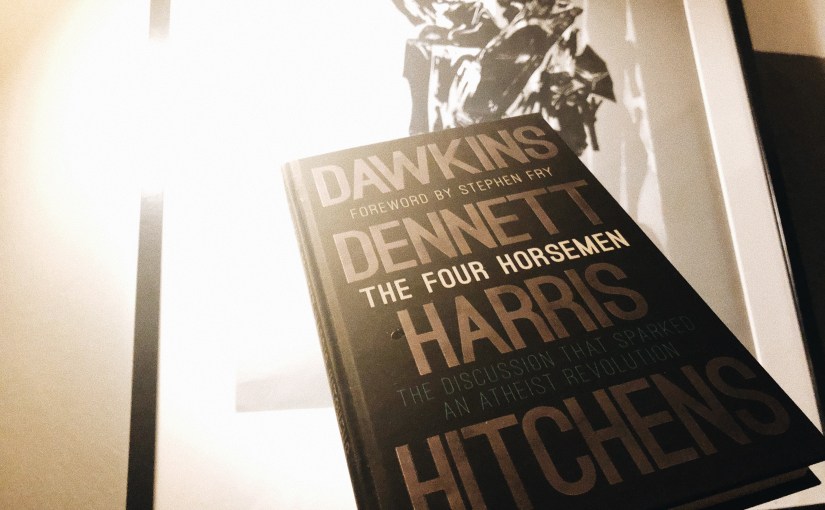
The Four Horsemen – Richard Dawkins, Daniel Dennett, Sam Harris and Christopher Hitchens

24-4-19

Dear Partners in thought,

Like with “The Diversity Delusion” I was a bit hesitant to cover a topic that is probably the most controversial of all but I will nevertheless tell you about “The four Horsemen” by Richard Dawkins, Daniel Dennett, Sam Harris and the late Christopher Hitchens (I can feel the tremors already) a.k.a. Atheism, Inc. that relates the famous two hour discussion they had in 2007 in Washington DC which then would have launched the new atheistic drive of our times. It is also clear that such a Book Note that is focused on fostering discussion is not done at the most easy of times considering the shocks of the recent fire at Notre Dame de Paris and the dreadful terror attacks in Columbo on Easter Day.

Most people will have known the very colourful, uber brilliant and bon vivant Christopher Hitchens, the author, journalist and literary critic but above all “the master of debate…unmatched in his lifetime”, who sadly departed in 2011, and Richard Dawkins, Fellow of the Royal Society, Oxford New College Senior Fellow and once its Professor for Public Understanding of Science from 1995 until 2008 most known for “The God Delusion” that was published a year before that “mindful” get together. Fewer will know Daniel Dennett,  the Tufts Philosophy Professor who is probably the leading beacon in his field today in the world and Sam Harris, the eminent UCLA neuroscientist and founder of NGO “Project Reason”. The four of them published a major book in the mid-2000s that spearheaded a movement rejecting religion, defining atheism and stressing the importance of rationality and science as the only ways forward for humanity. Not a trivial matter indeed. Those books were “Breaking the Spell” (Dennett; 2006); “The God Delusion” (Dawkins; 2006); “The End of Faith” (Harris; 2004) and “God is Not Great” (Hitchens; 2007, who also wrote many great books like Hitch 22 and lastly little-known Mortality, a remarkable collection of Vanity Fair essays on his own decay as he was dying from cancer).   

As this topic is very personal to many I wanted to add a personal touch for background purposes. In covering “The Four Horsemen” I do so as religion has had a major impact on international affairs and geopolitics throughout history well beyond its sheer tenets if only thinking about the Crusades and Jihadism. I also chose to do so based on free speech, albeit highly respectful, and the beauty of discussing matters however sensible they can be among civilised people if not all perhaps “souls”. As a Catholic school-educated Parisian youth (College Stanislas, the same beacon of excellence attended by the likes of Charles de Gaulle and… Carlos Ghosn) I was raised in a simpler world where questions were just not asked and you went along as the good boy you were. Sadly this matter-of-fact approach peppered with weekly bible studies often given by the devoted but mostly-blindly believing rather than scholarly-trained mothers of my peers did not make me “think”, something that I realised was not really the objective in any case. Today while respecting all religions and beliefs I do not really know where to stand but naturally would be on the side of rationality and facts (like with dealing with fake news in our challenging digital and political age). One temporal aspect of religion that is neither forgettable nor forgivable to me have been the slaughters and misery unleashed on behalf of religion by men throughout history against non-believers and “other” believers alike – even if accepting that many people would indeed welcome the structured  religious guidance for their lives and indeed after-life (rejecting deathly oblivion) so they could manage the former and their anguish regarding the latter much better. It is also clear that church groups have provided to many the real joy of belonging to a community and sharing experiences with its members in some practical and enjoyable earthly addition to the divine. There are topics one prefers to avoid and I am not yet there even if I relate more and more to the Horsemen today than I would have thirty years and a brain tumour ago, again based on life experience and sheer rationality. Once again with total respect for those who find in religion a way to define who they are and their life, as long as we do not fall into any lethal and doomed form of fundamentalism of the kind that killed theatre goers in Paris in November 2015 or Mosque attendants in Christchurch in March 2019. And yes I also believe that religion should be a private matter, oppose theocracy of any kind and feel quite French (for once) about laicity. And if I no longer attend church my wife and I made sure our daughters received a wholly traditional European cultural education that indeed included bible studies so they could make up their own minds – which I think they did.

The book starts with a preface from another great character who is none other than Stephen Fry, the complicated, brilliant character who once fled the stage of his London theatre not to come back and was known early as Jeeves in the Jeeves & Wooster of anthology with fellow Cambridger Hugh Laurie (if only all actors and “celebs” could be that bright today!). Of note Fry was reported in Ireland for blasphemy after describing God in words that were deemed unbecoming. The Four Horsemen are each given a name of Alexandre Dumas’s three musketeers (which as you you know were four) with Dennett being Athos (who was also a bit older and less fiery than the other three in the novel), Hitchens being Porthos (indeed the bon vivant), Harris being Aramis (the refined ladies man and gifted swordsman, doubtless my favourite) and Dawkins of course being d’Artagnan (the thinking swordsman) as perhaps the leader of the pack. Fry sets out the landscape of the discussion which was heavily marked by 9-11 and the rise of Jihadism and Islamic fundamentalism and introduces the key themes of rationality, free thinking and the “supremacy of evidence”, all which do not make for easy bedfellows with religion. While they have championed free speech, the musketeers were often accused in their drive of illiberalism as they were also questioning the sheer idea of faith.

Following Fry’s crafty introduction about this new secular and humanistic drive, the three surviving authors provide a short piece written today, or 12 years after the DC discussion. Dawkins in the longer essay of the three (shortened “The hubris of religion” ) reaffirms even more strongly that science and religion can’t function together, the latter “having contributed literally zero to what we know combined with huge hubristic confidence in the alleged facts it has simply made up”. Focusing on Islam he goes deep into the Concise Commandments from a respected Iranian scholar about the wet-nursing of babies that could have come from Comedy Central or John Oliver if not for the likely penalty of fatwa that would have come with blasphemy. One of the key conclusions of Dawkins is about human courage which is required in the atheistic world given the dangerous stance it represents in many quarters, though also including the moral kind. As an atheist, one abandons his or her imaginary friend, foregoing the comforting props of a celestial father figure to bail one out of trouble. There is no holy book to tell one what to do and what’s right and wrong. One is an intellectual adult, facing up to life and moral decisions though standing tall and facing the wind of reality. For Dawkins the atheist has company: warm human arms around him or her, and a legacy of culture which has built up not only scientific knowledge and the material comfort that science brings but also art, music, the rule of law and civilised discourse on morals. For Dawkins, an atheist has the moral courage to live to the full the only life one is ever going to get, inhabiting reality, rejoicing in it and doing the best finally to leave it better than one has found it.    

Dennett, the Tufts philosopher, who takes the mantle of “the good cop” is more conciliatory seeing that organised religion did provide some “order” that we should preserve. He also stresses that many people whose lives would have been desolate if it weren’t for the non-judgemental welcome they have received in one religious organisation or another, even if regretting the residual irrationalism valorised in almost all religion, though not seeing the state, down here, playing the “succouring, comforting role” to people that need guidance and something else to feel whole. Dennett does not have plans to usher churches off the scene but would rather “assist” in their transformation into organisations that are not “caught up in the trap of irrational and – necessarily insincere – allegiance to patent non-sense”.

Harris, the neuroscientist, stressing the four of them only met once for such a conversation (and like all of them missing “Hitch” who was one of a kind), discusses the irony of religion that unites people though “by tribalism and spawning moralistic fears” (taking it to its extremity, leading actually to religion-based terrorism at least in the mind of misguided perpetrators) and giving bad reasons through faith for “doing good” when good reasons are naturally available. Harris ponders on the belief in the omniscient deity of the sort imagined by Christians, Muslims and Jews, using the example of the mosquito that bites the expecting Brazilian mother at night in her sleep while she dreams about the future and giving her the Zika virus that will eventually give her twin born daughters microcephaly while an omnipotent and omniscient God does nothing to prevent in the slightest the horror that will unfold. What are the faithful to believe in that point and how would they explain that? Harris feels that “they know that their God isn’t as nearly attentive as he would be if he actually existed”. Nothing stopped that long line of tiny monsters that have been at work for 200 million years from destroying that woman’s and her unborn girls lives in return for a quick drink. Harris feeling that the fact-based story dismantles whole libraries of “theological hairsplitting and casuistry” still knows that if a vaccine or a cure for Zika were to be found by science, that is not based on lies and ignorance however blessed, the faithful would still thank God for it. And given the fire at Notre Dame de Paris one is tempted as the devil’s advocate (pun intended) to wonder if Harris would adopt the “Zika principle” to this tragedy.

The conversation sees Harris wondering if all religions are equally awful, meeting a very even-handed Dawkins in his overall religious rejection while Hitchens finds Islam the far more damaging for the mind and indeed body given the ambient terrorism, a felling that is clearly followed by both Harris and Dennett again based on “evidence” and the number of deaths attributed to Jihadism. This approach in many ways that smells of bigotry did prevent Dawkins from sharing some conference platforms due to perceived Islamophobia, which he would defend on scientific, indeed statistical grounds. On this point, it is interesting to note that Ayaan Irsi Ali, the black Somali-born author, one time Dutch politician fighting for her life and fierce critic of Islam (now US-based and wife of renowned historian Niall Ferguson) had not joined at the last minute the DC discussion as originally planned (but will be with the surviving three at a big conference down under in 2011 to discuss the same themes). It is also interesting to note that Christianity seems less of a target for the Horsemen given the times and the central role of Islamic fundamentalism even if all religions remain the targets of the group.

Hitchens no longer with us will of course not write anything in terms of update or introduction to the discussion (I know some will wonder if he would have done it from paradise or hell…). One feels he is missed due to his superior intellectual brio and as he was indeed the most incisive and greatest debater of the four, something that the others will almost acknowledge. He focused on distinguishing the numinous (or divine will) from the supernatural while never desecrating and falling to the level of profanity as in Sophocles’ Antigone, “leaving the pious to destroy churches and burn synagogues or burn each other’s mosques” (on the quote his atheism as we will see had taken a very acerb anti-islamic tone post 9-11).  

The famed “discussion” will lead to several meandering conclusions along the way of their discussion following a loose framework:

– Whatever the softness of the criticism or invitation to debate religion and God, atheists will get hammered by the true religious and be deemed rude on the grounds of the hurt-feelings card which should lead them to say “nothing” (Dennett). It is akin to “trespassing a taboo” where it is safer to leave people to their own superstitions from a secularist and atheist standpoint (Harris) even if one should still try harder and indeed engage (Dennett).      

–  The Musketeers do not want religion to be desecrated as it happened with various contemporary art pieces harshly going after the Virgin Mary in the mid-2000s sharing with Sophocles and other pre-monotheists the revulsion for this and profanity and indeed being awed by some of the “aesthetic achievements” of religion (Hitchens) – something that the fire of Notre Dame reminded everybody vividly along other great things we usually take for granted only to miss them when they suddenly go away. The Musketeers just want to tell the religious that they are wrong to be offended even by existential type topics wanting them like physicists not to be offended by disproval or challenge to their view of physics. (Harris)  

– It is obviously challenging not to be rude when telling someone that she has wasted her life “believing” (Dennett). Based on former Christian preacher Dan Berker’s “collection”, some clergymen having lost their faith will not dare say so because it is their only living and the only thing they know how to do (Dawkins). They want to be able to say things about religion in the same way one says things about and against some of the less savoury aspects of the oil and pharmaceutical industries (Bennett), including denying them tax exemptions or state subsidies (Hitchens). Religion having benefitted from a charmed status has been historically immunised, a status that is accepted by most if not all people, religious or not (Dawkins). “What if I am wrong?” is not in the repertory of the faithful (Dennett) while it should be because religious people are in permanent crisis of faith as if they prayed to believe in something that will turn out to be real as deep down faith is a challenge to their inner unbelief (Hitchens)

–  Faith indeed does not require evidence but needs to be “rationalised” to some small degree. The fact that we have an intuition of God is itself a subtle form of evidence that allows to start a process without evidence with the demand for more evidence itself a kind of corruption of the intellect or a mere temptation to be guarded against, all of which creating a perpetual machine of self-deception (Harris).

– Agnes Gonxha Bojaxhiu, a.k.a. “Mother Theresa”, the Catholic nun who founded Missionaries of Charity in 1950 and was immune of criticism given her literally sainthood status on this earth once shocked her own religious hierarchy in saying that she couldn’t “hear a voice, feel a presence, even in the mass, even in the sacraments” to which the Clergy replied to her that it was actually good as she was in fact suffering, giving her a share in the Crucifixion and making her part of the Calvary” (Dawkins).

– The very same tricks used by religious leaders to strengthen their position and the faith of the believers are the same as those that could be used to sustain something that would be manifestly fraudulent, making a virtue out of sheer, wonderful trust (Dennett). When Einstein is deemed, by some trying hijack the scientist into the religious camp, to have felt a spiritual force in the universe, he really meant that there were “no miracles” (Hitchens).  
– The religious person who rejects the atheists who attach their beliefs also reject all other religions and their pseudo-miracles, pseudo-claims and the certainties of others, seeing the confidence tricks in other people’s faith. Every Christian would indeed know that the Q’ran can’t just be the perfect reflection of the creator and must be reading it more closely (Harris).

– Making the point about inventing ideologies or religions, the Musketeers postulated that a new religion could be created insisting that children study science, maths, economics and other terrestrial disciplines to the best of their abilities and if they didn’t persist would all be tortured after death by seventeen demons.  While the Musketeers laughed at the proposal (from Harris) they all agreed that there was zero chance the seventeen demons would ever exist – amusingly a very feeling that could be shared by many, including those of the faith whatever it might be.

– It is condescending not to confront people one by one or en masse. Public opinion is often wrong. Mob opinion is always almost wrong. Religious opinion is wrong by definition. What made H.L. Mencken (famed American author in the 1920s and 30s) respected of so many is that he said that the people who believe what the methodists tell them, or William Jennings Bryan (an anti-evolution Christian activist and US Democratic politician of the times) tells them are fools and they should make themselves undignified and ignorant. This was arguably the most successful anti-religious polemic ever uttered in the world in the 20th century. (Hitchens)  

– Addressing the word “mystery” the Musketeers mention that Noam Chomsky (US linguist and scholar) said there were two kinds of questions: “problems and mysteries”, which Stephen Pinker, the en vogue and ever optimistic Harvard philosopher, adding that the former were solvable while the latter weren’t. However even if accepting that premise there are no mysteries in science, only problems even if deep ones. There are things we don’t know and things we will never know but they are not things that aren’t systematically incomprehensible to human beings. The glorification of things that are systematically incomprehensible (like religious beliefs) has no place in science leaving the reader understanding that it has no place elsewhere in life. (Dennett). 

– Christianity and Islam evaporate if the Bible and the Qur’an are no longer “magic books” reflecting omniscience. There is not the slightest shred of evidence that these books (which incidentally mutually reject each other even if sharing some similarities if not shared history) are the product of omniscience “or that these words could not have been uttered by a person for whom the wheelbarrow would have been emergent technology”. However with the eyes of faith one can discover magical prescience in any text like (a weird example) walking into the cookbook aisle of a book store, picking a cookbook randomly and then coming up with a mystical interpretation of the recipe. It is possible to “play connect-the-dots” with any crazy set of things and finding wisdom in it” (Harris). As science writer and historian Michael Shermer did with the Bible Code in 2007, finding hidden messages in the Bible (Hitchens). 
– Asked why he still believed in God a renowned biologist and brilliant expositor of evolution answered “proudly and defiantly” that it is simply about faith screaming that “there’s a reason why it’s called faith” as a knock-down clincher (Dawkins). And the argument that “if faith is real to them, why can’t you accept it?” would not be accepted in any field of argument at all (Hitchens) adding that “faith, as often as it’s cut down or superseded or discredited, replicates principally to do with the fear of extinction or annihilation”.                

– Addressing the matter of Islam they all view as the worst religion in terms of its destructive effects on humankind (we are in 2007 so in the midst of the post-9-11 era and the ever going Iraq war, well pre-Arab Spring and the massive negative impacts on the Middle East and the world engineered by said Iraq war) the Musketeers are more interested in destroying (or “extirpating”) the Jihadists than understanding how they could think (Hitchens) even if they recognise that most Atheists would rather “go off and dump on Billy Graham” than going after the Iranian mollahs or their Saudi cousins (Hitchens). They nevertheless ponder on whether there would be any remote chance for a reformed, more moderate Islam (Dennett) given that the present savagery is relatively recent (Dawkins) a feeling that is supported (Harris) also looking back at the Andalusian period where Islamic civilisation was relatively at peace with its neighbours and un-Jihadist. Even if stressing that all religions have to espouse totalitarianism as they have to want an absolute, unchallengeable and eternal authority (Hitchens). At the time Jihadists were indeed killing more people than Christian fundamentalists were killing abortion doctors (Harris) though today Jihadists kill more in the West though through less terror strikes than Christian fundamentalists, Christchurch being a sad and despicable counter-example of that awful trend.

– The Musketeers do not want churches to be empty even if they would like religions to evolve as they somehow respect the “sacred” given its impact on humanity and the way mysticism was crafted. One aspect where atheists all agree is the artistic impact of and on religion if only thinking of music, painting, sculpture or devotional poetry (Harris and all), to which again we should add architecture and the cathedrals like Notre Dame de Paris and other great human achievements driven by religious faith. Listening to Bach in the beautiful church of Saint Sulpice in Paris indeed would strengthen religious belief and could make some mild atheists reconsider. It is interesting to note that the Musketeers have a deep religious culture that also includes art which provides religion with a high degree of aestheticism (Dawkins). Also, some have had close and rich friendships with clergymen (Hitchens). Some would even argue that one could not understand literature without knowing the Bible even if not adhering to its tenets (Dawkins). None of them have a problem with Christmas trees, while stressing that Christmas is a pagan Norse fest and reminding it was Oliver Cromwell and the puritans who first forbade the tree (Hitchens and his “good old norse booze-up”).          

– The fundamentalists and theocrats are winning the global fight and may destroy civilisation (Hitchens, who is keen on “fighting” and “confronting” together with the 82nd and 101st airborne – clearly 9-11 having had a big impact on him and again reminding us of the timing of the discussion and the main target of this key atheist), a feeling that is not unanimous among the Musketeers even if nobody offered other views as the discussion was coming to a close “due to a lack of time…”and possibly tape” (Hitchens again).          

While the Musketeers concur that there is a general queasiness about upsetting the pious, which is also impacted by an uneasy mix of political correctness and ingrained respect for such deep beliefs, it is clear that the atheist revolution has not started twelve years after the DC discussion and launch of a movement. The atheist movement seems to be still the domain of a few highly educated scholars and intellectuals and their societal elite-belonging followers who can think for themselves at all levels and do not fear any backlash, proving that deeply ingrained habits of that sacred nature are indeed hard to die or to evolve. It would not seem that the technology drive we have witnessed so far has dented “broad and generic faith in God or a God” in the West even if church attendance in Europe (unlike America) is at an all time low, while Islam’s mosques and Hinduism’s temples are doing well.

It is clear that at a minimum religion can assist people find moral directions and rules to lead lives they find fulfilling and they can also combine with a set of temporal laws, regulations, customs and acceptable manners of living in society. It is also clear that religion does help many to find solace in front of some of the terrible turns life can bestow like losing a child or a spouse or suddenly being faced with an incurable disease or medical condition. Having said all this very religious people are not usually equipped or willing to reflect freely upon the existence of God or the value of religion as if the subject matters were too dangerous for them to even consider – indeed as if a road to hell later or some form of inquisition now were the outcome of such moral deviance. It is somewhat hard to believe that rational men and women, many of them living with their times, can lead lives according to old scriptures so they feel better about the way they conduct themselves in the 21st century and can in doing so hang on to some feeling of fleshless immortality while visiting earth. In the meantime most people in Western Europe for sure, including notional believers, simply do not think in their daily lives about God or religion, these being by and large secular while usually not being formally atheist individuals (many would like the comfortable definition of “deist” that provides a sense of rationality boosted by minimal hedging), indeed happy to take Pascal’s bet that in the end “and usually right at the end” there is little to risk in finally believing in God – something the Horsemen or Musketeers would nobly reject preferring being whole and clear in their own full beliefs…in man and life “now”.

The book is a great read on many very interesting and challenging topics beyond the one of God’s existence and is an invitation to deal wth great minds even if the key subject matter could be summed up in a few words. Religion is based on faith and not on evidence or facts so if faith is not a good enough ingredient or driver for the rational mind then religion has no basis to be taken seriously. There is no need for a long book and a quasi-theological journey to disprove religion if faith is deemed to be too thin a burden a proof to the Cartesian mind. In many ways and with all due respect to the believers, the more one thinks the less one will believe – unless one is attracted by mysteries and indeed mysticism and is happy to let go any search for evidence. Having said all that, what matters is that everybody is happy and that believers and atheists happily coexist in mutual respect.

So much to think about…if one is willing, “in good faith” that is.

One cannot indeed write a Book Note like this one in April 2019 and not having a respectful thought for Notre Dame de Paris. The famed cathedral that was built and finished in 1345 was a prime example of the beauty that religion brought to the Parisians, not to mention humanity, throughout history as one of the greatest architectural contributions of the Catholic Church. Believers from all religions and non-believers stand together in the face of such a loss that touches us all, including doubtless the Musketeers. As star philosopher, Bernard-Henri Lévy a.k.a. BHL put it Notre Dame was (and still is as the firefighters did a master job) “a treasure of civilisation, for those who believe and those who don’t” – a symbol of the Europe of civilisations…of grandeur and softness”. The House of God for many, the symbol of French identity for many others, often both for the former. And well beyond religion an iconic historical and cultural testimony the world over.              

Warmest regards,

Serge  

Why closing down elite schools like ENA is no answer

21-4-19
Dear Partners in thought,
Growing up in the times of the rising Jacques Chirac who was giving a breath of fresh air and “Hussardism” to my Gaullist political family in the 1970s and even voting “No” at the 1992 Maastricht referendum (doubtless then a youthful mistake driven by “l’ancienne gloire” of the Napoleonic era combined with a scary, foresightful wink to the Brexiteers of the future), I never thought I would be impressed by and vote for a man who had been a member of the socialist government under François Hollande (even if we shared a stint as bankers for the Rothschild family). And then I did.
In 2017 I voted Emmanuel Macron having been throughly disappointed by François Fillon’s moral compas and sense of entitlement. Macron changed the French political landscape as some British friends would like to see cross-channel, sending the two main parties to quasi-oblivion for the Socialists and intensive care for the center right Républicains, unwittingly having to thrive without a real and constructive opposition which may have been a poison chalice in disguise. Macron led key reforms in a country that is eminently conservative regardless of whom was in power over the last seventy years and crucially became a leading voice for the renewal of the European project.
The “Gilets Jaunes” (Yellow Vests) erupted in November with conflicting demands to “change life”, many of them suffering from economic and social ostracism in a country that is the most redistributive of the OECD on a par with Sweden (see my Interludes on the Yellow Vests on this matter). Macron both quickly caved in and made concessions amounting to multiple billions of Euros while engineering the start of a Great National Debate so the French could express their views on their future. His reaction was seen by many as quickly surrendering to demonstrators, quite a few of them violent, who in turn were never satisfied by such concessions as they did not change the “horrible” system in which they and I guess we all lived.
Macron went further and wanted to “make a big splash” announcing that he would plan to abolish the Ecole Nationale d’Administration (ENA), the elite postgraduate institution established in 1945 that has formed future top French civil servants that counts presidents, prime ministers and chief executives among its alumni. Every year a class of 100 students graduate and is on its way to run France first as civil servants and then for some as business executives at the leading French corporates.  It was a very divisive step with some applauding “the long overdue reform in an unequal society” while others, like me, seeing it as a damaging act of populism.
This step triggers a debate about the elite in France and generally modern Western society. The French have always had since 1789 a “penchant” in their genes for equality or even equalitarianism as if society did not need an elite or the way that elites appeared was unequivocally inegalitarian thus wrong in essence. It is astounding as this emotional stance is deprived from any historical reality check and the fact that any society indeed “enjoys” elites, something the revolutionary Bolcheviks and then the Nomenklatura could attest to. So there is always an elite though the problem is how it does appear.
Is it better to have strongmen become the elite as they have more muscles or weapons as in many countries still today? Is it better to have an elite that benefits from dramatic changes in their countries and are well politically connected at the crucial time such as the oligarch class in parts of Europe? Or it better to have like at ENA a transparent examination process that everybody can take which will lead to an education that will give more tools to these students to take part in leading the government of their country?
Clearly the upper classes will be privileged in terms of school admissions the world over though mainly as its members spent time “reading” in their early youth (one of my professors always asked in his questionnaire to students if there were books at home). However nobody is prevented to take the ENA exam if she or he can show the right credentials. While I was part of a leading high school in Paris, I was not a good student and played far too much tennis in my teens (stopping my studying after flunking my Bac once to hit the ball) and could never have been admitted into ENA (America saved me but that’s another story). However I always recognised the value of ENA and its graduates who were so easily despised as being the dreaded elite at home while the world kept recognising the high quality of the top French civil service. And if you don’t have a tough knowledge-based selection process for getting into the best school, what do you have that is more fair? And looking abroad is it sensible to consider the closing down of these awful elitist beacons such as Oxford, Cambridge, Harvard, Yale, Princeton or Stanford? Maybe we could set up an admission lottery which no doubt would identify the best student in-take?
Suppressing ENA is caving in to populism. ENA should not be closed but could be reformed also to ensure that its in-take represents France better (in itself a very arduous endeavour) though without sacrificing the principles of selection that have produced the leaders of France since 1945. And whatever desire to assuage the Yellow Vests and the likes (who are a real, but admittedly vocal, minority that is being “heard”) Macron should indeed focus on pursuing his deep reforms in relation to economic development, the role of the state in that development and how to attract the best people in that key effort. At a time when many talented young Frenchmen now want to be entrepreneurs instead of senior civil servants and be part of the elite “without checking the box of a government job” (or indeed like I did go far away to study and build a life outside France), it would be also useful to retain some of these talents to work on building the next government chapters of France. ENA is a national asset for France and should stay.
And I still like Macron.
Warmest regards,
Serge

The Fox – Frederick Forsyth

17-4-19

Dear Partners in thought,

While Brexit reaches another climax I thought we might as well stay away from it and take refuge in the world of fiction…  

I would like to tell you about “The Fox” the latest spy-flavoured action novel by Frederick Forsyth, whom to my age group was with Jack Higgins what was John Le Carré may have been for the slightly older ones, that is a great entertainer and plotter with a limpid style of great stories that took you to exotic places in the midst of real life current affairs backgrounds. Those who like FF will remember the “Day of the Jackal” and the de Gaulle assassination plot (with another Fox on screen), the “Odessa file”, “the Dogs of War”, “The Fourth Protocol”, all made into a movie and a succession of other novels which somewhat peaked with Russian-flavoured “Icon” already years ago. Over recent years and since “The Veteran” in 2001 (time flies!), FF slowed down his production which nevertheless looks bigger than his 18 books, never going back to his heydays. FF was different as he was as much a novelist as he was an historian and one of war, making me remember the good times I spent listening to him in the late eighties when his military history show was on PBS and I was starting my professional career in New York City. He had the distinguished air of an Oxford Don combined with that of the operator of things displayed in his books and knew through his grave voice how to captivate an audience in the way he did so well in print. It is hard to believe that FF is now 80 and that his wife is very strict about his not traveling to hot world spots for inspiration. I can also remember when he played dead for a couple of years having been defrauded by personal friend turned con-man Roger Levitt  in the mid-1990s in London, something I always found hard to believe. The only sad part about his life, at least for me, was his passion for total British sovereignty and hatred of the EC/EU project and management which drove him to be an early supporter of UKIP when Jimmy Goldsmith founded it, before the Nigel Farage times and when it was deemed to be lunacy (well, again like today it seems bit let’s stay focused).

Like with younger David Ignatius (he is 68), FF jumps into the new era of intelligence and its electronic forms, not going into quantum computing but sticking to cyber warfare, which is advanced enough to the veteran spy writer (and I). He takes us into a massive cyber hack perpetrated against Fort Meade’s NSA though nothing was “stolen” prompting a rapid and equally massive hunt assisted with the British GCHQ (Government Communications HQ) and a joint-Navy Seal-SAS contingent in the English countryside where the target is finally identified and secured. Then they all find a family of four with a teenager with Asperger’s syndrome who simply had to penetrate the impregnable defences at the heart of the NSA just to show them he could and indirectly pointing their flaws. I will not go into the plot but as you would imagine the boy may not be extradited to face American judicial retribution and will stay in London working for “Cheltenham” and sharing his findings with the very target of his earlier and unique achievements.

FF is especially interesting to read as he is very well “connected” (read he has friends in British and likely US intelligence), knowing locations and operational ways as if he had like John Le Carré once worked in those shadowy spheres. His stories are peppered with real names of leaders and their top servants (like Sir Richard Dearlove, former head of the SIS or MI6) whose deputy (likely a fictional character) works closely with PM Marjory Graham, who happened to have been Home Secretary before David Cameron resigned in June 2016 (no mention of the fateful Referendum). One wonders why FF does not call her Theresa as her US counterpart is clearly the one with the blond coiffe who seems acting reasonably if not rationally (I suspect FF likes Donald but does not stress it, preferring depicting him as the leader we all would want). The story looks always real with the hideouts coming back from the Cold War where East Block agents were sheltered and interrogated and the London clubs serve as useful locations for low key meetings. FF has a very insightful take on the post 9-11 era and the unleashing of dangerous changes in the Middle East taking the opportunity to lambast Tony Blair and his “Dodgy Dossier” about weapons of mass destruction used to back and follow the US in their new crusade and democracy export. He has a great take on new Russia, the Putin regime and its power plays, the quality of which would be on a par with the most leading Kremlinologists of the day illustrated by his focus on the use of newfound nationalistic pride and orthodox religion as key drivers. Even the driving around DC looks as if we would be there which is natural for such an old Western Alliance chap.

The story takes place after the Salisbury Skrypal affair when and where a former Russian intelligence agent turned British MI6 enabler and his daughter came close to dying from the Novichock nerve agent “assumed” to have been engineered by the Russian services. The Brits take advantage of their cyber genius “catch” to launch an humiliating response against the old foe which will trigger an immediate counter-response at the height of Russian power. Interestingly FF offers some thoughts as to the Salisbury attack that may have been out of control and resulted in a massive Cold War-like diplomatic row with dozens of Russian diplomats (all SVR-linked we are told) being sent back in a loss-loss scenario for Russia. This side comment implies that Russia may not be as well organised or led as one would believe, something that may ring true when reading about the arrest in mid-February of a prominent Western financier and 25 year veteran of investing in Russia (well accepted by the power and business circles) on “strange” grounds closer to partners’ rivalry than anything else, prompting Putin to reassure foreign investors that investing in Russia is sound and that some of the people running those kinds of cases may not be all competent (in itself an amazing admission). Without going into details and letting you discover the full story, FF manages a rather entertaining succession of events that have nothing to do with the usual spies exchanging bons mots at cocktail parties while looking for Kompromat. We see the unavoidable SAS again in action (FF is always a fan) and the Russian Night Wolves bikers (far more dangerous than the Hell’s Angels we are told) going head to head, some to terminate and the others to protect in what is more akin to hot than cold war exchanges in the nights of the English countryside. If anything one senses that FF wants to points out throughout the novel that Russia has gradually become more daring in its goals and aggressive in its means in the conduct of its active intelligence operations, new and old style – something that Salisbury would seem to confirm if we accept the last explanation standing.  FF develop the story with a succession of hacks and reprisals lining up successfully Iran, Israel and in a multiple set of scenarios, the Hermit Kingdom going as far as giving us a final development that is not yet certain but could well happen one day – and I shall keep under the requisite wraps. As for dealings with Russia, the descriptions of the other protagonists is very solid giving the novel a strong reality flavour and underlining FF’s mastery at creating one of the best “fictional non-fiction” spy action novels around.

You will enjoy “The Fox” that reads fast like an enjoyable James Patterson crime novel with the real stuff on top.  

Warmest regards,

Serge