In Defense of Elitism (also by William A. Henry III)

04-05-20

Dear Partners in thought,

As I was reading “In defense of elitism” by William A. Henry III, a Pulitzer-winning author and once cultural editor of Time Magazine, I felt his book was very relevant 26 years later given the times we know and the slow and unfair descent of the word “elitism” into the hell of the bad words in our societies. As Henry had written then and Bill Clinton was in full swing in his first term, the word “elitist” was beginning to be a catchall pejorative of all times and on its way to outstrip “racist”. The book was published in 1994 and sadly Henry died of a heart attack as it was coming out (hopefully not from the wave of harsh critics from the dissenters of his times). Henry, while a Yalie (but of course), was not your conservative or reactionary type of his times or someone like a current Trump official à la AG William Barr or red MAGA cap supporter. Henry was a registered Democrat and an ACLU (for those too young to know its heydays, the American Civil Liberties Union, a champion of the civil rights movement in the 1960s) which makes his opus all the more fascinating and relevant in our times even if flavored by the America of the early nineties. In other words, being a liberal democrat and an elitist was possible then as it should be now, this if I may say also translated globally.

While his views reflect Henry’s times, even if we remember them as being only yesterday, and would be odd in terms of how we see some key topics, like gender equality, then affirmative action, education in society, nature vs. nurture, I recommend you the book as it makes you think (there a few copies on Amazon, costing literally nothing). As a side matter It is also interesting to see how society changes in such a short time without us really noticing while some of the ways we may look at things may stay broadly unchanged.

As we watch and sadly get used to the “new normal” of Donald Trump’s White House briefing reality show in these pandemic times, we cannot help thinking about what went wrong in our world. Trump if anything has been the culmination point, through his ascent to what we grew up as seeing as the top job in the world, of the war against elitism and what goes with it such as the “experts”, the “Deep State”, not to mention intellectualism, the mainstream media and fact-based news and knowledge. Elitism, which is nothing more than the expression of common sense, has been under attack by the rise of the effortless and fact-less “know it all” populists with their primacy of vote-grabbing pseudo-egalitarianism usually combined with their dose of hatred for what used to constitute power as well as curiously the “foreigner” and globalization, all wrapped up in a narrow defense of nationalist-flavored cultural identity, to seize or increase their power and audience in the democratic West in recent years. Those with easy answers to complex issues have now taken over world leadership positions and try to stay in charge while they do not possess the simplest attributes of leadership. I grew tired long ago by the easy attacks on “those who knew” or had risen to “senior positions” as if by sheer mistake or a form of lottery, this all the more as their critics were experienced an always hard to suppress feeling of resentment and unfairness at times tainted of jealousy – something that the new populist “normal” if not era has helped them assuage.

Henry felt rightly that the populist scorn had more to do with values and intellectual distinction-making than with money even if those part of the elite had also secured the latter to some degree, this all the more as the anti-elitist crowd had never been really against money for themselves as demonstrated by the “stable genius”. The redeeming feature of elitism is that it is an approach which if aristocratic in the Greek sense (“the best”), it could never be only a reflection of inherited nobility (even if admittedly the latter were part of if not the elite in ancient times. Elitism in modern times has been thriving for excellence as the old McKinsey duo of old used to proclaim in my youth in their famed book on the very topic. Elitism in our times is not the product or a reflection of a closed shop and is always open to those who work and think hard or harder, this even today.

As you may daily meet populist idiocy and they scorn “elitism” in your face you should borrow from William Henry and remind those enlightened people what elitism really is:

  • Respect and even deference toward leadership (assuming it is real and of the old-fashioned kind unlike what we have seen lately in some key countries, something Henry might not have fathomed as possible) and position
  • Esteem for accomplishment especially if achieved through long labor and rigorous education
  • Reverence for heritage, particularly in history, philosophy, and culture
  • Commitment to rationalism and scientific investigation
  • Upholding of objective standards
  • (more importantly for Henry though I see it as a by-product) the willingness to assert unyieldingly that one idea, contribution or attainment is better than another (this being seen a quarter of a century ago as the overly “insensitive” drive for some that helped political correctness, one of Henry’s nemesis, to thrive but which should never prevent us from discussing any matters freely and openly)

Lloyd Glenn, one of the lead opposition research campaign counsels to Vice President George H.W. Bush in 1988 (the race against Mike Dukakis), so in other words today a “Never Trumper” Republican, wrote an interesting piece in the FT last Thursday. He felt that Trump, clearly a successful American-flavored populist, strong in his hatred of the despised elite, and experts of all types for highly practical reasons, had been the director of the new Republican Party orchestra remaking the U.S. the country of White America and the South (he could have added some of the rural Midwest and be more precise in stressing “older white male America”). It is telling that the title of his op-ed was “The American Confederacy Rises Again” as shown with the many and at times unsurprisingly counter-productive Dixie flags out in the open across America during the anti-lockdown demonstrations. What else do we need to see to confirm that traditional elitism together with its fact-based drive and its search for excellence is again and always on the right side of history? Writing those words I admit that the statement is more of an Hercule Poirot exercise of connecting the dots which could be construed as an easy sophistic exercise while I admit shamelessly that I grew up liking “Gone with the Wind”. However, there is something there…

A new book by Joel Stein again entitled “In defense of Elitism” (perhaps the old heading was so good and to the point there was no need for reinventing the wheel, copyright aside) was just published, this time based on our current times including visits to some of the Trump “left out” strongholds of Middle America. I have not been able to read or even secure the book in these pandemic times (Amazon not having it yet when I checked as part of its wide offering) though a conversation between him and the great Walter Isaacson on CNN (I plead guilty for being a viewer of the globalist news channel) was very interesting, the book being more based on the author’s inter-actions with people he interviewed than his views on the principles of elitism as with William Henry. Different times, different approaches though same focus.

Warmest regards,

Serge

Some frank thoughts on the pandemic

2-4-20

Dear Partners in thought,

We are already reading – as it should be – a lot about the pandemic and I was hesitant to add to the flood of news and thoughts on the dire matter. However, if I may and if you could indulge me, I would like to take the liberty of expressing some very frank thoughts about the pandemic we are all going through, this in full respect of those who have suffered and will suffer directly and indirectly from this very tragic event.

These thoughts, while frank in nature, do not cover all key aspects of the pandemic but only some coming to mind now. There is no doubt we could add to the sad pile. In sharing these thoughts, I will stay away (if only for one or two aspects) from those macro-developments triggered now or later in the economic sphere, the latter which has already been the theater of unprecedented and massive financial assistance packages from most leading governments in the world.

The virus did not come from nowhere and its roots require fixing. We hear that it is a “natural” development and it happened through the virus passing from animals to humans. Fine but this passing process happened due to “unsafe practices” in wild animal markets in Wuhan, China. The point here is not to blame China and call Covid-19 the “Chinese virus” as did President Trump for his own reasons, but to make sure that the Beijing authorities drastically change these unsafe practices in their wild animal markets so we avoid a repeat.

Good Chinese behavior now should not excuse lack of timely response earlier. The Beijing and Wuhan authorities knew of the virus outbreak in December and did nothing, likely out of worries about local and national responsibilities or blame, thus delaying early responses that might have prevented the pandemic we know today. The fact that China helps countries in need is very good, but showing their superior skillset astutely compared with substandard American crisis management should not make us forget that geopolitics never catches viruses.

Crises of that nature may show that the emperor has few clothes. The White House reaction throughout the crisis was staggeringly inept, with Trump going from denial to gradual crisis recognition and now dire death toll prospects all the while finger pointing and offering false hopes of crisis resolution in terms of means or timing. To be fair, the very set-up of America with its 50 states and mutually arduous relation with their federal government could never produce time-efficient and practical nation-wide solutions to crises like the pandemic. America simply cannot manage the pandemic like the Czech Republic or Taiwan.

Rallying around the flag is a default mechanism in times of crises. While both Donald Trump and Boris Johnson have been less than stellar in the way they slowly reacted to the crisis and prepared their countries to manage it, their popularity ratings have risen. The same happened to most leaders across the world (not sure about Brazil or Mexico as apparently there is no pandemic in the minds of their leaders). While this is surprising – especially in the blatant American case – this reaction is normal as people do not focus on facts and want comfort and solace from whomever leads them formally. However, it is likely that such over-reactions will not translate well in an electoral context, like in November in the U.S., if the crisis has passed by then and the economy has markedly declined.

Many people are often stupid, at times greedy or even prisoners of cultural habits, worsening the onslaught. While we can understand why traditional family gatherings and masses in Northern Italian villages went on initially as people did not seize the extent of the threat, then why did these mass evangelical gatherings take place like in Florida over the weekend? What about righteous Liberty University and its come-back to campus approach? What about letting Mardi Gras go on in New Orleans? What about Madrid being fine with the International Women’s Day march of hundreds of thousands on…8th March? All these events have worsened the rate of local infections with additional secondary effects. What did they think? Why did they think a God or more people in restaurants and cafés could help them, assuming they were not in total denial? It is also hard to think that the now lonely Swedish bet on its population being asocial and well behaved is a sound one.

Big Tech may again win in the end. As the “office” concept may be reconsidered as we go through the pandemic and many will work from home, remote working or home-working may become the way of the future for many. This new era will be facilitated by Big Tech which will provide the tools for people to go through this redefinition of what work may mean. Better be prepared to upgrade your skills as Skype, Zoom or Huddle will soon be obsolete!

What do we do with those small jobs that may not come back? Many companies have gone under and will keep going under triggering mass unemployment among low-paid workers as already seen by U.S. job market figures. Many of these jobs will not come back any time soon and will create social upheaval in terms of livelihood as well as simply paying the rent. The concept of Universal Basic Income, be it temporary or not, that was heralded by people as different as Jeff Bezos, Andrew Yang or Rutger Bregman may be the only solution going forward that governments will institute out of sheer necessity while forgetting whether they like its philosophical foundations.

Do not make globalization the culprit. Globalization that gives trendy Nike sneakers or dazzling Apple phones to many may indeed retreat but not forever and completely. Travel and its airlines, the latter which had to be a pandemic vector and will suffer (not from that sin), will keep bringing people all over the world for business and pleasure. The world, even if it changes in some aspects post-pandemic, will not go to where it was one hundred years from now. Solutions will be found and globalization will adjust as will we. Globalization as it adjusts and learns lessons from this pandemic will be ready for the challenges of the future, this likely through an increased focus on multilateralism, reflecting a multipolar world that will keep moving forward as we will want it to do so.

Beware the creeping dictator supposedly acting for your own good. The extraordinary measures that are taken to fight the pandemic have to be temporary and with a good parliamentary-like oversight. Civil liberties are at stake and some governments, however democratic in name only would be too happy to seize the opportunity for a permanent or, supposedly on health grounds, long-lasting state of emergency. Such an approach would give rise to another pandemic, this time of a political nature.

In the end, three things seem to matter in winning the war against this pandemic:

  1. Adopting tough temporary lockdown and physical distancing measures at country level.
  2. Cooperating among nation-states against a borderless evil.
  3. Behaving individually with common sense and not falling for any easy superstition.

Stay safe and well, do not watch CNN (or Fox News, mind you!) all day, read and watch more great movies at home and do not forget to Pence-elbow ☺.

To borrow from a great man: “We shall overcome”.

Warmest regards,

Serge

Coronavirus in the age of Trump or a case study in stable genius crisis mismanagement

13-3-20

Dear Partners in thought,

We are all living through an unexpected and rare pandemic which has required challenging decisions taken by many if not all countries, starting with China and then Italy but now involving the globe. Some countries have declared regional or national quarantines, others closed down schools and universities. Many countries like in the Czech Republic, where I live, have closed borders for now 30 days to incoming visitors while their schools, cinemas and shops are closed or can only accommodate no more than 30 people while cafés and restaurants also have to close after 8 pm. These measures are not nice but are probably the only ones to stop the spread of the virus together with following common sensical hygiene like washing one’s hands.

Without dwelling on the particulars of the Coronavirus and whether it is only a super-flu and whom it affects most, it is fair to say that the measures taken are the best to stop the spread of the virus. Most if not all these decisions, which are hurting the economy and social lives, are not taken with a political agenda in mind. Well unless in the U.S. where President Trump, having initially played down the threat and clearly distanced himself from medical experts (too elite no doubt), has given us a series of reminders as to the excellence of his leadership and sanity not to mention the competence of his advisers who should have done their jobs better and contain the natural presidential impulse to try taking political advantage of any situation including pandemics. However, this time Trump showed even more clearly his lack of fit for the top American job not to mention that of world leader, stressing all his inadequacies, so much so that even Republicans and the markets seemed to worry for once.

The European travel ban was the cherry on the Trumpian cake. As the FT’s Edward Luce rightly wrote “On Wednesday night the global pandemic met US nationalism”. After criminalizing Europeans for having unleashed the virus (I did not know Wuhan was in Europe) Trump decided to impose the ban to “Schengen” EU countries from having its nationals travelling to America. The Schengen zone that allows free circulation and travel includes most of the EU member states today. In declaring the ban, Trump excluded Britain and Ireland as well as Malta, Bulgaria and Romania which was odd as I really thought there had been virus cases in Britain already (more than in the U.S. in relative terms). Then this travel ban did not apply to U.S. citizens or Green Card holders as if that kind of status prevented individuals from virus infection. While Trump pointed the finger at Europeans and the EU, the latter that he clearly sees as the enemy, he did so and imposed the ban without consulting EU leaders, this on the basis that “I didn’t want to take time” as “it takes time to make individual calls” and “when they raise taxes on us, they don’t consult us”. Putting aside the amateurish approach and basis for the travel ban which is in line with many of Trump’s initiatives even though this one topped the lot, it is now clear that the stock market, and the Dow Jones Index, did not enjoy the move sending shares to their lowest levels in years and entering the dreaded bear market territory which is only a prelude to economic decline, something Trump strangely had not expected and does not need in November. Putting aside the criminalization and inequity of the move, not to mention the impact on the world economy which requires a very sensitive approach (America is not the Czech Republic), it might have been sounder to first focus on mitigation efforts at home with thousands of likely cases already there. It would be better for Trump and his administration to focus on testing with only 6,000 tests done to date out of a population of 327 million. And stay away from the inefficient and useless finger pointing, domestic base-aimed, rhetoric.

It is clear that many if not all of Trump’s statements are made with November in mind and strengthening his core electoral base. While Trump’s base will always rejoice at his simple attacks to solve complex issues, they are simply not numerous enough to reelect him in November if the markets keep tanking and the economy falters, this for all to see. Every serious U.S. media, including the Republican-leaning Wall Street Journal, have been baffled by Trump’s latest decisions to handle the Coronavirus outbreak. His response is now judged as inept across the board to the point that former White House Republican speechwriters have dared saying that it would be better if he shut up and especially stop referring to the outbreak as a “foreign virus”. For the first time, critics from across the aisles, pointed to factual errors in Trump’s latest address to the nation, underlining the poor quality of his circle of advisers (not news I would say) who produced a speech that was apparently vetted by senior staff and agencies. This development causes concerns as to who is at the driving wheel in DC, even beyond the usual worries about Trump as a President. One could be forgiven for wondering more than ever if the American executive is not looking like an imperfect version of the extended Corleone family. In a more serious note, the Wall Street Journal rightly stressed as an omen coming from friends that “disasters and crises can make or break presidencies – not from the event itself but from how the public judges a President’s response”.

One could be forgiven for wondering if Trump in a twisted case that psychoanalysts should devote some time on is not systematically driven to decisions that will meet strong opposition as if the latter helped him existentially. Food for thought. In an almost amusing twist of fate, we have now learned that both Trump and Pence have met at the White House with an infected Brazilian official…Not being Trump I sincerely wish him the best in any adverse development that could ensue. On a more serious note and as expected, Joe Biden’s approach to the crisis shows all of us why, in spite of some of his weaker features, that it is ample time for America and the world to restore “decency” – a word we almost forgot for more than three years and that should be a key electoral driver – in that House that is on the shining city on the hill.

Warmest regards,

Serge

Why Joe is the only choice for America and for the world

5-3-20

Dear Partners in thought,

You know I always thought Joe Biden was the only choice to go and beat Donald Trump in November, this against many pundits. I even wrote back last June that it ought to be a Biden-Harris ticket.

Sometimes good fortune strikes and Super Tuesday gave the once perceived tired candidate, who did not seem to come through, a resounding victory. This did not come out of nowhere. He had what it took and the center finally woke up realizing that these primary processes may please extremes, but are bound to fail in terms of the end game. America, if anything, is highly practical and also cares about values.

Now that the primary contest is down to two candidates, it is very likely that Joe will prevail. It should not be a surprise. And yes he will likely select Kamala Harris, an amazing woman with the right credentials who will create a balanced ticket in terms of geography, gender, age and style.

However what matters – and his key strength – is indeed decency. With Joe, we get back the values that have made America and that we all grew up with. America should be a fairer society, led by a man who cares for the working man and woman. The world will be a safer place, without the unnecessary fights with powers that will be, dealt the old style way with the same and more efficient resolve.

Go America. Go Joe.

Warmest regards,

Serge

When democratic processes may destroy the essence of democracy

26-2-20

Dear Partners in thought,

Looking back at the two major break points in recent history, which were Brexit and the election of Donald Trump, also points to electoral systemic issues that helped these outcomes. In both cases, these were linked to electoral processes that were perfectly legal and enshrined though markedly less than suitable in the way they led to the final outcome of these historical turns. We are actually witnessing a third development that, if not a denial of democracy, carries some serious problems like with the current Democratic Party’s presidential primary process.  

In the case of Brexit and while “the will of the people had been heard in June 2016 (as we rightly heard from Brexiters), the final outcome was only made possible after three and half years of a divisive process. Brexit finally happened strangely through a general election, this mainly as a result of an enshrined inept and unsuitable technical “first pass the post“ one single round process favouring a de facto abysmal two party system choice that for tactical reasons mainly benefitted the pro-Brexit Tories. Adding insult to injury, this general election that was set up to find an outcome for Brexit took place in lieu of a second referendum where the focus would have been clearer. Putting aside that opinion polls for two years had shown a majority at 52-54% for Remain, it is a fact that 53% of the voters in the December 2019 general election voted for parties that were in favour of a second referendum but the unsuitable and arcane electoral system on offer nullified their wishes. Based on all those facts why did Britain, however tired, let itself be convinced that such a convoluted and unfair decision process was suitable to decide finally on its future in Europe? Where is the debate on this key question? Nowhere.

In the case of the election of Donald Trump in November 2016, he was amazingly elected with a popular vote of less than three million votes thanks to the way state delegates are allocated, this by narrowly winning less populated, rural states though getting in many cases all of their delegates. This relatively over-weighted representation of some “lower profile“ states originates from a system that was enshrined by the principles behind the thinking of the Founding Fathers who wanted then to build a nation and were aiming at what they strongly perceived as fairness among diverse states. It is likely that Donald Trump will not win the popular vote in 2020, this with an even wider gap than in 2016, all the more with the mobilisation of the bi-costal states like New York and California. However this massive bi-coastal influx of votes for the Democratic candidate will not change the 2016 picture those states will give in terms of impact via delegates. In the end and quite aside from the identity of his Democratic opponent, Donald Trump may be reelected by winning, even by small margins the rural and “lower profile“ states that already gave him the White House in 2016 and get most if not all of their delegates. By how many millions of popular votes less than his or her opponent can a presidential candidate seize the White House, making a joke of the “one man one vote“ principle, hiding behind out-dated historical reasons? Today nobody in America, even among well-balanced individuals, dares speaking about this denial of democracy given the enshrined roots of the electoral system.

In both cases of the British referendum and the last U.S. Presidential election the “majority“ lost or could not express itself fairly this due to technicalities and sheer politics. And yet no real debate has taken place as some matters are too sacred or sensitive to even be discussed. There is a need for the spirit of democracy to supersede its tools when those become unsuitable or obsolete, also as a way to save democracy from itself.

Similarly, the primary system of selecting a candidate for the presidential contest that allows “only party members”, many of whom have “strong” and not moderate views, to vote enables a radicalization process that favors the selection of a nominee who while being fairly selected, may not represent the average voter of the party concerned and stands a high likelihood of losing the eventual presidential election. A case in point is the current Democratic primary process where a motivated radical base is driving Bernie Sanders to eventually become the nominee, while standing little chance of winning the presidential race even against an incumbent like Donald Trump, this with far reaching consequences for America and the world. It is clear that the current primary outcome is helped by the highly differentiated style of Mike Bloomberg and his fragmentation of the moderate vote, this regardless of the many qualities the three times Mayor of New York may have. It is also clear that the choice of candidates, none of whom seem to have attracted primary voters like an Obama did in 2008, is also the cause of the potential disaster to come.    So while this third case may be less blatant a problem and likely not a denial of democratic essence there might be some merits for U.S. political parties to review how they select their presidential nominees. Food for thought.

Warmest regards, Serge

The Fifth Domain – Richard A. Clarke and Robert K. Knake

13-2-20

Dear Partners in thought,

As you know, Desperate Measures is a blog about the defense of Western liberal values in an unstable world which macro-events like the Trump ascent or now Brexit have made markedly worse from Western bloc standpoints be they related to NATO, the transatlantic relationship or the EU. Another sub- and linked facet of the blog is the discussion of conflicts in our world and their theaters, of which the newest one is doubtless cyber warfare. 

I wanted to give you yet another glimpse at cyber warfare this time through “the Fifth Domain” the latest book of Richard A. Clarke and Robert K. Knake. The Fifth Domain is that of cyber after sea, air, land and space which have been the traditional “theaters of war”. Richard (Dick) A. Clarke, a 30 U.S. year government veteran, was one of the lead counter terrorism and indeed the first cyber warfare/security adviser to Bill Clinton and George W. Bush, and is now considered the foremost American expert on cyber warfare strategy while the younger Robert (Bob) K. Knake, now a senior Fellow at the Council on Foreign Relations, in New York was Director for Cyber Security Policy at the National Security Council under Barack Obama. Those who like to spend their time in the trenches of defense strategy matters will recall that they both published “Cyber War” which in 2010 was giving a preview many did not believe about a world that would be subjected to cyber-attacks or hacks from both nation-states and criminal gangs that would threaten countries’ infrastructures like power grids, the business and financial sectors not to mention our ways of life. 

The book, covering the recent years of cyber warfare and its potential future, is about making us understand the cyber threat, its impact on our societies and defining ways that would make us stronger and one day immune from it. While going through many current facets of cyber warfare, Dick and Bob cover the topics of international cooperation, the protection of the integrity of elections, the impact of AI and Quantum Computing while making a number of proposals to improve cyber defense. It is clear that their approach and vantage point are very American and will thus involve a lot of things that Europeans may not directly relate to though many topics such as the role of government in protecting business and by which precise ways, triggering many sub-issues like privacy, may transcend borders (at least in the democratic West as cyber regulations are indeed simpler in China or Russia, this creating another sub-topic like the existence of one global or several internets in the future).      

Rather than going through the whole book I would like to list via bullet points key thoughts and facts put forward by Dick and Bob about cyber warfare and its battlefield today.

  • Cyber warfare is about the superiority of offense against defense, the latter which always has been so far in a catch-up mode. Cyber is about the Offense Preference even if defense is closing the gap by taking advantage of new technologies and a renewed focus on the part of governments and businesses. 
  • Leading businesses and governments are attacked several hundreds of thousands of times every day.  Nearly all these attacks now fail but it takes one win for the offense to prevail.
  • According to Dick and Bob, cybersecurity should be a shared responsibility between government and the private sector, with the onus for protecting computer systems falling on the owners and operators of those systems – a view that is not shared by some in government, notably by some in the military and intelligence communities who would see the fifth domain as a field where they should also lead the charge, all the more due to the threats caused by the direct and indirect hacks of nation states.  
  • “Cyber resilience” should be the main focus, this in building systems so that most attacks cause no harm, allowing for responses and recovery from attacks that do succeed, with minimal to no disruption. Cyber resilience would lead to shifting the traditional and often erroneously historically perceived advantage from the attacker to the defender.  
  • One of the objectives of the “defenders”, largely Western nation-states (even if they go at times preemptive or retaliatorily offensive) is now through resilience to make attacks more difficult and costlier to execute for criminal outfits at times acting as proxies for nation-states of for the latter themselves when emanating from one of their military or intelligence units. 
  • Identification of offenders can be complex and time-consuming as experienced hackers, whoever they may be, often use mundane ways to carry their attacks. One of these could be using a stolen credit card number bought for 50 cents on the dark web and setting up an Amazon Web Services account that would be used to carry out the attack.    
  • Offenders can be nation states and/or criminal gangs (sometimes combined) and identification is always challenging even if the culprits are well-known. Among nation states, Russia, China, North Korea and Iran are to some degree the worst offenders with Russia being the most dangerous and volatile is usually strategically politically motivated while China has traditionally been focused on IP theft, which it always considered a key element of its world leadership building ambitions. Offenders officially deny all cyberattacks or, if required, reject the blame on non-governmental entities, even if “patriotic” ones they state they would not control.
  • For some nation-states like Russia, cyberwarfare is one of the elements of hybrid warfare, which along diplomacy, intelligence and other means short of actual war and as part of it even if not obvious at times can be deployed precisely like in the case of the seizure of Crimea and the activities of so-called local militias or “green men” in eastern Ukraine. Hybrid warfare is about “disruption” something cyber offense, a relatively cheap tactical tool, is focused on.
  • Western powers, including the U.S. now also resort to preemptive strikes or offensive defense (the most well-known being Stuxnet when the U.S. and Israel struck at the Iranian Natanz nuclear processing facilities to stop nuclear enrichment). This attack that was both a success (it achieved it goals) was also a fiasco as the attackers were quickly discovered and the viruses hit well beyond Iran, spreading worldwide and ended up being stolen for re-use by a number of hacking groups also aiming at American businesses.
  • The three main attacks that had a wide impact in recent years were those that took place in 2016 and 2017 and were named Petya, WannaCry and NotPetya. Two were Russian military-initiated (at times unwittingly) and one was North Korean-military sponsored.
  • WannaCry, that was “officially” a ransomware attack, occurred in May 2017 and got well-known for one of its targets being the British NHS and its network of hospitals, many of which came to a standstill, not being able to proceed with planned, at times time-critical, surgeries. Seven months later WannyCry was identified as having being perpetrated by the North Korean Lazarus Group, an outfit part of the North Korean government and in line with the reaction against a movie that had mocked the country’s leader and for which an American studio had suffered a strong cyber attack.  
  • WannaCry was a prelude to NotPetya (named after a 2016 Russian-originated cyberattack against Microsoft servers globally which took its name after one of the bad Russian characters in a James Bond movie), which was launched by the Russian GRU with Ukraine in sight but which went well beyond Ukraine via the infection of computer systems operating globally. While 10% of all Ukrainian computer systems went down many global companies suddenly grounded to a halt. Maersk, Merck, Mondelez (the OJ Oreo cookies) or TNT Express were severely affected, even if they had not been intended GRU targets. (Interestingly Zurich Insurance denied paying for the cyber insurance coverage of Mondelez as it viewed the attack as not covered by the cyber policy as an act of war; the matter is currently being discussed in a court of law).   
  • For those who want to know how NotPetya took place, the GRU hacked into Linkos Group, the Ukrainian software company responsible to install and manage the accounting software of most companies and government ministries in Ukraine, sending periodic updates to programs. The updates were digitally signed by Linkos and thus recognized by all the firewalls of their clients. The GRU planted an attack package in one of the Linkos updates that exploited a known Microsoft server software vulnerability combined with a password-hacking tool and instructions that would spread to any connected device on the network, wiping them of all software. In doing so, the GRU would have not realized that global companies operating in Ukraine and their global network would be hit due to the virus spread over Virtual Private Networks and corporate fiber connections back to headquarters in locations like England, Denmark, the U.S. and elsewhere.         
  • To be sure Russia, China, Iran and North Korea are not the only offenders even if they tend to use cyber very liberally as a policy tool and are often starting cyber conflicts unlike the U.S. and Western powers. During the 2018 mid-terms, U.S. Cyber Command led massive attacks against Russian targets as a preemptive strike and doubtless a reminder of what happened with the astute attacks of Russian social networks during the 2016 presidential elections (it is to be noted that the Trump campaign and then administration which benefitted unwittingly – one will say – from these Russian attacks kept to the 20 year US cyber warfare strategy implemented by President Clinton, though allowing for cyber strikes to take pace without presidential authorization as required by President Obama, this to avoid dangerous and slippery slopes).      
  • Estimates put worldwide spending on cybersecurity (in the West) at USD 114bn in 2018 while venture capital investments in cybersecurity start-ups reached USD 5bn and cyber insurance, long a fringe market, reached USD 2bn in gross written premium that year. Cyberattacks created a new, substantial market that gave another life and segment to the tech sector among big and smaller operators.   
  • Leading banks, that have actually  become tech companies that happen to lend money, spend today USD 500m on cyber defense tools per budget year so our bank accounts and data are protected with many of them feeling that in five years they should be immune from cyber threats. Their in-house cybersecurity teams number hundreds of staff. Each of these banks use and daily rotate upwards of five or six dozen different, layered software tools developed by as many cybersecurity vendors to detect and prevent attacks.  Banks are the most impregnable targets for hackers, most low-level criminal hackers having left that field which is still pursued by nation states as shown in 2012 in the U.S. as a payback for Stuxnet. JP Morgan Chase, the leading U.S. bank spends USD 10bn a year in tech and employs 50,000 technologists (Facebook and Google in comparison have staffs of 35,000 and 61,000) while it spends 6% or USD 600m on IT security.  
  • Contrary to popular opinion “defense” when properly funded and equipped is winning against offense though knowing that the cost of the latter is a tiny fraction of that of the former. While offense is often a prevailing tactics to preempt or retaliate against cyberattacks (notoriously advocated by then NSC head John Bolton in 2018) many U.S. cyber experts also in government take the view that “those who live in glass houses should not throw stones”.    
  • Attackers’ helmets can be ripped off by defenders who can identify them but nothing is being done as the latter are operating from jurisdictions like Russia or Iran that will not cooperate with U.S. and Western European countries. Two well-known Iranian hackers (pure criminals in this case) are now living happily in the suburbs of Tehran, having earned several millions of dollars from a series of sophisticated ransomware hacks against businesses in 2018. However, one should add that they have to spend their ill-gotten gains in Iran…    
  • The risk of contagion through supply chains comprising thousands of SMEs for large industrial groups is one of the main weak points that require attention and is tricky due to the vast fragmentation of the segment and costs associated with the defense for SMEs.  Cloud service providers that have dedicated thousands of people and billions of dollars to protecting data enable SMEs to operate more safely on-line.
  • NotPetya which struck in June 2017 was launched by Fancy Bear, a.k.a. the GRU or Russian military intelligence’s cyber unit. According to the UK, the GRU operating as Sandworm attacked the Ukrainian power grid in 2015 and 2016. Operating under Cyber Caliphate, the GRU shut down TV5, the French television network. It interfered in the investigations of assassination attempts against dissidents in Bristol, England, the Russian doping of Olympic athletes and the downing of Malaysia Airlines Flight 17. And as we know too well it penetrated the Democratic National Committee during the U.S. presidential elections in 2016.  
  • As Dmitri Alperovitch, Chief Technology Officer (CTO) and founder of famed cybersecurity firm CrowdStrike, when at McAfee said: “There are two kinds of companies: those that have been hacked and know it; and those that have been hacked and don’t” (as an aside and as a tribute to their strong education system throughout the regimes and ages, there are many Russians involved on both sides of the cyber warfare equation!). Cyberwarfare has led to the emergence of many firms and a new segment with the likes of CrowdStrike, Dragos, Cylance and FireEye, not to mention Kaspersky (even if its Russian origins has cast a few shadows in some U.S. quarters recently) or Microsoft’s Advanced Threat Detection.
  • There are 200 so-called groups propagating Advanced Persistent Threats or APTS and going after governments and leading businesses, 77 of them Chinese and focused on Intellectual Property Theft. 
  • Most sophisticated attacks today still rely on spear phishing, hoping that some individuals (only one) will click on the link or attachment of an email offering him or her a free vacation or an amazing date that was long overdue. No amount of training, even if consistently pursued, will eliminate what the “sector” calls the “Poor Dave” after a well-known cartoon showing a boxing ring with on one side, firewalls, encryption and anti-virus software and on the opposite corner an overweight, slovenly, middle-aged Dave sporting a silly grin and a T shirt that says Human Error…There is no training Daves as they always click. However, companies now increasingly do random tests so the Daves can be identified and made to reflect after they get a “you’ve got phished” message and a delightful invitation to HR. 
  • The future of technology will be impacted by Artificial Intelligence (AI), Quantum Computing, 5G (much in the news due to the Chinese control of the main 5G provider, Huawei and associated strategic issues) and IOT or the Internet of Things. While explaining the basics of these four key items and their developments, Dick and Bob go through technical details that apply to their current and future developments that will delight the tech-minded and security policy wonks alike.     
  • It would be bad not to address the key topic of cyber hygiene that concerns us all as telecommunication device users and which Dick and Bob do cover in the book. They offer a list of steps to be taken to prevent as much as possible the impact of cyberattacks even if in our case usually not emanating from nation-states or their proxies.  The list is admittedly long and many of the steps are unlikely to be followed strictly as we are not corporations or governments or perhaps not all IT or cyber-interested. Anyway, here they are and some of these pieces of advices should be read in terms of what matters to you: 
  1. If you are an American citizen, just stop worrying about your Personally Identifiable Information (PII). Your Social Security Number was already stolen several times.
  2. Keep your passwords differentiated even if they may number 20+, use ten digit passwords (no less), pepper them with #, ^and *, potentially obtain a password manager like those at LastPass, Dashlane or Zoho – admittedly not household names.
  3. Do not keep all your password on a yellow ticker on your laptop. Duh. 
  4. If worried use one main password and a second certification like getting an SMS with a number to use as a second password. Many banks require this already.
  5. If worried, don’t use debit cards. Use only credit cards. Limit the monthly amount on them. For really unusually huge transactions, ask a human to call you for confirmation. Don’t be surprised if your transaction is stopped when you travel to and discover beautiful Chad at the last minute…Use answers to bank verification questions which are weird but yours (like if the question is what is your favorite baseball team and you are from Boston, don’t say the Red Sox. I know it’s hard).
  6. Beware of emails from Apple, Google, Microsoft and Facebook that look perfectly fine telling you need to rest your password. Just focus on the weird address of the sender with all these X, Z, w and its range of weird numbers. And don’t click, Dave!
  7. Beware of webcams on your devices including laptops and even if they look dormant. The same is true of cell phones (and why I always have to leave mine at the entrance of the US Embassy in Prague, this for several years. Strangely their French counterpart is more trustworthy…).   
  8. I can’t do that but Dick and Bob advise to keep only two months of emails (back up the previous ones if you really to keep them) unless you want your prose potentially found in strange places, especially if you write incendiary or compromising pieces…       

I know I wish we could all be so good and wise. By the way the final advice of Dick and Bob is also to enjoy all the wonderful things that the internet provides modern society and stop worrying about the threats lurking in the shadows.  

I hope you enjoyed this Book Note on a topic that I would have never bothered with ten-fifteen years ago so tech-foreign I always was. However, it is great to keep up with our times and even fight the good fight while keeping young (even for those 1960ers like me!).

While I do not want to unduly advertise it, I am also a seed investor in a young UK cyber security start-up (yes even with the dreadful Brexit), Britain thanks to GCHQ being a beacon of cybersecurity excellence globally. If any of you may have a need in cyber risk prevention and management, so beyond managing the “after attack” and going after these guys in Tehran, I will always be very happy to put you in touch with my cyber warriors.

Warmest regards,

Serge       

On the need to understand the “rationale” for the impeachment process

15-1-20

Dear Partners in thought,

As we are in the midst of the Trump impeachment process and what looks like a comedy combined with a partisan fight, it is important to see through the sound and the fury and try to understand its rationale, the latter word which is almost a trespasser in the current American climate. 

Many high level witnesses who have played a role in the “Ukrainian story” behind which was launched the impeachment process (I will not restate it so well-known it is) have clearly and unequivocally stressed that there was indeed a “Quid Pro Quo”. The general view that the request to obtain information from a foreign ally on domestic political opponents in the context of a looming presidential election was made against military and financial aid is clear and not even any longer much disputed by the President himself. A few key additional witnesses such as former National Security Adviser John Bolton could confirm the point further and new evidence could also be heard at the trial if made available by the Senators (something 69% of Americans in a recent poll would want, so cross-party voter affiliation). The point of contention is more about the criminal aspect of the “Quid Pro Quo” which would lead to an impeachment (putting aside politics and which party controls the Senate) even if constitutional legal scholars (including the law professor arguing for the Republicans at the House) were clear in stressing that impeachment could be triggered even if no crime per say was committed. Putting fine constitutional legal matters and partisan politics aside, the common sense question should be whether a sitting President should withhold aid to an ally until he gets the information he would need for his reelection. Even if Trump’s “The Art of the Deal” (of which I have a first edition) would not concur, the answer is probably not.

It is clear that the impeachment process has been politically partisan since the beginning. It is clear that the Democrats or some of them among the radical wing of the party have wanted to impeach President Trump since he was in office and more so after the Mueller Report (some of us now forget) came to the fore. It is also clear that the Republicans in both houses have given little thought to the actual matter at hand, not seeing any problem with the “trifle” accusation and wanting to defend the President come what may. It is also clear that the outcome of the trial in the Senate was always  a forgone conclusion, making some wonder why there was any need for the Democrats to bother with such an acrimonious process, all the more near and in a reelection year,  the latter which should provide for a national forum to take a definite view on the President. However and putting omnipresent politics and motivations aside, the common sense question should be whether an impeachment process, however partisan in nature,  should simply be forgone due to its likely outcome while the behaviour of a sitting President has (once more) broken the tradition of the American presidency and put his country’s national security and the world stability at risk? The answer is certainly not.

The impeachment process of President Trump is not about partisanship even if it will be partisan by nature, it is about upholding now and for generations to come the core values that made America, this being said by someone who would have been a Rockefeller Republican had he been born in the once land of the free. 

Warmest regards,

Serge

What after striking Soleimani or carefully weighing the risk of creating chain reactions

6-1-20

Dear Partners in thought, 

I would like to wish all of you and yours a glorious New Year 2020 full of great achievements and of course a health of iron.

I would like to take this opportunity to express my gratitude for your readership and support understandably if not for all I write certainly the possibility to share thoughts with you and defend the Western liberal values that made whom we are.

Without wanting to using poor words the New Year started with a big bang though not one we would have expected in this period of revelling. Qassem Soleimani, the head of Iran’s Revolutionary Guards’ Quds Forces for twenty years, lead engineer of Iranian expansion in the Middle East and de facto number two of the theocratic regime was eliminated by a surgical drone strike near Baghdad airport on 3rd January. According to Donald Trump and Mike Pompeo, this strike took place to prevent imminent strikes in the Middle East that could have cost “hundreds” if not “thousands” of American lives over the near term. 

The decision to eliminate General Soleimani was taken as former Presidents George W. Bush and Barack Obama chose not to do so given the high risk of a chain reaction with events that would rapidly be out of control and could lead to a disastrous upheaval in the Middle East and beyond. While it is clear that some decisions have to be taken regardless of the high risks associated with their potential consequences, it is important to take them at the right time, for the right reasons and understanding, in order to manage them, the dynamics of chain reactions.

It is a fact that few in the West and many other parts of the world would miss General Soleimani who, as the mastermind behind Iran’s muscular regional foreign policy, was behind the losses of many American but also Iraqi lives while saving the regime of Bashar al-Assad in Syria. However it is not yet clear that the stated Iranian attacks were imminent and justified a drone strike when it took place. It is a reflection of the personality of President Trump that it is hard not to be skeptical about his motivations to strike right in the middle of an impeachment process and the context of a presidential election so as to create elements of diversions and an environment when America needs to be eventually “together” if next steps go awry . It is also also hard not to find a degree of recklessness in a strike of that nature, however its supposed preemptive nature, targeting the number two of an already hostile and aggressive power, thus actually making more American lives and others at risk.  

At this point Iran has made it clear that they will retaliate as they have to, seeing the strike as an act of war, which was to be expected. President Trump replied that 52 Iranian sites were earmarked for attack in case an Iranian reprisal, this oddly including cultural sites (while spontaneous and local responses, a U.S. military base was already attacked in Kenya by Al-Shabaab terrorists and a couple of rockets have landed into Baghdad’s Green Zone). A few thousands American troops are now shipped back to the Middle East at a time when the Trump administration’s long-stated goal was to decisively (and riskily for many) disengage America from the region as seen with recent Syrian developments and the last tragic Kurdish episode. One of the initial reactions to the strike in Iran was to largely mobilise a mourning and wounded nation (even if also orchestrated to some degree), many of whom were actually demonstrating in the streets against the mollahs’ regime a few weeks before. If anything the strike has given another life to the Teheran’s regime, which probably did not believe its good fortune, allowing to deflect popular discontent about the sad state of the economy, not to mention basic freedom rights. In another positive development for Teheran, the Shia-majority and Teheran-friendly Iraq has quickly reacted through his Prime Minister in asking its parliament to vote on requiring U.S. forces to leave Iraq, long a priority strategic goal of Iran in the region. And in a bad turn for the whole world, Iran now decided to roll back on the 2015 nuclear deal, something the Europeans and others were trying hard to preserve. The strategic gains of the Soleimani strike do not look very clear for America or the stability of the region and that of the world.      

To be sure, Iran has been a destabilising factor across the Middle East as seen in Yemen but also in its dealings with regional nemesis Saudi Arabia, though has also worsened its approach following the American withdrawal from the 2015 nuclear deal while getting more involved, together with Russia, in ensuring that Bashar al-Assad regime perdured in Damas. There is little doubt that Iran’s foreign policy and its overtly aggressive approach to Middle eastern affairs led largely by General Soleimani’s Quds Forces have been against the interests of creating a more stable world especially one closer to Western liberal values. Very few in the Western capitals will moan the demise of General Soleimani. However the action such as the one taken on 3rd January needs to have been taken at the right time, for the right reasons and understanding its consequences given the whole play at stake.

While it is too late to avoid an Iranian retaliation, it is still time to try avoiding a worse chain reaction or limiting its damages. It is thus key to go deeper into why such an initial strike decision was taken given its likely consequences. As a first step, the Trump administration, while explaining its strategic rationale in relation to Teheran, also needs to offer Congress and the world – as none of us will be bystanders in what could take a much worse turn – the irrefutable evidence that a strike against this target was all but inevitable in order to prevent a far more destructive outcome. Based on past experience gained over the last three years, such a development is very unlikely but judgement should be reserved.

Warmest regards,

Serge

What the historians may write about this 12th December General Election and its Brexit subtext years from now

13-12-19

Dear Partners in thought,

When writing about the 12th December election years from now, historians may tell future generations a few things that are worth saying even today.

This election was to be about Brexit even though the matter was surprisingly little mentioned besides catchy slogans and involved two political parties with equally abysmal leaderships that no moderate voter, still representing a majority of Britons, could support so extreme the two parties had become. As if “entryism” had become a national political sport.

The Tory leadership wanted to win so Brexit could “get done” while the Labour leadership by refusing to back a clear Remain position and offering a radical “manifesto” guaranteed its loss and automatically ensured Britain left.

One leader, Boris Johnson focused on winning but had no program to govern. The other Jeremy Corbyn, had a program to govern (few wanted) and did all he could not to win, which should also seal his fate, not that many would mind, especially in the Remain camp, for he he had been the true Brexit-enabler. 

To be fair, while many moderate conservatives switched to the Liberal Democrats with little success given the “first pass the post” system eternally favouring the two main parties, Boris Johnson, a great campaigner, successfully convinced otherwise solid Labour voters in the impoverished Leave constituencies of the North of England and the Midlands to back him so Brexit could indeed “get done”, which explains his strong majority and will be a headache in future governing given the steep disparity with his traditionally Tory base. I am not sure these Labour voters will be happy either by the Brexot outcome or what they will end up receiving from this “One Nation” Tory government.  

A likely majority of Britons were Remainers, this for more than two years, but party affiliation and the greater repelling factor of the opposition party leader still prevailed, all facilitated by the “first pass the post” electoral process that already favoured the now “dreadful twos” in the first place. 

In the end, the British voted to prevent a radical and questionable Corbyn to enter Number Ten even at the cost for many Remain voters of seeing Britain leaving the EU. That the future of Britain in Europe was decided by such a low quality and devious electoral offering will be sadly remembered in British history.    

The Liberal Democrats who were the key to trying to stop Brexit acted strangely autistically by backing “revoke Article 50” in spite of the fair option of a second referendum that was even put forward by the lukewarm Corbyn. Their fate was sealed. 

The road to the a second referendum, this one on Scotland as part of Union, was now open, with an expected outcome at this point given where they stood on Brexit.  

So Brexit “got done” (how, we still don’t know) mainly as the British electorate grew tired, to be fair, also of the dire process and preferred to put it behind them even at the cost of leaving, hence the apt Tory campaign slogan choice. In the end a strange election took place where voters went for the least hatable leader to decide the future of Britain in Europe while they were not even asked to confirm if their views of June 2016 were still the same three and half years and more facts at hand later. Even more sadly, the 18-29 age group (not to mention those we were 15, 16 and 17 then and would now be electors) that had a participation rate of 26% in June 2016 – definitely their mistake – would not be able to redeem themselves and vote for the future they of all people would fully live through. 

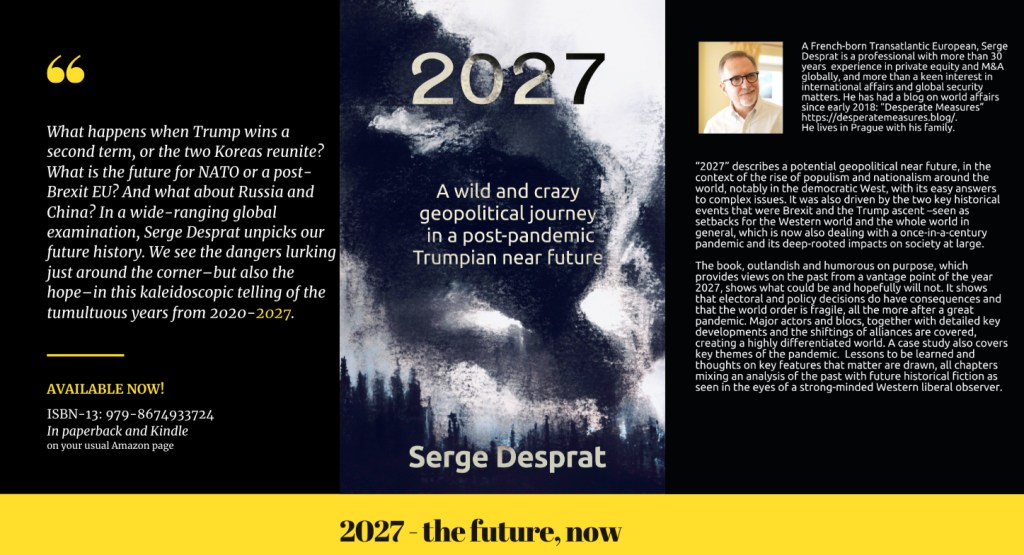
Delusion is still running high in the rejoicing Leave camp following this electoral outcome, some dreaming about the return of the Victorian era or the advent of a national “Singapore-on-Thames” and others simply about jobs in “left out” areas of Britain. In the end none will likely come but the tears associated with the realisation of what is “notional” sovereignty, the steep decline in foreign investment, less plumbers as the Poles are now going back to a thriving Poland, and the continued deindustrialisation desolation of the Midlands and Northern England. The Special Relationship has already taken a beating lastly with the US forcing Turkey to not buy British military aircraft, this one day before the General Election. Listening to Donald Trump congratulating Boris Johnson, one could only worry about the hidden assymetry when he added that he looked forward to a great trade deal “that they so desperately want” I could go on with such developments but, if I may say, will keep this for a book of “alternative future history fiction” (for a lack of better words) – not focused on Britain but spanning the world – that I am finalising and hopefully should be published in early 2020. 

While as a true Anglophile I “feel” for all my Remainer friends (probably on the true majority side of things if not for their political party system) and really only wish for Europe and Britain to work together as well as they can even as no longer fellow club members, one should honestly wonder, even within the Leave camp, whether that terrible question that never needed to be asked and ensuing process that benefited only an awful political class and a dubious cast of characters, was really necessary…The sober answer being no unless the goal was to be poorer and alone. 

The only question now is: When will Britain apply to rejoin the EU, this time without the nice rebate?  

Warmest regards,

Serge 

Hong Kong and the Western conundrum

20-11-19

Dear Partners in thought,

The unrest in Hong Kong (HK) started about a proposed law pushed by HK’s Chief executive, Carrie Lam, to extradite criminals to the mainland. Incidentally Carrie Lam, may be remembered, as David Cameron always will be for Brexit, for a proposal that was not really needed and created havoc. Like with the Yellow Vests in France and while that proposed law was shelved, unrest continued to focus on more fundamental issues centred around freedom and the very future of HK. Demonstrations became increasingly violent, like now at HK Polytechnic University, as months went by, opposing two sides that could no longer relate to each other.

Premier Xi Jinping likely looks at the HK situation with incredulity so much he has been focused on restoring power and dignity to his country as if it had been held under servitude since the Boxers’ revolt of 1900 (the restoration of national pride is in effect very similar to what has happened in Russia under Putin). To Xi, HK is a spanner thrown in all his good works and a very untimely one too. It is clear that the hopes that HK would have a gradual liberal impact on the mainland ahead of the 2047 full integration is as justified as the belief that economic liberalism would bring personal freedom to the mainland Chinese. If anything it shows that the seven years of Xi have been a focus on world power rise and national economic improvement combined with an increased dose of unsurprising authoritarianism in line with the early credos of Mao’s Little Red Book.

It is clear that Xi and his team are lost and do not know how to manage the HK crisis as the Chinese leadership was never faced with such a massive series of events if we exclude Tiananmen Square in 1989 at a time when news travelled less fast and fluidly. They believe in “One China” and do not know to deal with the singular Hong Kong leadership whom they find inefficient while not being sure how to quell the riots, mostly in terms of image impact globally and the likely cost to the Belt and Road Initiative. China reiterated that it would use military force if it needed to so as to assist local police forces and restore order in HK, a division of the PLA being already on site and using the old Gurkhas’s barracks.    

We got used to the demonstrations and the tear gas as a daily dose of news on the major media outlets but see not much reaction from the West, especially its leading governments beyond the mild protests from some, the UK in the lead for obvious historical  reasons. The European Commission stressed that the response to the protest had to be “strictly proportionate” and that violence was “unacceptable” all with good intent and little weight (again stressing the power void of EU foreign policy beyond trade and why Macron is right in wanting to change it). As for the US, it has kept relatively silent on the whole matter, being busy trying hard to disentangle itself from an ill-fated trade war with potential electoral consequences. 

The West experiences a very strong conundrum. Human rights and freedoms of all sorts, that are part and parcel (in theory at times) of our Western existence are not a daily feature of Chinese life, including now in once differentiated HK that gets daily reminders that it is de facto part of the Popular Republic of China. The West does not know yet how to express views on what is happening in what it also sees as a sovereign country entitled to manage its own affairs without interference, which is another respected Western tenet called sovereignty. 

Values face realpolitik for the West with HK today. The problem obviously is that Hong Kong is not ruled ultimately by a non-relevant country in world affairs but by a rising world power if not already by many standards the leading world power. There is a pervasive and unsaid Dantzig feeling (like in the “not wanting to die for Dantzig” of 80 years ago)  about the HK events as many in the West would not want to upset a key trading partner (already destabilised by trade wars with America) not least going to war so Hong Kongers could feel more free. We see every day a descent into more serious and ultimately lethal confrontations between the HK police and demonstrators with no end in sight as Beijing will never soften its approach to ruling its people, all the more in HK whose value to the mainland is far less than it used to be in today’s economic context and given its ability borne out of sheer power not to bother with how the West would perceive its ruling ways. 

While Xi is unlikely to display “humility, open-mindedness and tolerance” in thriving to find a peaceful and well-balanced resolution to the HK “conflict”, the West should press more forcefully Beijing, though in a cooperative manner, focusing on mutual interests, on finding ways to find a way forward to go back to a peaceful environment. Hong Kongers should also realise that their protests have indirectly endangered the high status enjoyed by HK as a business and financial center the world over, with one of the most desirable environments to do business, itself a factor of prosperity and a barrier to authoritarianism from the mainland. There is a point when protests will create chaos that will only bring in the PLA and condemn HK to economic oblivion, with possibly an earlier and more challenging full integration into the mainland.

We cannot – the West – go and fight with China on a matter that may be close to our values but which is also deeply “Chinese”. It is not as if China invaded Japan or indeed Taiwan (which they would if the latter declared independence). We need to soberly engage with China (as we need to engage with Russia) making them make progress on fronts we deem important, including HK, but we need to be realistic and cautious in doing so as we first and foremost need them to be a key part of the community of leading nations. 

Warmest regards, 

Serge